High Levels of Herpesvirus Gene in Kaposi Sarcoma Driven by DNA Sequence

Jim Crocker
18th March, 2025

High Levels of Herpesvirus Gene in Kaposi Sarcoma Driven by DNA Sequence

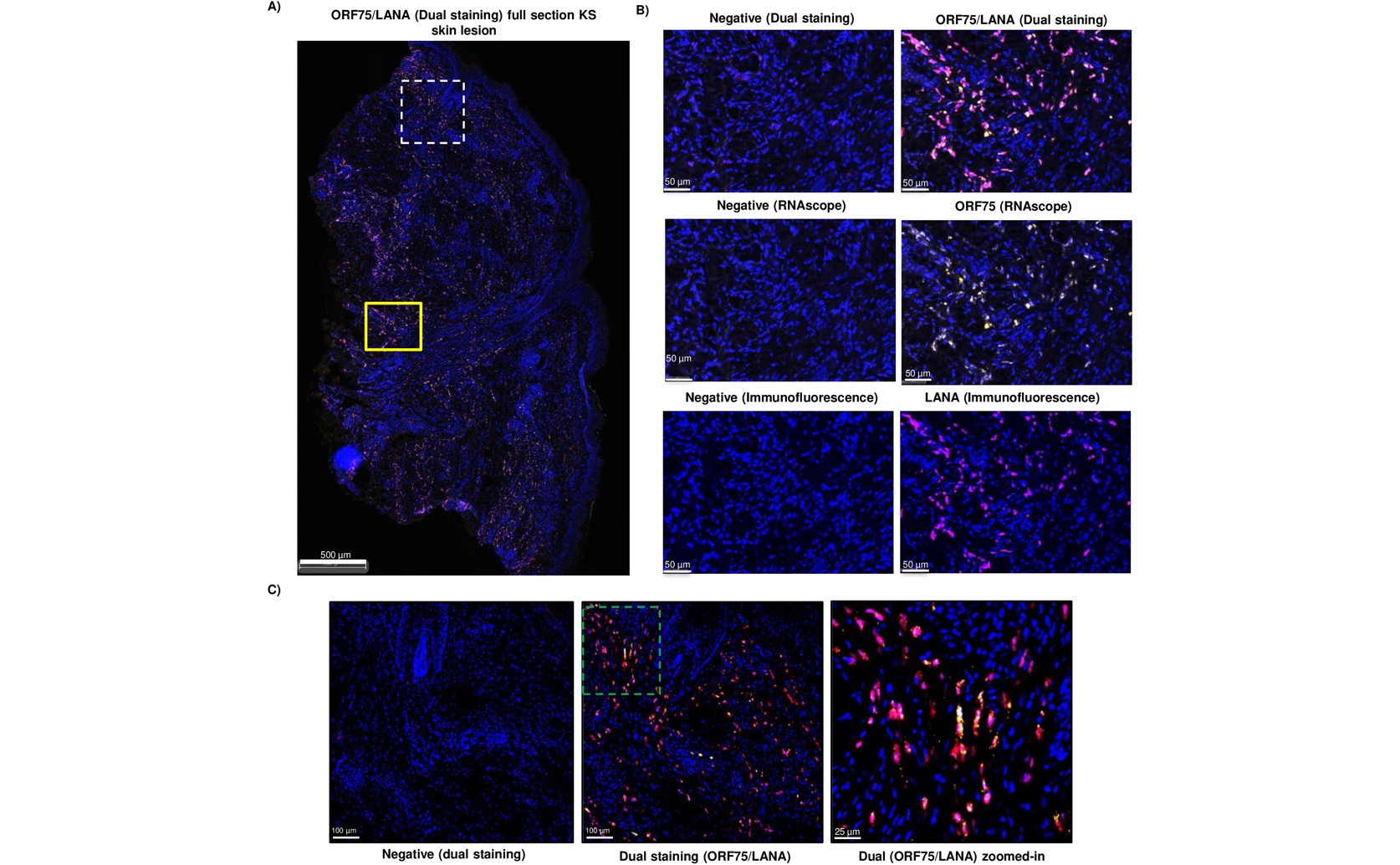
ORF75 RNA is expressed in the majority of LANA-positive spindle cells within Kaposi sarcoma lesions, demonstrating that this late lytic gene is broadly transcribed during latent KSHV infection in endothelial-derived tumor cells.

Image adapted from: Nair et al. / CC BY (Source)

Key Findings

  • Researchers at the National Cancer Institute and UNC Chapel Hill discovered high levels of the ORF75 gene in Kaposi sarcoma tumors
  • The ORF75 gene remains active even when the virus is dormant, thanks to regulation by the Sp1 protein
  • These findings help us understand how the virus persists. This knowledge could lead to more effective treatments for Kaposi sarcoma
Kaposi sarcoma (KS) is a type of cancer that forms in the lining of blood and lymph vessels, often presenting as tumors on the skin or other organs. It is closely associated with the Kaposi sarcoma-associated herpesvirus (KSHV), also known as human herpesvirus 8 (HHV-8). Understanding how KSHV operates within KS lesions is crucial for developing effective treatments. Recent research conducted by scientists at the National Cancer Institute and the University of North Carolina at Chapel Hill[1] has shed new light on the behavior of a specific gene within KSHV, known as open reading frame 75 (ORF75). Traditionally, KS spindle cells—specialized cells within the tumors—were thought to primarily express KSHV genes associated with a dormant, or latent, state of the virus. These latent genes help the virus persist in the body without causing immediate harm. However, transcriptome analyses, which examine the complete set of RNA transcripts produced by the genome, revealed high levels of ORF75 expression in KS lesions. ORF75 is typically classified as a late lytic gene, meaning it is usually active when the virus is actively replicating and spreading. The main study explored why ORF75 is highly expressed in KS lesions despite being a lytic gene. Researchers used a technique called RNAscope to visualize ORF75 RNA in KS tissue samples. They found that most cells expressing a latent marker called latency-associated nuclear antigen (LANA) also showed ORF75 expression. This was unexpected because LANA is associated with the virus's dormant state, suggesting that ORF75 might play a role even when the virus is not actively replicating. To understand the regulation of ORF75, the team created luciferase fusion reporter constructs. These are tools that allow scientists to study gene activity by producing light when a specific gene is active. By analyzing the ORF75 promoter—the region of DNA that initiates gene transcription—the researchers identified key elements that drive its expression in endothelial cells, which line blood vessels. Specifically, a protein called specificity protein 1 (Sp1) binds to the promoter region, enhancing ORF75 transcription. Additionally, other DNA elements known as CCAAT boxes were found to contribute to this regulatory process. Interestingly, the study discovered that in B cells, a type of white blood cell, different factors interact with the ORF75 promoter to suppress its expression. This repression does not occur in endothelial or epithelial cells, indicating that the regulation of ORF75 varies depending on the cell type. Moreover, alternate forms of Sp1 were observed to accumulate during the latent phase of the virus and were more prevalent during active viral replication in both primary effusion lymphoma (PEL) cells—a type of cancer cell—and infected endothelial cells. The exact role of these alternate Sp1 forms remains unclear. Another significant finding is that ORF75 can enhance its own expression as well as that of other KSHV genes. This self-regulating mechanism suggests that ORF75 not only plays a role in viral replication but also in maintaining the virus's presence within infected cells. This study builds on previous research that identified different forms of KSHV-associated diseases. For instance, multicentric Castleman disease (MCD), particularly KSHV-MCD, is a condition linked to KSHV infection in HIV-positive patients[2]. KSHV-MCD is characterized by systemic inflammation and elevated viral loads, similar to another condition called KSHV inflammatory cytokine syndrome (KICS). These conditions highlight the complex interactions between KSHV and the human immune system, emphasizing the need for ongoing research to fully understand and effectively treat KSHV-related diseases. By elucidating the mechanisms behind ORF75 expression in KS lesions, the current study provides valuable insights into how KSHV maintains its presence in infected cells. Understanding these regulatory processes is essential for developing targeted therapies that can disrupt the virus's ability to persist and cause disease. Additionally, the findings may have broader implications for other KSHV-associated conditions, potentially informing treatment strategies for diseases like KSHV-MCD and KICS. In conclusion, the discovery of high ORF75 expression in KS spindle cells challenges previous notions of KSHV latency and opens new avenues for research into viral regulation and pathogenesis. Continued investigation into the roles of viral genes and their interactions with host cell factors will be crucial for advancing our understanding of KSHV-related diseases and improving patient outcomes.

MedicineGeneticsBiochem

References

Main Study

1) The elevated expression of ORF75, a KSHV lytic gene, in Kaposi sarcoma lesions is driven by a GC-rich DNA cis element in its promoter region

Published 17th March, 2025

https://doi.org/10.1371/journal.ppat.1012984


Related Studies

2) Clinical Manifestations of Kaposi Sarcoma Herpesvirus Lytic Activation: Multicentric Castleman Disease (KSHV-MCD) and the KSHV Inflammatory Cytokine Syndrome.

https://doi.org/10.3389/fmicb.2012.00073


Related Articles

An unhandled error has occurred. Reload 🗙