SNHG4 RNA Boosts Brain Tumor Growth by Controlling Key Molecules

Jenn Hoskins
16th February, 2025

SNHG4 RNA Boosts Brain Tumor Growth by Controlling Key Molecules

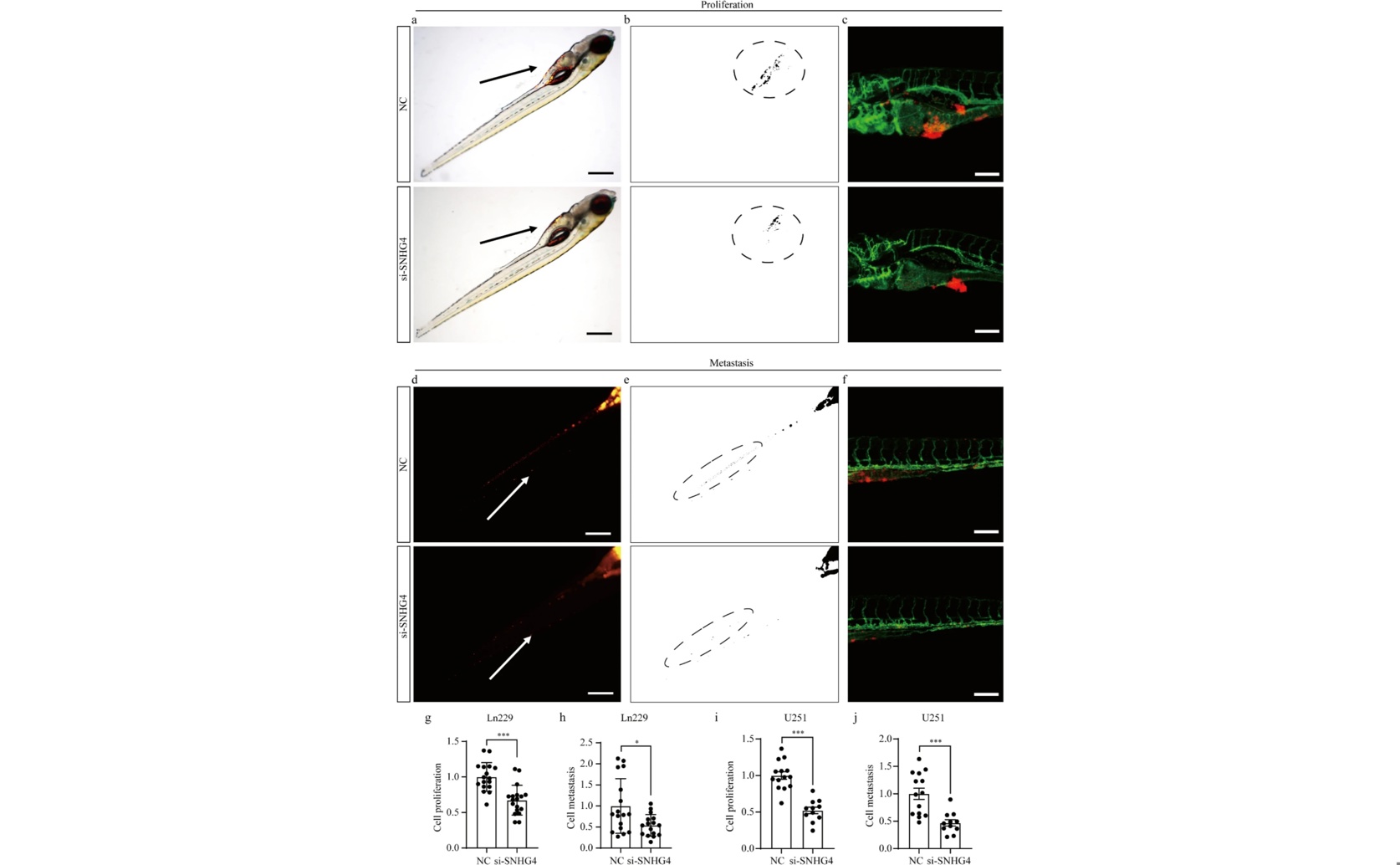
Reducing SNHG4 expression in human glioma cells significantly inhibited tumor growth (a-c, g, i) and metastasis (d-f, h, j) in a zebrafish xenograft model, confirming its critical role in promoting glioma progression in vivo.

Image adapted from: Zhang et al. / CC BY (Source)

Key Findings

  • Researchers at Soochow University discovered that SNHG4, a specific molecule, is elevated in aggressive brain tumors known as gliomas, promoting their growth and spread
  • SNHG4 interacts with other molecules to enhance tumor cell multiplication and movement, driving the malignancy of glioma
  • Targeting the SNHG4 pathway may offer new therapeutic strategies to effectively treat and manage glioma
Glioma, a prevalent and aggressive type of brain tumor, poses significant challenges due to its high mortality rate and poor prognosis[2][3]. Despite advances in cancer therapy, the survival rates for patients with malignant gliomas remain disheartening, highlighting the urgent need for a deeper understanding of its molecular underpinnings[3]. Recent research has shed light on the critical roles of long non-coding RNAs (lncRNAs) in the progression of various cancers, including glioma[2][4]. These lncRNAs, once considered mere transcriptional noise, are now recognized as key regulatory molecules that influence tumor growth and malignancy. A study conducted by researchers at Soochow University[1] delves into the role of a specific lncRNA, small nucleolar RNA host gene 4 (SNHG4), in glioma. Previous research has indicated that aberrant expression of lncRNAs is closely linked to glioma progression[2]. Moreover, studies have shown that dysregulation of microRNAs (miRNAs) like miR-539 can contribute to the malignant progression of glioma by affecting cell proliferation and invasion[5]. Building on this foundation, the Soochow University team sought to explore how SNHG4 interacts with miRNAs to influence glioma behavior. Utilizing data from public databases, the researchers discovered that SNHG4 is significantly upregulated in various cancer tissues, including glioma. To investigate the functional role of SNHG4, they conducted experiments that involved reducing (knocking down) and increasing (overexpressing) the levels of SNHG4 in glioma cells. The results were telling: knocking down SNHG4 led to a marked inhibition of glioma cell proliferation and migration, whereas overexpressing SNHG4 had the opposite effect, enhancing these malignant properties. These in vitro findings were further validated using a zebrafish xenograft model, an in vivo tool that allowed the researchers to observe the effects of SNHG4 in a living organism. Delving deeper into the mechanisms behind these observations, the study identified that SNHG4 interacts with miR-367-3p, a microRNA, through binding. Additionally, SNHG4 was found to regulate MYO1B, a gene involved in cell movement and structure, by targeting the same miRNA. Specifically, both SNHG4 and MYO1B can bind to miR-367-3p, thereby modulating its availability and activity. This interaction forms what is known as the miR-367-3p/MYO1B axis. When miR-367-3p is inhibited or when MYO1B is expressed, the suppressive effects on glioma cell proliferation and migration caused by SNHG4 knockdown are partially reversed. This indicates that SNHG4 promotes glioma progression by regulating this specific molecular pathway. This study not only highlights the pivotal role of SNHG4 in glioma but also integrates previous findings on the significance of miRNAs and lncRNAs in cancer progression[2][4][5]. By elucidating the SNHG4/miR-367-3p/MYO1B axis, the research provides a clearer picture of the molecular interactions that drive glioma malignancy. This understanding opens up potential avenues for targeted therapies. For instance, strategies aimed at inhibiting SNHG4 or modulating the miR-367-3p/MYO1B axis could potentially suppress glioma growth and spread, offering hope for more effective treatments. Furthermore, this study exemplifies the intricate network of gene regulation involving non-coding RNAs. As highlighted in earlier research, lncRNAs can influence gene expression and cellular behavior through various mechanisms, including acting as molecular sponges for miRNAs or directly interacting with proteins[4]. The findings from Soochow University reinforce the notion that targeting lncRNAs and their associated pathways could be a promising strategy in cancer therapy. In conclusion, the research from Soochow University advances our understanding of glioma by uncovering the role of SNHG4 in promoting tumor growth and migration through the miR-367-3p/MYO1B axis. This not only builds on existing knowledge about the importance of lncRNAs and miRNAs in cancer but also paves the way for developing novel therapeutic interventions aimed at disrupting these molecular pathways to combat glioma more effectively.

MedicineGeneticsBiochem

References

Main Study

1) Long noncoding RNA SNHG4 promotes glioma progression via regulating miR-367-3p/MYO1B axis in zebrafish xenografts.

Published 14th February, 2025

https://doi.org/10.1007/s13577-025-01183-1


Related Studies

2) Expression of lncRNAs in glioma: A lighthouse for patients with glioma.

https://doi.org/10.1016/j.heliyon.2024.e24799


3) Molecularly targeted therapy for malignant glioma.

Journal: Cancer, Issue: Vol 110, Issue 1, Jul 2007


4) Long noncoding RNAs: functional surprises from the RNA world.

https://doi.org/10.1101/gad.1800909


5) MicroRNA-539 inhibits glioma cell proliferation and invasion by targeting DIXDC1.

https://doi.org/10.1016/j.biopha.2017.06.097


Related Articles

An unhandled error has occurred. Reload 🗙