How Seafood Consumption at Age 7 Affects Children’s Brain Development

Jenn Hoskins
14th March, 2025

How Seafood Consumption at Age 7 Affects Children’s Brain Development

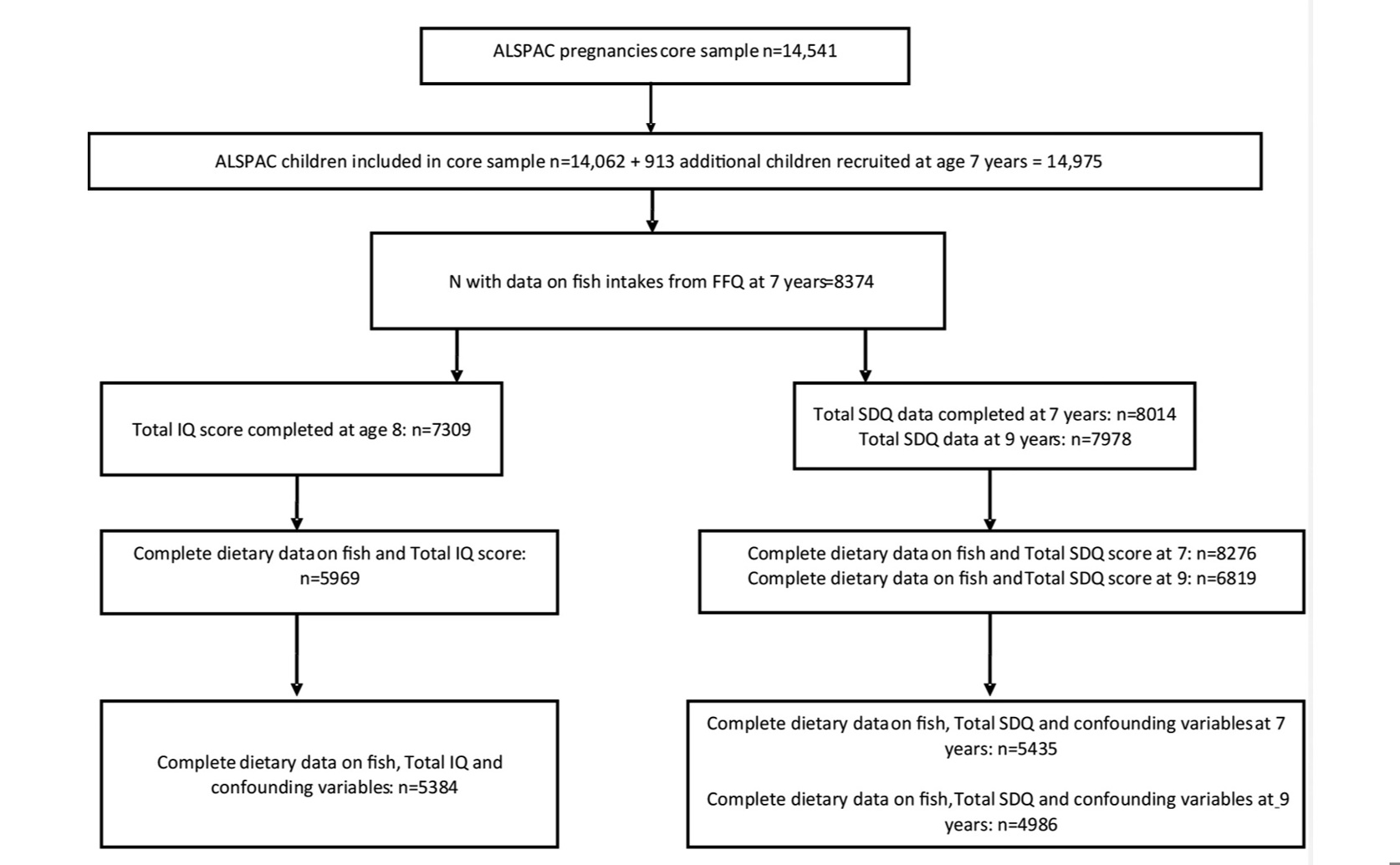
Study flow diagram for participant data from the Avon Longitudinal Study of Parents and Children (ALSPAC)

Image adapted from: Nel et al. / CC BY (Source)

Key Findings

  • Researchers at the University of Bristol examined how seafood consumption at age seven affects children's behavior up to age nine
  • Children who ate less than 190 grams of seafood weekly were 35–43% more likely to show poorer prosocial behaviors such as sharing and empathy
  • The study found no link between the amount of seafood consumed and the children's IQ scores at age eight
Recent research from the University of Bristol[1] sheds light on the impact of seafood consumption on children's behavioral development. While seafood is renowned for its rich nutrient profile, including essential long-chain fatty acids, selenium, and iodine, its specific role in shaping cognitive and behavioral outcomes in children has been less clear. This study aimed to bridge that gap by examining the relationship between seafood intake at age seven and subsequent behavioral and cognitive measures up to age nine. The study utilized data from the Avon Longitudinal Study of Parents and Children (ALSPAC), a comprehensive research project tracking the health and development of children over time. Researchers collected detailed information on the participants' seafood consumption when they were seven years old. They then assessed behavioral outcomes using the Strength and Difficulties Questionnaire (SDQ) at ages seven and nine, and measured cognitive performance through IQ tests at age eight. Findings revealed a significant association between lower seafood intake and poorer prosocial behavior. Specifically, children who consumed less than 190 grams of seafood per week had a 35% higher likelihood of exhibiting suboptimal prosocial behaviors at age seven, which increased to a 43% higher likelihood by age nine. Prosocial behaviors include actions like sharing, helping, and showing empathy towards others, which are crucial for healthy social development. Interestingly, the study did not find a direct link between seafood consumption and IQ scores at age eight, suggesting that the benefits of seafood may be more pronounced in behavioral aspects rather than cognitive intelligence as measured by traditional IQ tests. These results align with earlier research highlighting the importance of omega-3 fatty acids found in fish and shellfish. Omega-3s, particularly EPA and DHA, are vital for brain health and development[2][3]. Study[2] emphasizes that while fish provide these essential nutrients, they can also contain harmful substances like methylmercury. However, the balance between beneficial nutrients and potential toxins varies among different seafood species, making the type of fish consumed an important consideration. Study[3] further explains that omega-3 and omega-6 fatty acids play a central role in brain function, and imbalances between them are linked to developmental disorders such as ADHD and autism spectrum disorders. The current study's findings on prosocial behavior may reflect these underlying biochemical influences. Moreover, the significance of iodine, another nutrient abundant in seafood, cannot be overlooked. Iodine is crucial for thyroid hormone production, which is essential for brain development and function[4]. Iodine deficiency during critical periods of development can lead to severe cognitive and motor impairments. Although the main study did not directly measure iodine levels, the association between seafood intake and prosocial behavior might be partially mediated by adequate iodine nutrition, supporting the findings of study[4] which links iodine intake to neurodevelopmental outcomes. Previous research has also explored the broader relationship between diet and cognitive development. Study[5] highlights that while individual micronutrients like omega-3s, iron, and iodine are important, the overall dietary pattern plays a critical role in cognitive outcomes. The University of Bristol's study contributes to this body of knowledge by focusing specifically on seafood consumption as a component of the diet, providing more targeted insights into how specific food groups influence behavior and cognition. The methodology of the Bristol study involved adjusted logistic regression models to account for various confounding factors, ensuring that the observed associations were robust and not due to other variables. By focusing on a population where fish intake was below national recommendations, the study underscores the potential public health implications of inadequate seafood consumption in children. Given that seafood is a primary source of essential nutrients like EPA, DHA, and iodine, promoting adequate intake could be a straightforward strategy to support better behavioral outcomes in children. However, the study also points out that further research is needed to explore the full spectrum of neurodevelopmental indicators influenced by seafood intake. Future studies could investigate other aspects of behavior and cognitive function, as well as consider the types of seafood consumed to balance nutrient benefits against potential toxin exposures[2]. Additionally, longitudinal studies tracking dietary patterns over a more extended period could provide deeper insights into how sustained seafood consumption affects development. In conclusion, the University of Bristol's research highlights the vital role of seafood in supporting prosocial behavior in children. This study builds upon previous findings that link essential nutrients from seafood to brain health and development[2][3][4][5]. As public health guidelines continue to evolve, ensuring that children receive adequate amounts of seafood could be an important step in fostering healthy social and behavioral development.

NutritionHealth

References

Main Study

1) Seafood intake in children at age 7 years and neurodevelopmental outcomes in an observational cohort study (ALSPAC)

Published 11th March, 2025

https://doi.org/10.1007/s00394-025-03636-7


Related Studies

2) Fish and shellfish as dietary sources of methylmercury and the omega-3 fatty acids, eicosahexaenoic acid and docosahexaenoic acid: risks and benefits.

Journal: Environmental research, Issue: Vol 95, Issue 3, Jul 2004


3) Significance of long-chain polyunsaturated fatty acids (PUFAs) for the development and behaviour of children.

https://doi.org/10.1007/s00431-009-1035-8


4) The role of iodine in human growth and development.

https://doi.org/10.1016/j.semcdb.2011.07.009


5) The role of nutrition in children's neurocognitive development, from pregnancy through childhood.

https://doi.org/10.3389/fnhum.2013.00097


Related Articles

An unhandled error has occurred. Reload 🗙