Blood Fats and Sugar Levels in People on Plant-Based Diets vs. Meat-Based Diets

Jim Crocker
29th October, 2024

Blood Fats and Sugar Levels in People on Plant-Based Diets vs. Meat-Based Diets

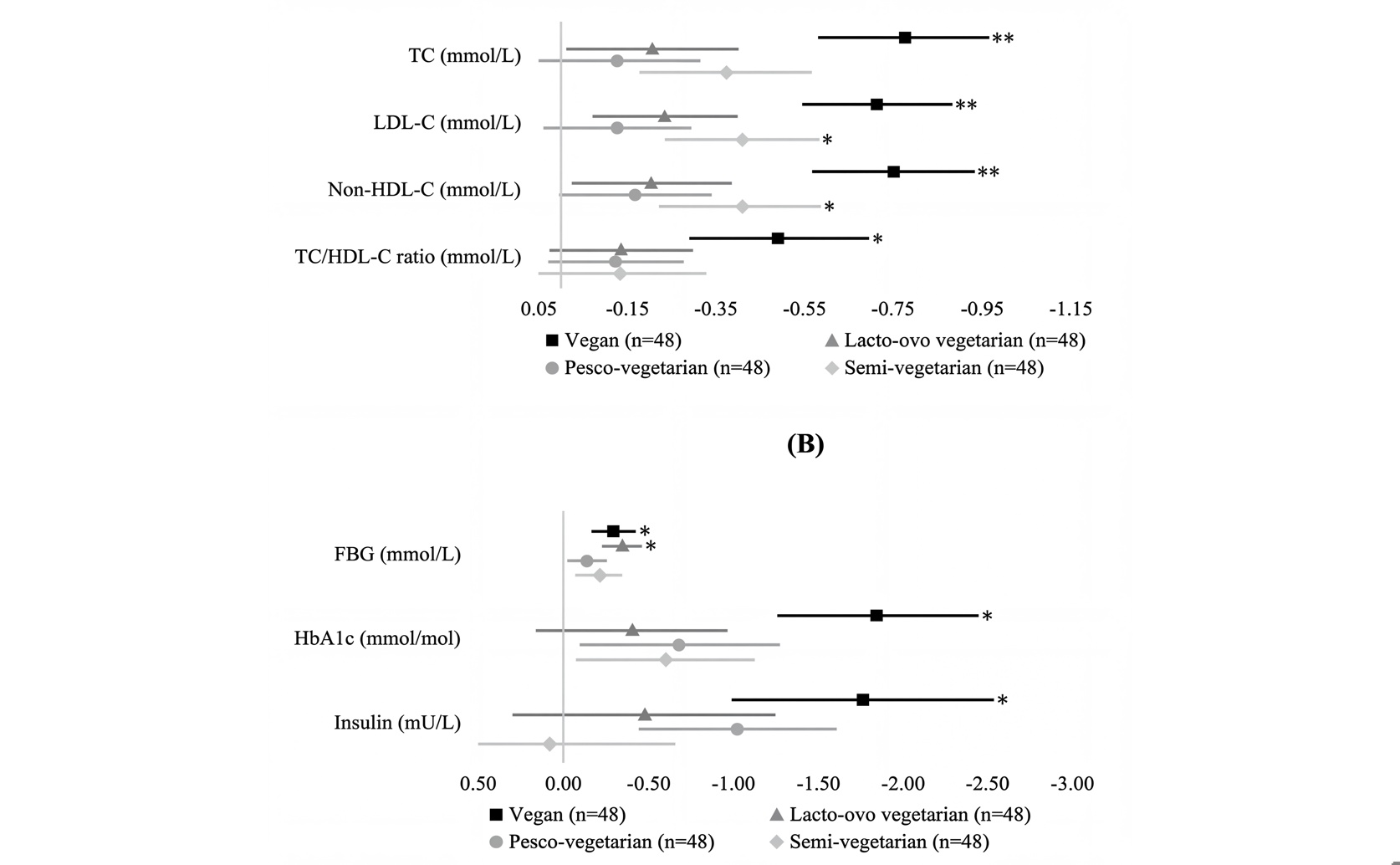
Adjusted mean differences ± SE in (a) lipid levels and (b) glycaemic indices of plant-based compared to regular meat-eating diets

Image adapted from: Austin et al. / CC BY (Source)

Key Findings

  • The University of Newcastle, Australia, found that vegans had significantly lower levels of total cholesterol, LDL-C, non-HDL-C, and the total cholesterol/HDL-C ratio compared to regular meat-eaters
  • Vegans also had lower fasting blood glucose, hemoglobin A1C, and insulin concentrations than regular meat-eaters
  • Semi-vegetarians and lacto-ovo vegetarians showed some favorable outcomes, such as lower LDL-C and non-HDL-C for semi-vegetarians and lower fasting blood glucose for lacto-ovo vegetarians
Cardiovascular disease (CVD) remains a leading cause of premature mortality worldwide, and addressing its risk factors is critical for achieving global health targets[2]. The University of Newcastle, Australia, conducted a study to examine how different plant-based diets compare to regular meat-eating diets in influencing plasma lipids and glycemic indices[1]. This article will delve into the findings of this study and how they contribute to our understanding of dietary impacts on cardiovascular health. The study focused on Australian adults aged 30-75 years who were habitual consumers of various diets: vegan, lacto-vegetarian, pesco-vegetarian, semi-vegetarian, or regular meat-eaters. By using multivariable regression analysis, the researchers adjusted for various covariates to ensure the accuracy of their comparisons. The results were telling. Vegans had significantly lower levels of total cholesterol, low-density lipoprotein cholesterol (LDL-C), non-high-density lipoprotein cholesterol (non-HDL-C), and the total cholesterol/HDL-C ratio compared to regular meat-eaters. Additionally, they had lower fasting blood glucose (FBG), hemoglobin A1C, and insulin concentrations. Semi-vegetarians and lacto-ovo vegetarians also showed some favorable outcomes, though not as comprehensive as vegans. Specifically, semi-vegetarians had lower LDL-C and non-HDL-C, while lacto-ovo vegetarians had lower FBG. However, there were no significant differences in HDL-C and triglycerides between plant-based and regular meat diets. These findings are significant in the context of earlier research. For instance, the study aligns with the understanding that dietary patterns significantly influence cardiovascular risk factors[3]. Type 2 diabetes mellitus patients, who are already at a higher risk for cardiovascular diseases, could benefit from plant-based diets due to their impact on both traditional and non-traditional risk factors[3]. Additionally, the study's focus on plasma lipids and glycemic indices ties in with the metabolic syndrome (MetS), which comprises risk factors such as insulin resistance, hypertension, and dyslipidemia[4]. By showing that plant-based diets can favorably modulate these indices, the study supports the notion that diet is a crucial component in managing MetS and, by extension, CVD. The study also adds to the growing body of evidence supporting plant-based diets as a means to combat obesity, a major global health issue[5]. Obesity is closely linked to both diabetes and cardiovascular diseases, and plant-based diets have shown promise in weight management and improving overall health metrics[5]. The reduced blood glucose and insulin levels among vegans in this study further underscore the potential of plant-based diets in managing obesity-related complications. In summary, the University of Newcastle's study provides robust evidence that various plant-based diets, particularly vegan diets, offer significant benefits in managing plasma lipids and glycemic indices compared to regular meat-eating diets. These findings reinforce the importance of dietary choices in preventing and managing cardiovascular diseases and related conditions, aligning with the broader public health goals of reducing premature mortality from noncommunicable diseases[2].

NutritionHealthFitness And Diet

References

Main Study

1) Plasma lipids and glycaemic indices in australians following plant-based diets versus a meat-eating diet.

Published 26th October, 2024

https://doi.org/10.1186/s12944-024-02340-5


Related Studies

2) Addressing the Global Burden of Cardiovascular Diseases; Need for Scalable and Sustainable Frameworks.

https://doi.org/10.5334/gh.1139


3) Type 2 diabetes and cardiovascular disease: Have all risk factors the same strength?

https://doi.org/10.4239/wjd.v5.i4.444


4) Targeting inflammation in metabolic syndrome.

https://doi.org/10.1016/j.trsl.2015.06.017


5) Plant-based diet for obesity treatment.

https://doi.org/10.3389/fnut.2022.952553


Related Articles

An unhandled error has occurred. Reload 🗙