Animal-Based Foods Enhance Child Nutrition

Jenn Hoskins
4th December, 2024

Animal-Based Foods Enhance Child Nutrition

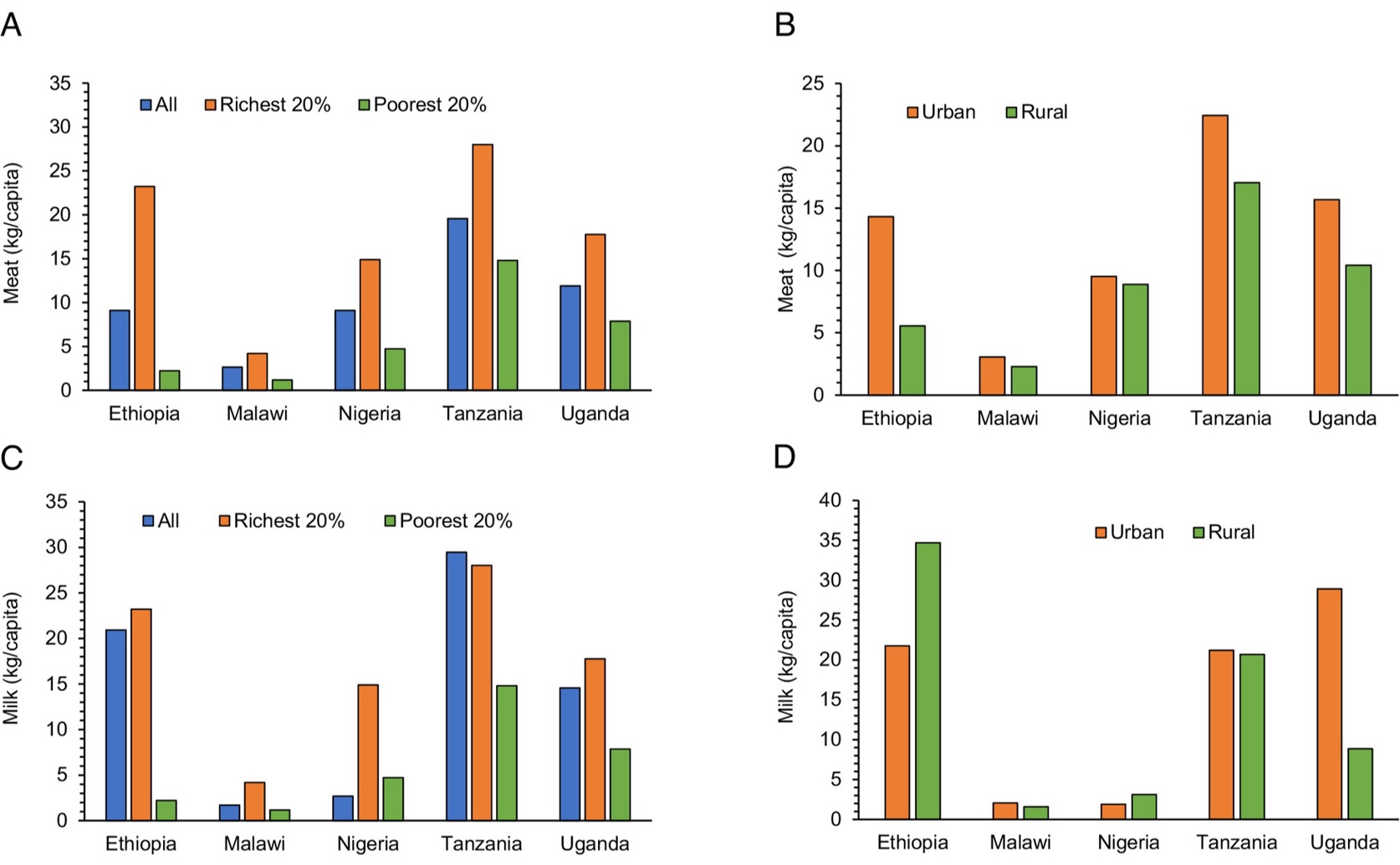
Data from five African countries reveal that consumption of meat (a, b) and milk (c, d) is considerably lower among poor and rural households, illustrating the access disparities that underpin the study's key finding on the importance of animal-sourced foods for preventing child undernutrition.

Image adapted from: Khonje et al. / CC BY (Source)

Key Findings

  • The study analyzed data from Ethiopia, Malawi, Nigeria, Tanzania, and Uganda to assess the impact of animal-sourced food (ASF) consumption on child nutrition
  • ASF consumption significantly improves child height-for-age Z-scores (HAZ) by 0.30 points and reduces the likelihood of stunting by 6.8 percentage points
  • Including ASF in children's diets provides more reliable essential nutrients compared to purely plant-based diets, which is crucial for child growth and development
Child undernutrition remains a significant public health issue in the Global South, particularly in Africa. One of the primary indicators of chronic child undernutrition is stunting, which refers to impaired linear growth. Insufficient nutrient intake is a major contributing factor to stunting. Previous research has indicated that the consumption of animal-sourced foods (ASF) such as meat, dairy, eggs, and fish is associated with lower rates of child stunting. However, reliable evidence specifically for Africa has been limited. In a new study conducted by CABI, representative panel data from Ethiopia, Malawi, Nigeria, Tanzania, and Uganda was analyzed to investigate the impact of ASF consumption on child nutrition[1]. The study examined over 32,000 observations of children aged 0 to 5 years and found that ASF consumption significantly improves child height-for-age Z-scores (HAZ) by 0.30 points and reduces the likelihood of stunting by 6.8 percentage points. These findings hold even after accounting for various confounding factors. This evidence underscores the nutritional benefits of including ASF in children's diets compared to purely plant-based diets. Nutritious plant-based foods, such as fruits, vegetables, and legumes, can provide most of the essential nutrients and have positive effects on HAZ. However, their availability and accessibility can be inconsistent, particularly in rural areas. This inconsistency is often due to seasonal variations and limited agricultural productivity. In contrast, ASF can provide a more reliable source of essential nutrients, which is crucial for child growth and development. Previous studies have also highlighted the importance of ASF in child nutrition. For instance, a longitudinal analysis in Nepal, Bangladesh, and Uganda demonstrated that regular ASF intake is associated with a significant reduction in stunting among young children[2]. This aligns with the findings from the new study, reinforcing the argument for improving access to ASF in resource-constrained settings. The new study's findings are particularly important in the context of ongoing global discussions about sustainable food systems. While reducing ASF consumption is often recommended in regions with high consumption levels to minimize environmental impacts, the situation in Africa is different. ASF consumption is generally low, and improving access to these foods could play a crucial role in addressing child undernutrition. This is especially relevant given the increased volatility in food prices and the impact of food inflation on child nutrition[3]. In developing countries, food inflation can lead to a deterioration in diet quality, further exacerbating the risk of undernutrition among vulnerable populations. Furthermore, climate change is expected to worsen child nutrition outcomes by increasing the frequency and severity of droughts and other extreme weather events[4]. These environmental changes can disrupt local food systems, making it even more challenging for families to access nutritious foods, including ASF. By identifying the regions and factors that contribute to resilient food systems, policymakers can better target interventions to support child nutrition in the face of climate change. The affordability of nutritious diets is another critical consideration. The EAT-Lancet Commission's global benchmark diet, which aims to promote health and protect the planet, is not affordable for many people in low-income countries[5]. This highlights the need for targeted interventions to increase household incomes, provide nutritional assistance, and reduce food prices to make healthier diets more accessible. In conclusion, the new study by CABI provides robust evidence that increasing access to ASF can significantly improve child nutrition outcomes in Africa. This finding supports the need for policies and interventions that enhance the availability and affordability of ASF in regions where consumption is currently low. By addressing both nutritional and environmental challenges, such initiatives can help reduce child undernutrition and promote sustainable development in the Global South.

NutritionHealthAnimal Science

References

Main Study

1) Animal-sourced foods improve child nutrition in Africa.

Published 10th December, 2024 (future Journal edition)

https://doi.org/10.1073/pnas.2319009121


Related Studies

2) Sustained intake of animal-sourced foods is associated with less stunting in young children.

https://doi.org/10.1038/s43016-021-00259-z


3) Food inflation and child undernutrition in low and middle income countries.

https://doi.org/10.1038/s41467-023-41543-9


4) Mapping the effects of drought on child stunting.

https://doi.org/10.1073/pnas.1905228116


5) Affordability of the EAT-Lancet reference diet: a global analysis.

https://doi.org/10.1016/S2214-109X(19)30447-4


Related Articles

An unhandled error has occurred. Reload 🗙