Bacterial Enzymes and Structure-Guided Changes to Their Processing Preferences

Jenn Hoskins
11th March, 2025

Bacterial Enzymes and Structure-Guided Changes to Their Processing Preferences

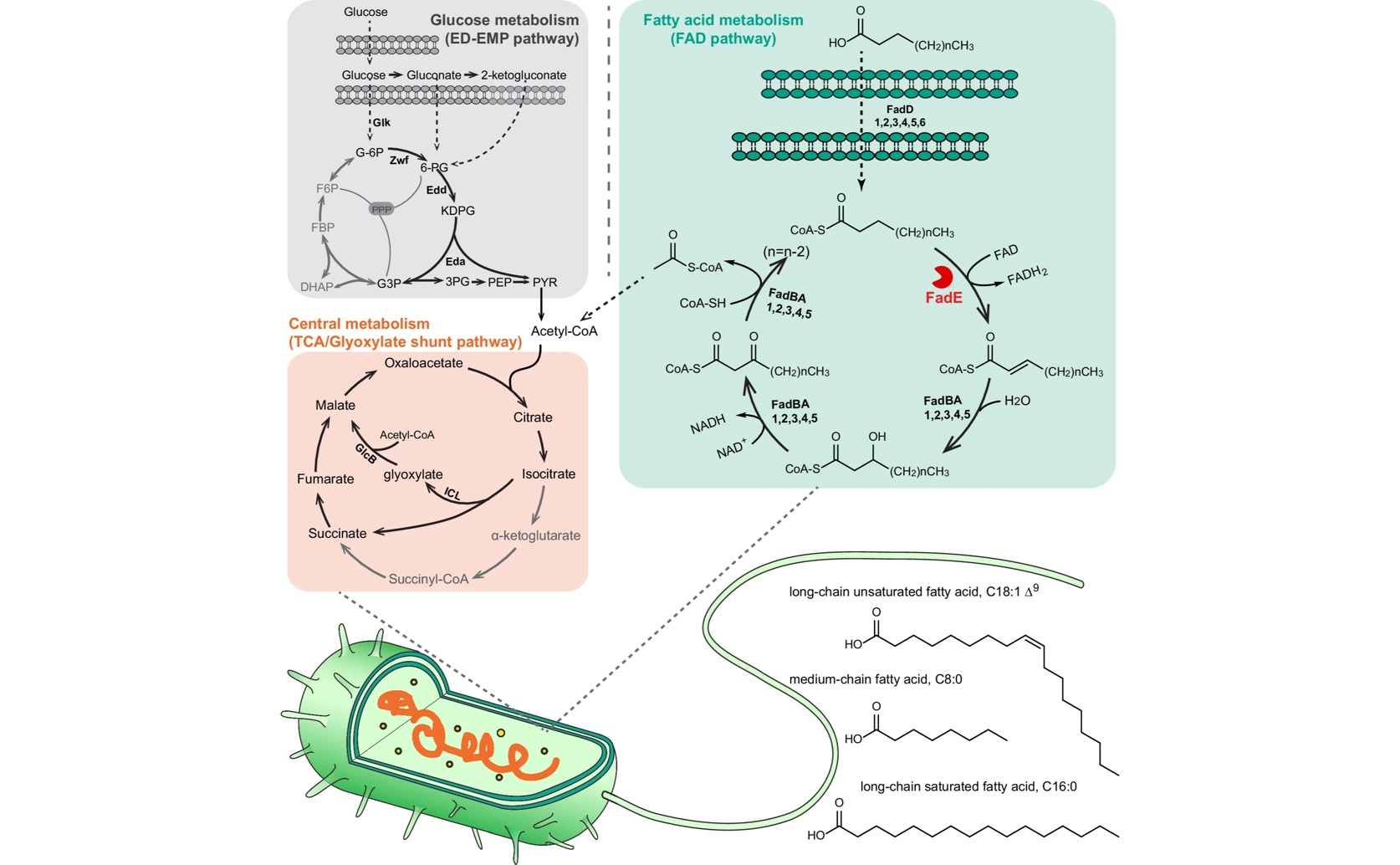
The figure illustrates how Pseudomonas aeruginosa integrates acetyl-CoA from fatty acid β-oxidation (highlighting the FadE-catalyzed step) with the glyoxylate shunt to conserve carbon for gluconeogenesis, providing metabolic context for the study's focus on FadE1 and FadE2 as key enzymes enabling growth on fatty acid carbon sources.

Image adapted from: Wang et al. / CC BY (Source)

Key Findings

  • A University of Cambridge study discovered that Pseudomonas aeruginosa uses two key enzymes, FadE1 and FadE2, to break down fatty acids in the lungs of cystic fibrosis patients
  • FadE1 is essential for processing long-chain fatty acids and maintaining the bacteria’s ability to cause persistent infections
  • Inhibiting FadE1 and FadE2 could lead to new treatments that weaken the bacteria, helping to manage chronic lung infections in cystic fibrosis
Pseudomonas aeruginosa is a common and persistent pathogen in the lungs of individuals with cystic fibrosis (CF). Understanding how this bacterium thrives in such a challenging environment is crucial for developing effective treatments. Recent research from the University of Cambridge[1] has shed light on the metabolic strategies P. aeruginosa employs to survive and remain virulent in the CF lung. Previous studies have established that fatty acids are a primary carbon source for P. aeruginosa in CF airways[2][3]. In particular, long-chain fatty acids found in lung surfactant lipids like phosphatidylcholine (PC) play a significant role in sustaining bacterial growth[3]. Additionally, research has identified key enzymes involved in fatty acid metabolism, such as FadD1 and FadD2, which help the bacteria utilize these nutrients effectively[4]. These enzymes not only support bacterial growth but also influence virulence factors and motility, which are essential for infection persistence[4]. Building on this foundation, the University of Cambridge study delved deeper into the specific proteins that P. aeruginosa expresses when metabolizing different fatty acids. Utilizing a technique called tandem mass-tag proteomics, the researchers analyzed the protein expression profiles of a CF clinical isolate of P. aeruginosa grown on various fatty acid substrates. This approach allows for the precise quantification of proteins, providing insights into which enzymes are active under specific growth conditions. The study identified two fatty acyl-CoA dehydrogenases, named FadE1 and FadE2, that are significantly upregulated when the bacteria are grown on fatty acids. These enzymes play a crucial role in the breakdown of fatty acids, facilitating their use as energy sources. Notably, FadE1 showed a strong preference for long-chain acyl-CoAs, while FadE2 was specific to medium-chain acyl-CoAs. This distinction suggests that P. aeruginosa has a sophisticated system for optimizing its metabolism based on the available nutrients. Further structural analysis of FadE1 and FadE2 revealed specific amino acid residues that determine their substrate preferences. By engineering these residues, the researchers were able to invert the substrate specificity of each enzyme. This modification provided valuable insights into how slight changes in enzyme structure can alter metabolic pathways, potentially affecting the bacterium's ability to thrive in different environments. To assess the impact of these enzymes on virulence, the study examined mutants lacking either fadE1 or fadE2. The fadE1 mutants exhibited reduced virulence in an infection model, alongside decreased growth when provided with long-chain fatty acids. This finding underscores the importance of FadE1 in supporting the bacterium's ability to cause disease, particularly in environments rich in long-chain fatty acids like the CF lung. In contrast, the fadE2 mutants did not show a similar level of impairment, highlighting the distinct roles these enzymes play in bacterial metabolism and pathogenicity. The research also explored the potential for targeting these enzymes with specific inhibitors. The unique features of the substrate binding pockets in FadE1 and FadE2 allowed the identification of an inhibitor that differentially affected each enzyme. This selective inhibition could pave the way for new therapeutic strategies that disrupt the bacterium’s metabolic processes without broadly affecting other cellular functions. Integrating these findings with previous research, it becomes clear that P. aeruginosa's ability to adapt its metabolism is closely linked to its virulence and persistence in CF lungs. The identification of FadE1 and FadE2 adds another layer of understanding to how this pathogen exploits available nutrients to maintain high cell densities and resist treatment[2][3][4]. By targeting specific metabolic enzymes, it may be possible to develop treatments that weaken the bacteria’s ability to thrive, offering a new avenue for managing chronic infections in CF patients. Overall, the University of Cambridge study contributes significantly to our understanding of P. aeruginosa metabolism and its role in CF lung infections. By elucidating the functions of FadE1 and FadE2, the research highlights potential targets for therapeutic intervention and underscores the intricate connection between nutrient utilization and bacterial virulence.

BiotechBiochem

References

Main Study

1) Pseudomonas aeruginosa acyl-CoA dehydrogenases and structure-guided inversion of their substrate specificity

Published 8th March, 2025

https://doi.org/10.1038/s41467-025-57532-z


Related Studies

2) Requirements for Pseudomonas aeruginosa acute burn and chronic surgical wound infection.

https://doi.org/10.1371/journal.pgen.1004518


3) In vivo evidence of Pseudomonas aeruginosa nutrient acquisition and pathogenesis in the lungs of cystic fibrosis patients.

Journal: Infection and immunity, Issue: Vol 75, Issue 11, Nov 2007


4) Multiple FadD acyl-CoA synthetases contribute to differential fatty acid degradation and virulence in Pseudomonas aeruginosa.

https://doi.org/10.1371/journal.pone.0013557


Related Articles

An unhandled error has occurred. Reload 🗙