Predicting Protein Interactions and Their Role in Phosphorylation

Jenn Hoskins
6th March, 2025

Predicting Protein Interactions and Their Role in Phosphorylation

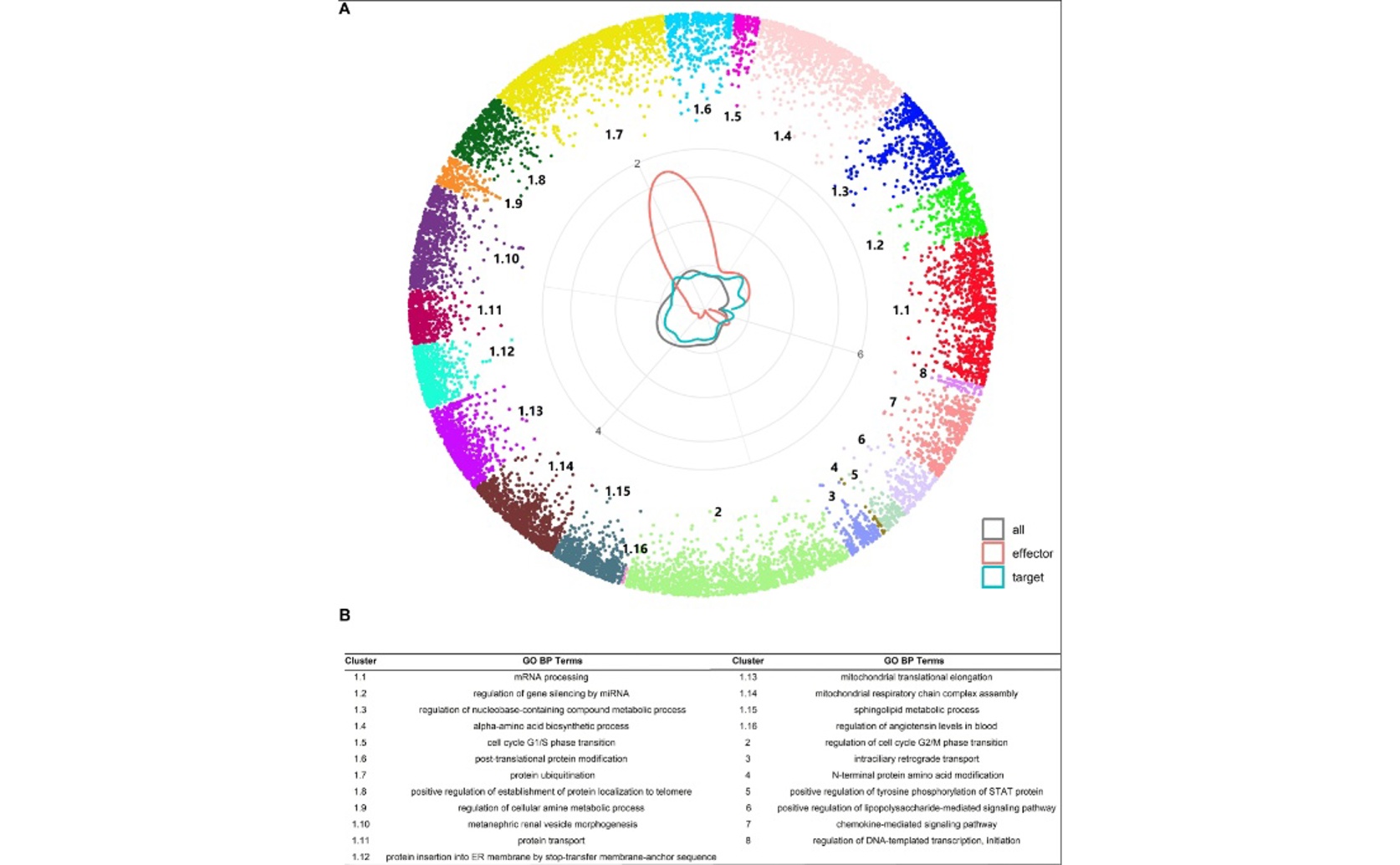
This figure demonstrates that proteins involved in experimentally validated phosphorylation and dephosphorylation interactions (effectors and targets) occupy distinct, functionally enriched angular clusters in the hyperbolic human protein interaction network, indicating that hyperbolic embedding captures biologically meaningful organization relevant to predicting PTM-directed PPIs.

Image adapted from: Vagiona et al. / CC BY (Source)

Key Findings

  • *Mainz researchers mapped human protein interactions using advanced geometry to understand cell functions.*
  • *They applied machine learning to predict key protein interactions linked to various diseases.*
  • *The study identified specific protein disruptions in a neurodegenerative disease, paving the way for new treatments.*
Proteins are essential molecules that perform a wide range of functions within our cells, often working together by physically interacting with one another. These interactions form complex networks known as the "interactome," which play a crucial role in regulating cellular processes and maintaining healthy bodily functions. Understanding the interactome is key to uncovering the mechanisms behind various diseases and developing effective treatments. Researchers at Johannes Gutenberg University in Mainz, Germany, have taken a significant step forward in mapping and understanding the human interactome[1]. Their study focuses on protein–protein interactions (PPIs), which are the physical contacts between proteins that enable them to carry out their functions. By mapping these interactions, scientists can gain insights into how proteins work together to regulate cellular activities and how disruptions in these interactions can lead to diseases. Previous efforts to map the interactome have laid the groundwork for this research. For instance, a systematic mapping project identified thousands of PPIs, increasing the known interactions by about 70% and revealing new connections to over 100 disease-associated proteins[2]. Additionally, studies using quantitative proteomics have shown that protein networks are dominated by weak interactions, with a smaller number of stable complexes playing critical roles in network topology[3]. Reviews of protein network mapping techniques emphasize the importance of integrating multiple experimental methods to ensure the accuracy of PPI data[4]. These foundational studies highlight the complexity of the interactome and the need for advanced methods to decode its intricacies. The recent study by Johannes Gutenberg University leverages these insights by exploring the geometric properties of the interactome. Specifically, the researchers investigated whether the human Protein-Interaction Network (hPIN) can be effectively represented in hyperbolic space, a type of geometric space that naturally accommodates the complex, hierarchical structures found in biological networks. Embedding the hPIN in hyperbolic space (H2) allows for a more accurate and informative representation of the interactions. To predict the functions of PPIs, particularly those related to post-translational modifications (PTMs) like phosphorylation and dephosphorylation, the researchers employed a machine learning technique known as a random forest algorithm. This approach analyzes various features of the PPIs, including their hyperbolic properties and centrality measures—metrics that indicate the importance of a protein within the network. By training the algorithm on known interactions, the team aimed to identify new, functionally relevant PPIs that could play a role in cellular processes and disease mechanisms. One of the key applications of this method was the study of ataxin-1, a protein implicated in Spinocerebellar Ataxia type 1 (SCA1), a neurodegenerative disorder. The algorithm predicted specific PPIs involving ataxin-1 that are related to its phosphorylation activity. To validate these predictions, the researchers conducted proteomics analysis in a cellular model of SCA1. This analysis confirmed that several of the predicted PPIs were indeed dysregulated in the disease context, suggesting that these interactions could be critical for understanding the pathology of SCA1. This approach not only validates the predictive power of the algorithm but also highlights the potential of integrating geometric representations with machine learning to uncover meaningful biological insights. By mapping the interactome in hyperbolic space and focusing on quantitative aspects like interaction strengths and protein abundances, the study builds on previous efforts to create comprehensive and reliable PPI networks[2][3][4]. Moreover, the identification of a compact cluster involving ataxin-1 and its dysregulated interactions provides a focused target for further research. Understanding how these specific interactions contribute to disease can lead to the development of targeted therapies that address the root causes of disorders like SCA1. This aligns with ongoing challenges in drug discovery, where targeting PPIs has been difficult due to the complexity of their binding interfaces[5]. The insights gained from this study could inform new strategies for designing drugs that modulate specific protein interactions, potentially overcoming some of the traditional barriers in PPI-targeted therapies[5]. Overall, the research from Johannes Gutenberg University represents a significant advancement in the field of interactome mapping. By combining hyperbolic geometry with machine learning, the study offers a novel framework for predicting and validating functionally important PPIs. This not only enhances our understanding of cellular networks and their role in disease but also paves the way for innovative approaches in drug discovery and therapeutic intervention.

BiotechBiochem

References

Main Study

1) Prediction of protein interactions with function in protein (de-)phosphorylation

Published 3rd March, 2025

https://doi.org/10.1371/journal.pone.0319084


Related Studies

2) Towards a proteome-scale map of the human protein-protein interaction network.

Journal: Nature, Issue: Vol 437, Issue 7062, Oct 2005


3) A human interactome in three quantitative dimensions organized by stoichiometries and abundances.

https://doi.org/10.1016/j.cell.2015.09.053


4) Protein-protein interaction networks: unraveling the wiring of molecular machines within the cell.

https://doi.org/10.1093/bfgp/els036


5) Evolution of In Silico Strategies for Protein-Protein Interaction Drug Discovery.

https://doi.org/10.3390/molecules23081963


Related Articles

An unhandled error has occurred. Reload đź—™