How Moisture and Temperature Affect Clay-Rich Shale's Strength

Jenn Hoskins
10th March, 2025

How Moisture and Temperature Affect Clay-Rich Shale's Strength

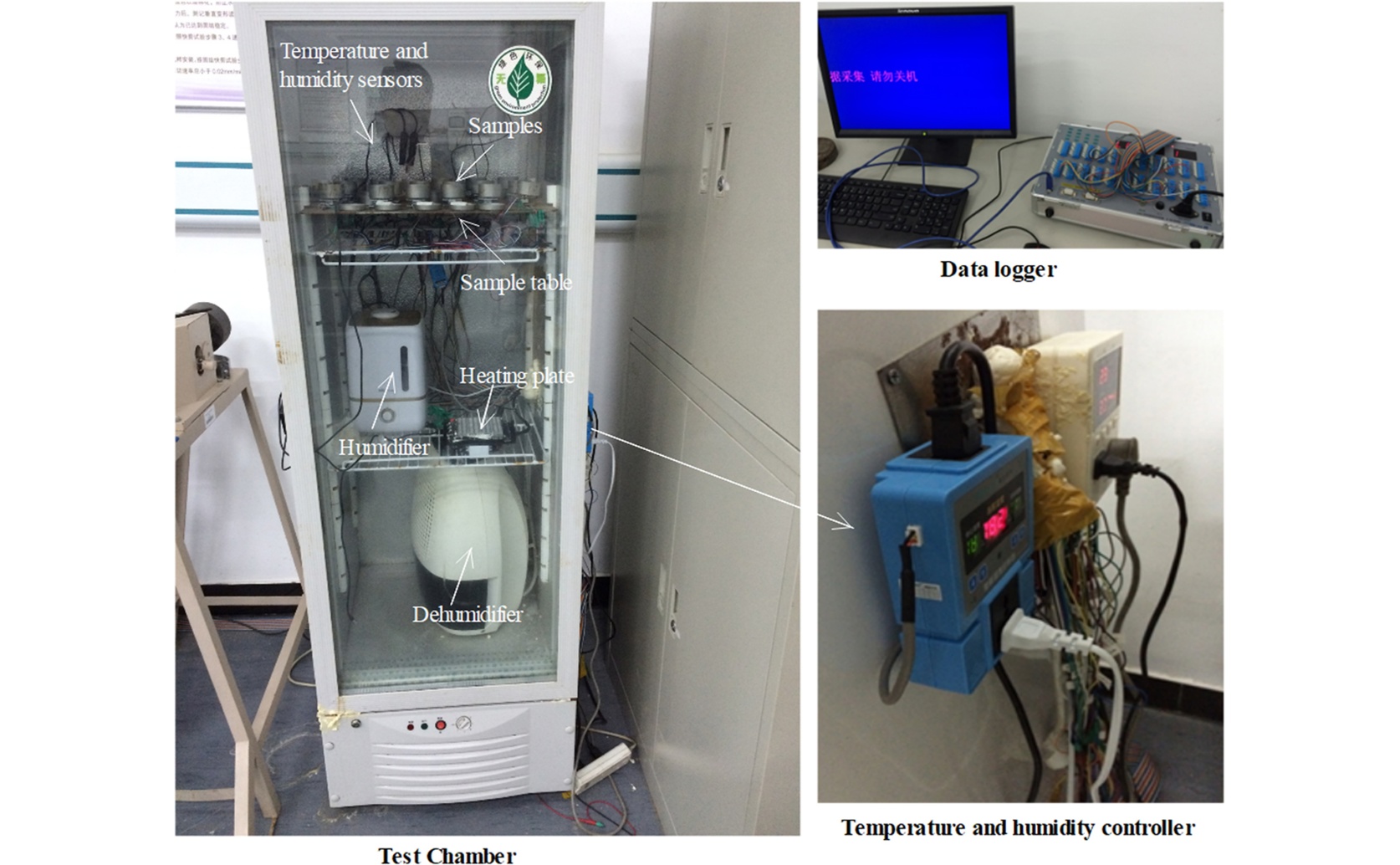
Hygroscopic experimental device.

Image adapted from: Zhao et al. / CC BY (Source)

Key Findings

  • Researchers in China found that lowering humidity significantly decreases water absorption in clay-rich shale used in underground structures
  • Reducing humidity helps maintain the shale’s strength, greatly enhancing the stability and safety of tunnels and mines
  • Although higher temperatures also lower water content, controlling humidity proves to be more effective for ensuring shale stability
High clay-content shale is a common material in underground structures such as mining roadways, tunnels, and storage chambers. However, its hydrophilic nature makes it highly sensitive to environmental temperature and humidity. When exposed to moisture from the air, shale absorbs water, increasing its water content and consequently reducing its mechanical strength. This poses significant challenges for the stability and safety of underground engineering projects. Researchers at the China University of Mining and Technology conducted a study[1] to investigate how temperature and humidity influence the water content and mechanical properties of high clay-content shale. By understanding these factors, the study aims to provide a scientific basis for controlling environmental conditions to enhance the structural stability of underground constructions. The study employed hygroscopic experiments using a temperature and humidity chamber to simulate different environmental conditions. Quartz sand was used as a control group since it is a non-clay mineral and does not absorb moisture in the same way as shale. Additionally, strength experiments were performed on reconstituted shale samples with varying water content to assess how moisture affects their uniaxial compressive strength (UCS). The results revealed that the equilibrium water content (EWC) of high clay-content shale is significantly influenced by both humidity and temperature. Specifically, as relative humidity (RH) decreased from 100% to 80%, the EWC dropped from 15.88% to 7.53%. Similarly, at a constant high humidity of 100% RH, increasing the temperature to 30°C reduced the EWC to 11.92%. This indicates that lower humidity levels are more effective than higher temperatures in decreasing the water content of shale. Mechanical testing further demonstrated that reducing humidity can substantially mitigate the loss of UCS caused by moisture absorption. Under high-humidity conditions, the UCS of shale decreased by approximately 50%. However, when humidity was reduced, the UCS loss was limited to about 15.48%. This highlights humidity as the primary factor affecting both the water content and mechanical strength of high clay-content shale. These findings build upon earlier research on the hygroscopic growth of water films on clay particles. A study conducted using molecular dynamics (MD) simulations established the relationship between adsorbed water film thickness and relative humidity or disjoining pressure[2]. This earlier work demonstrated that the hygroscopicity of clay minerals varies, with phyllosilicate minerals like mica being less hygroscopic compared to K-smectite and Na-smectite. The MD simulations revealed that the thickness of water films on clay surfaces follows a double exponential decay, attributed to hydration repulsion and osmotic phenomena in the electrical double layer at the clay-water interface[2]. By integrating these molecular insights, the current study provides a macroscopic perspective on how moisture interacts with high clay-content shale under varying environmental conditions. The comprehensive approach of combining hygroscopic experiments with mechanical strength tests allows for a better understanding of the practical implications of water absorption in underground structures. The implications of this research are significant for the field of underground engineering. By demonstrating that controlling humidity is more effective than merely adjusting temperature, engineers can implement targeted strategies to maintain the integrity of shale-based structures. For instance, ventilation systems can be optimized to reduce humidity levels, thereby preventing excessive moisture absorption and maintaining the mechanical strength of the surrounding rock. Furthermore, this study underscores the importance of considering both environmental factors and material properties in the design and maintenance of underground structures. High clay-content shale, while prevalent, requires careful management of moisture exposure to avoid compromising structural stability. The insights gained from this research can inform guidelines and best practices for constructing and preserving safe underground facilities. In summary, the study conducted by the China University of Mining and Technology advances our understanding of how temperature and humidity affect high clay-content shale. By leveraging previous findings on the hygroscopic behavior of clay minerals[2], the research provides actionable recommendations for enhancing the stability of underground engineering projects through effective environmental control.

Environment

References

Main Study

1) Hygroscopic effect of high clay-content shale under temperature and humidity conditions and its impact on mechanical properties

Published 7th March, 2025

https://doi.org/10.1371/journal.pone.0319672


Related Studies

2) Hygroscopic Growth of Adsorbed Water Films on Smectite Clay Particles.

https://doi.org/10.1021/acs.est.3c08253


Related Articles

An unhandled error has occurred. Reload 🗙