Study Identifies Key Genes That Help Corn Stalks Grow Strong

Jim Crocker
4th March, 2025

Study Identifies Key Genes That Help Corn Stalks Grow Strong

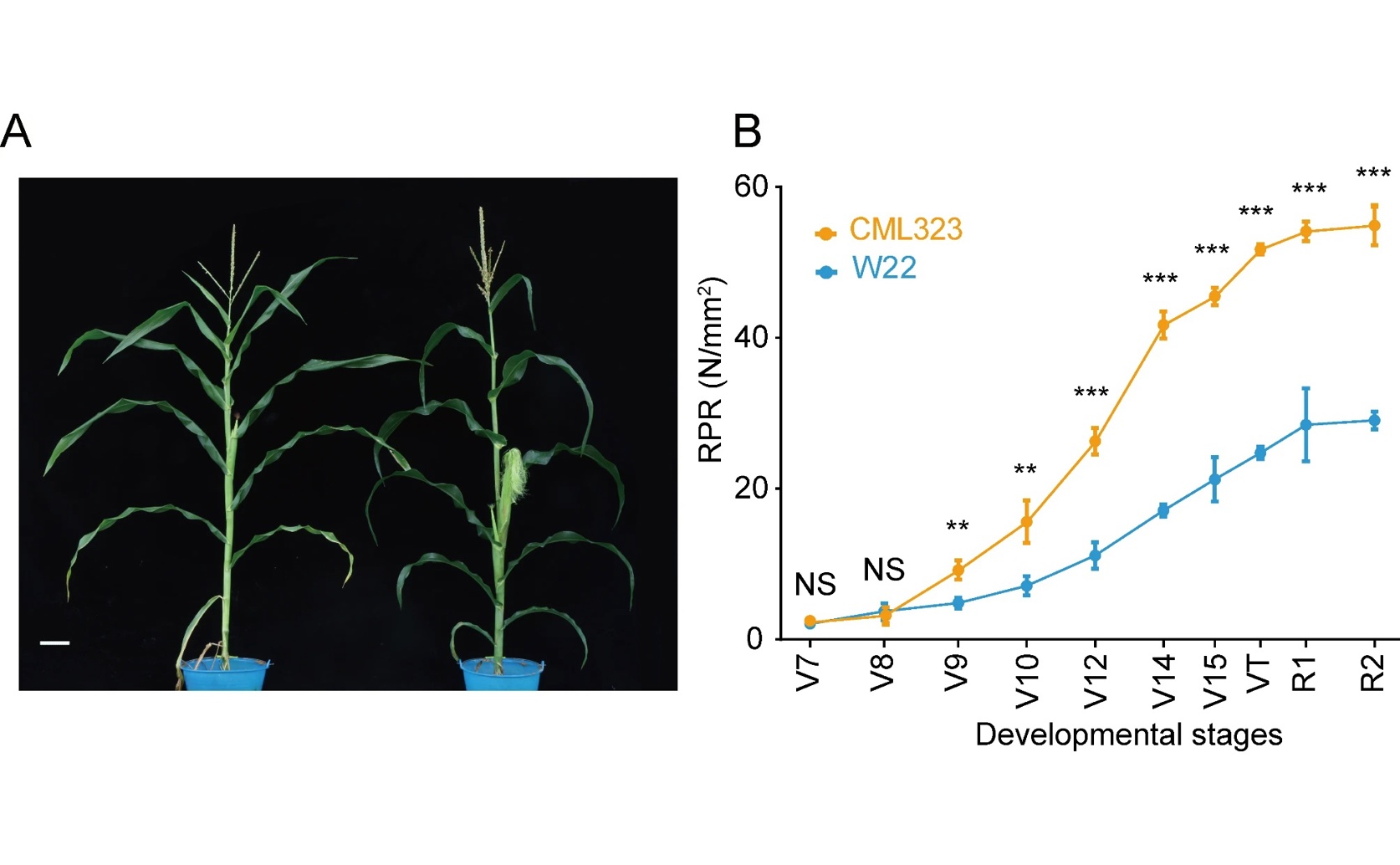
The figure demonstrates that the strong-stalk maize line CML323 exhibits a significantly earlier and greater increase in rind penetrometer resistance than the weak-stalk line W22 from V9 onward, establishing clear phenotypic divergence in stalk strength during key developmental stages that frame the study’s transcriptomic analyses of maize (Zea mays) stalk strength formation.

Image adapted from: Cheng et al. / CC BY (Source)

Key Findings

  • In Shandong, China, scientists identified specific genes that strengthen maize stalks, helping prevent them from bending or breaking
  • They mapped how these genes operate during different growth stages, highlighting those crucial for building sturdy cell walls
  • These discoveries can aid breeders in developing maize varieties that are more resilient and produce higher yields
Maize stalk strength is essential for maintaining plant stability, preventing lodging, and ensuring high grain yields. Lodging, which refers to the bending or breaking of plant stems, can lead to significant yield losses and is exacerbated by high-density planting practices. Understanding the genetic factors that contribute to stalk strength is crucial for developing maize varieties that are both resilient and productive. A recent study conducted by researchers at Shandong Agricultural University[1] sheds light on the genetic mechanisms underlying maize stalk strength. By analyzing the gene expression profiles of two distinct maize lines—one tropical and one non-stiff-stalk—across various developmental stages, the study provides a detailed temporal map of the genes involved in stalk development and strength. The researchers collected 53 transcriptomes from the vegetative stage (V7) through to the silking stage, a critical period for stalk maturation. These transcriptomes were categorized into four distinct phases: early development, early elongation, late elongation, and maturation. Using advanced techniques such as fuzzy c-means clustering and Gene Ontology (GO) analysis, the study identified key biological processes active during each phase. For instance, active cell division was prominent in the early development phase, while processes like cell wall extension and lignin deposition were crucial during the elongation phases. In the maturation phase, defense responses and nutrient transport became highly active, indicating the stalk's preparation for structural integrity and resilience. One of the significant contributions of this study is the identification of differentially expressed genes (DEGs) and potential regulatory genes that influence stalk strength. Through weighted gene co-expression network analysis (WGCNA), six regulatory genes were pinpointed as key players in stalk strength formation. These findings build upon previous research that identified critical genes involved in stalk strength. For example, the gene stiff1, identified in an earlier study, plays a pivotal role in enhancing cellulose and lignin content, thereby increasing stalk strength[2]. The current study complements these findings by providing a broader genetic context, revealing how multiple genes and regulatory networks interact over time to contribute to stalk robustness. Furthermore, the study highlights differences in gene expression pathways between the two maize lines, particularly in the phenylpropanoid and flavonoid biosynthesis pathways. These pathways are integral to the synthesis of lignin and other cell wall components, which are essential for stalk strength. This aligns with findings from other research that emphasize the importance of cell wall-related genes in determining stalk lodging resistance[3][4]. By identifying specific genes within these pathways that are differentially expressed, the study offers targets for future genetic improvement efforts. The research also underscores the complexity of genetic control over stalk strength. Previous studies have shown that multiple quantitative trait loci (QTLs) influence traits like rind penetrometer resistance (RPR), a measure of stalk lodging resistance[3]. The current study adds another layer of understanding by demonstrating how gene expression changes dynamically throughout stalk development, suggesting that enhancing stalk strength may require coordinated regulation of multiple genes across different developmental stages. In addition to identifying potential regulatory genes, the study provides a high-resolution atlas of gene expression during maize stalk development. This resource is invaluable for breeders and geneticists aiming to develop maize varieties with improved stalk strength. By integrating these gene expression profiles with existing genetic data, such as the QTLs identified in previous studies, researchers can more effectively target specific genes and regulatory elements for modification. For instance, combining the knowledge of stiff1 from[2] with the regulatory genes identified in this study could lead to more robust strategies for enhancing stalk strength through genetic engineering or selective breeding. Moreover, the findings from this study emphasize the importance of considering both genetic diversity and gene expression dynamics in breeding programs. Earlier research has highlighted the substantial genetic variation in maize, which affects gene expression networks related to cell wall synthesis and metabolism[4]. The current study further illustrates that different maize lines may utilize distinct genetic pathways to achieve stalk strength, highlighting the need for tailored approaches in molecular breeding. In conclusion, the study from Shandong Agricultural University provides a comprehensive overview of the genetic factors involved in maize stalk strength by mapping gene expression across key developmental stages. By identifying phase-specific genes, DEGs, and potential regulatory genes, the research offers valuable insights and resources for future efforts to enhance maize resilience and productivity. This work not only builds on previous genetic studies but also paves the way for more integrated and efficient strategies in maize improvement programs.

AgricultureGeneticsPlant Science

References

Main Study

1) Comparative transcriptome analysis reveals potential regulatory genes involved in the development and strength formation of maize stalks

Published 1st March, 2025

https://doi.org/10.1186/s12870-025-06276-5


Related Studies

2) A Large Transposon Insertion in the stiff1 Promoter Increases Stalk Strength in Maize.

https://doi.org/10.1105/tpc.19.00486


3) Genetic basis of maize stalk strength decoded via linkage and association mapping.

https://doi.org/10.1111/tpj.16583


4) Expression profiles of cell-wall related genes vary broadly between two common maize inbreds during stem development.

https://doi.org/10.1186/s12864-019-6117-z


Related Articles

An unhandled error has occurred. Reload 🗙