How Calcium Helps Soybeans Cope with Salt Stress: Discovering Key Genes

Jenn Hoskins
11th February, 2025

How Calcium Helps Soybeans Cope with Salt Stress: Discovering Key Genes

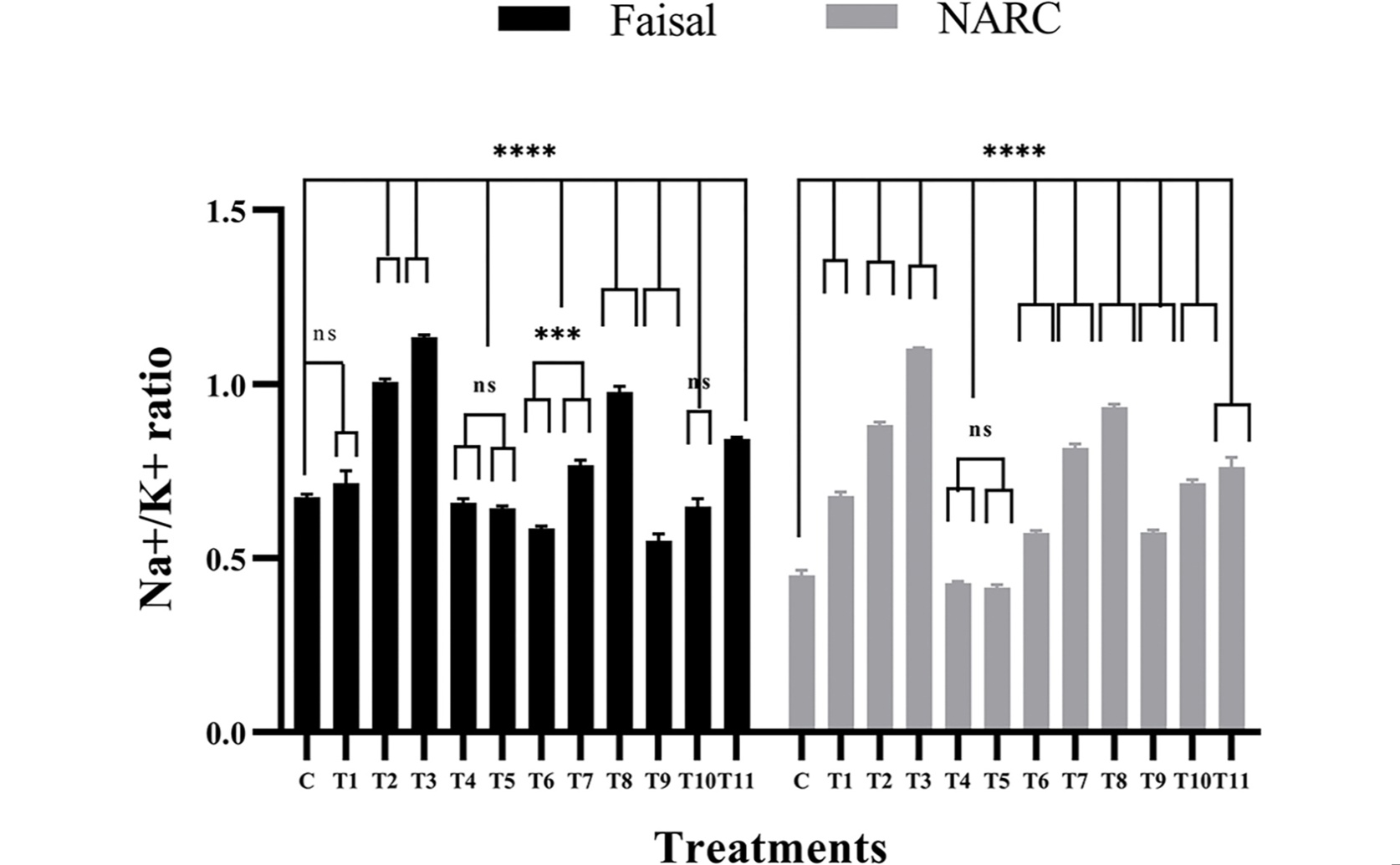
Priming with calcium significantly reduces the harmful Na+/K+ ratio caused by salinity in both salt-tolerant (Faisal) and salt-sensitive (NARC) soybean (Glycine max) varieties.

Image adapted from: Hameed et al. / CC BY (Source)

Key Findings

  • In Multan, Pakistan, applying calcium helped soybeans grow better in salty soils
  • Calcium improved seed germination by up to 25% and increased plant size and health under salt stress
  • Scientists identified key soybean genes for salt tolerance, aiding the development of more resilient crops
Soil salinity is a growing global challenge that threatens agricultural productivity and food security. High salt levels in the soil can hinder plant growth by disrupting water uptake and nutrient balance, leading to reduced crop yields. This issue is exacerbated by factors such as improper irrigation practices, excessive use of fertilizers, and climate change, which collectively increase the salinity of arable lands worldwide[2][3]. Leguminous crops, like soybeans, are particularly vulnerable to salt stress, especially during critical stages of germination and growth[4]. Researchers at MNS-University of Agriculture in Multan, Pakistan, conducted a study to explore ways to mitigate salinity stress in soybeans, a key legume crop. Their research focused on the application of calcium, a vital nutrient, to alleviate the adverse effects of high salt levels on soybean plants[1]. In their experiments, the team used seeds from both salt-tolerant and salt-susceptible soybean varieties. These seeds were treated, or "primed," with water or calcium at concentrations of 10 and 20 millimolar (mM). The primed seeds were then exposed to varying levels of sodium chloride (NaCl) stress—60, 80, and 100 mM. The researchers evaluated several aspects of plant growth and health, including seed germination rates, seedling length, plant height, number of nodes, activity of an enzyme called superoxide dismutase (SOD), and the balance of sodium (Na+) and potassium (K+) ions within the plants. The results were promising. Calcium treatment improved seed germination by 7% in non-stressed conditions and by 15-25% under salt stress. Additionally, calcium-primed plants showed increased seedling length by 3-8%, plant height by 9-18%, and a greater number of nodes by 3-14%. The activity of SOD, an important enzyme that helps protect plants from oxidative damage, increased by 20% in calcium-treated plants. Moreover, the ratio of sodium to potassium ions decreased by 3-5%, indicating better ionic balance and reduced salt toxicity. To understand the genetic basis of salt tolerance, the researchers also investigated the Salt Overly Sensitive (SOS) pathway, a key signaling mechanism in plants that helps manage salt stress. They identified and confirmed the presence of SOS gene orthologs in soybeans by comparing them to known SOS genes in the model plant Arabidopsis thaliana. The soybean SOS genes, referred to as GmSOS, showed significant similarity to their Arabidopsis counterparts, suggesting that they play a similar role in managing salt stress. This discovery is crucial as it provides a genetic target for future breeding programs aimed at developing salt-tolerant soybean varieties. This study builds on previous research that highlights the importance of genetic and agronomic strategies in combating soil salinity[2][3][4]. By demonstrating the effectiveness of calcium in mitigating salt stress and identifying key genetic components involved in salt tolerance, the research offers a comprehensive approach to improving soybean resilience. Calcium application not only enhances physiological and biochemical traits but also supports genetic strategies for long-term sustainability. Furthermore, the findings align with broader soil salinity management practices such as the use of salt-tolerant genotypes and improved irrigation techniques[2][3]. Integrating calcium treatment with these existing strategies could provide a synergistic effect, further enhancing crop performance in saline conditions. The identification of GmSOS genes opens new avenues for genetic engineering and selective breeding, potentially leading to the development of soybean varieties that can thrive in increasingly saline environments. In conclusion, the study from MNS-University of Agriculture provides valuable insights into mitigating soil salinity effects on soybeans through calcium application and genetic advancements. These findings contribute to the ongoing efforts to ensure agricultural productivity and food security in the face of rising soil salinity challenges driven by climate change and unsustainable agricultural practices[2][3][4].

AgricultureGeneticsPlant Science

References

Main Study

1) In Silico identification and characterization of SOS gene family in soybean: Potential of calcium in salinity stress mitigation.

Published 10th February, 2025

https://doi.org/10.1371/journal.pone.0317612


Related Studies

2) Impacts of salinity stress on crop plants: improving salt tolerance through genetic and molecular dissection.

https://doi.org/10.3389/fpls.2023.1241736


3) Soil salinity under climate change: Challenges for sustainable agriculture and food security.

https://doi.org/10.1016/j.jenvman.2020.111736


4) Grain Legumes and Fear of Salt Stress: Focus on Mechanisms and Management Strategies.

https://doi.org/10.3390/ijms20040799


Related Articles

An unhandled error has occurred. Reload đź—™