Developing Climate-Resilient Barley Varieties Using Advanced Stability Measures

Jenn Hoskins
21st January, 2025

Developing Climate-Resilient Barley Varieties Using Advanced Stability Measures

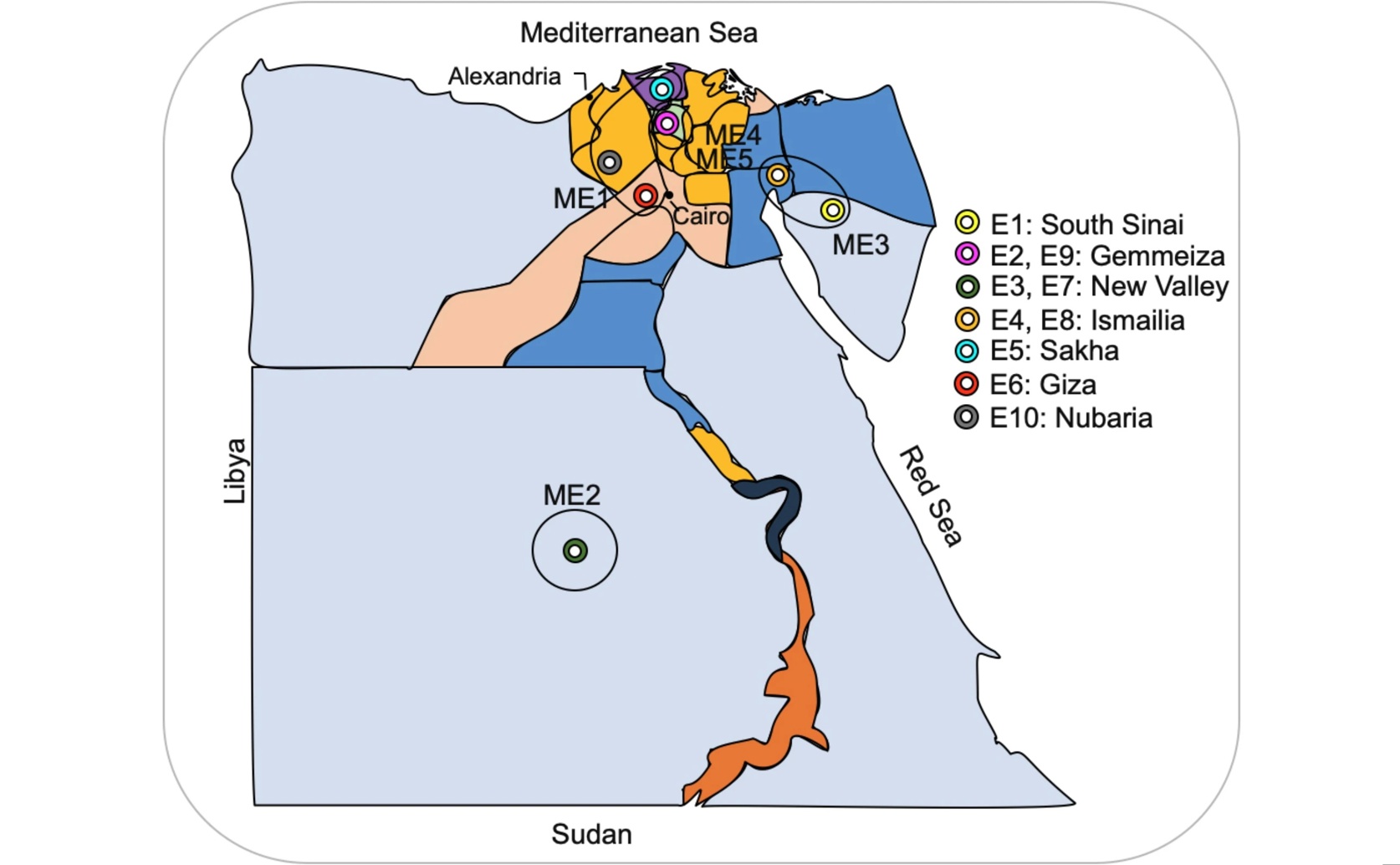
The ten diverse Egyptian environments used for testing Barley (Hordeum vulgare) were statistically grouped into five distinct mega-environments to identify genotypes with superior performance in specific regions.

Image adapted from: Elakhdar et al. / CC BY (Source)

Key Findings

  • The Agricultural Research Center in Egypt studied the yield performance of 32 barley genotypes across 10 different environments
  • The environment had the biggest impact on yield variation, explaining 81.3% of the total variation, while genotypes and their interaction with the environment explained 18.6%
  • The study identified eight barley genotypes with higher than average grain yield, and highlighted genotypes G32, G1, and G27 as the most stable across different environments
Studying genetic variability through the phenotypic performance of genotypes is crucial in breeding programs. Evaluating yield performance and stability across diverse environments is essential in yield trials to identify high-yield potential and stable cultivars. The Agricultural Research Center, Egypt, conducted a comprehensive study to analyze the yield performance of 32 barley genotypes across 10 different environments[1]. The study employed 12 univariate and 10 multivariate stability models to understand how genotype (G), environment (E), and their interaction (G × E) affect yield performance. It was found that the environment's main effect explained 81.3% of the total variation, while genotypes and G × E interaction effects accounted for 18.6%. Using the GGE biplot 'which-won-where' polygon, environments were categorized into five groups and genotypes into six groups. This analysis identified eight genotypes with mean grain yield (GY) superior to the overall mean of 4.43 tons per hectare. Spearman's correlation analysis showed significant positive correlations between GY and various stability parameters, such as linear regression coefficients (bi), Perkins and Jinks's stability parameters (Bi), environmental variance (Sxi2), and Tai's environmental effects (αi). These correlations suggest that these stability parameters are reliable indicators of genotype performance across different environments. Nonparametric measures such as Nassar and Huhn's (SI 6 and SI 3) and Thennarasu's (NP I (3) and NP I (4)), TOP-rank stability, and the yield stability index (YSI) also showed significant correlations with GY. Both univariate and multivariate stability models highlighted genotypes G32, G1, and G27 as the most stable, exhibiting minimal yield variation across environments. Additionally, genotypes G15, G13, G7, and G9 demonstrated high stability based on multivariate measures. This study emphasizes the importance of using a combination of univariate and multivariate stability models to comprehensively assess genotype stability and select "ideal genotypes" that offer both high yield potential and stability. This approach helps in the identification of genotypes that can perform well across varied environmental conditions, thereby contributing to more sustainable agricultural practices. Previous studies have also highlighted the importance of stability in crop performance. For instance, a study on genotypic stability in soybeans developed a genotypic stability space to measure homeostasis and the similarity of stability responses among genotypes[2]. This approach, while useful, had limitations that the current study addresses by incorporating a broader range of stability models. Additionally, the use of GGE biplots in the current study aligns with earlier findings that demonstrated their utility in evaluating genotype by environment data[3]. This method helps in visualizing the performance of different genotypes across various environments, facilitating better decision-making in breeding programs. The findings from this study are crucial for developing barley cultivars that can withstand the challenges posed by climate variability. For example, earlier research on the impact of climate change on wheat and barley yields in the Iberian Peninsula indicated that regional adaptation strategies are essential to mitigate yield losses due to increasing temperatures[4]. The current study's comprehensive approach to evaluating genotype stability can aid in developing such strategies by identifying genotypes that are resilient to environmental changes. In conclusion, the Agricultural Research Center, Egypt, has provided valuable insights into the importance of combining univariate and multivariate stability models to identify stable and high-yielding barley genotypes. This research contributes to the broader goal of developing resilient crop cultivars that can adapt to diverse environmental conditions, ensuring food security in the face of climate change.

AgricultureGeneticsPlant Science

References

Main Study

1) Integrating univariate and multivariate stability indices for breeding clime-resilient barley cultivars.

Published 18th January, 2025

https://doi.org/10.1186/s12870-024-05530-6


Related Studies

2) Genotypic stability.

https://doi.org/10.1007/BF00285245


3) Biplot Analysis of Test Sites and Trait Relations of Soybean in Ontario.

Journal: Crop science, Issue: Vol 42, Issue 1, Jan 2002


4) The impact of climate change in wheat and barley yields in the Iberian Peninsula.

https://doi.org/10.1038/s41598-021-95014-6


Related Articles

An unhandled error has occurred. Reload 🗙