Predicting Wheat Traits Using Genomic Data in Different Field Conditions

Jim Crocker
15th November, 2024

Predicting Wheat Traits Using Genomic Data in Different Field Conditions

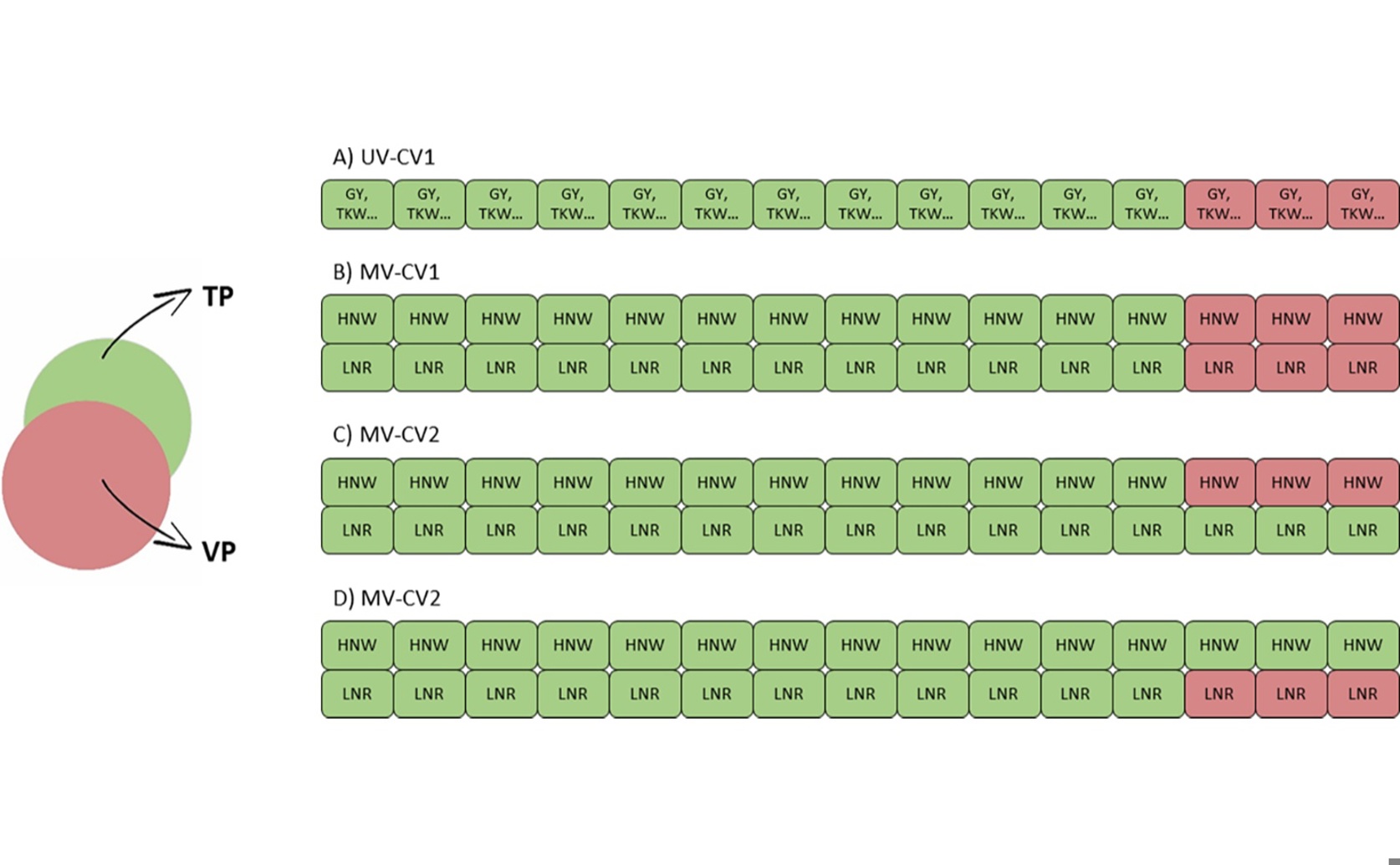
This figure illustrates the cross-validation schemes used to demonstrate that incorporating phenotypic information from a trait measured in an alternate field condition (c, d) significantly improves genomic prediction accuracy in Durum wheat (Triticum turgidum) compared to standard univariate (a) or basic multivariate (b) methods.

Image adapted from: Vitale et al. / CC BY (Source)

Key Findings

  • The study was conducted by CREA in Italy to improve durum wheat breeding using genomic prediction models
  • Multivariate analysis (MV) significantly improved prediction accuracy for agronomic traits compared to univariate models
  • MV-CV2, which includes phenotypic information, showed the highest improvement in prediction accuracy, especially under low nitrogen and rainfed conditions
The global demand for food is projected to increase significantly by 2050, necessitating a 50% rise in agricultural production[2]. One of the critical crops in this equation is durum wheat, which faces numerous biotic and abiotic stresses that limit its yield and quality[2]. Recent advancements in genomic prediction (GP) offer a promising avenue to enhance breeding programs for durum wheat, particularly by improving prediction accuracy (PA) for various agronomic traits. A recent study conducted by the CREA-Council for Agricultural Research and Economics in Italy has explored the potential of multivariate (MV) analysis to boost PA in durum wheat breeding programs[1]. The study focused on evaluating PA for several agronomic traits using both univariate (UV) and multivariate genomic prediction models. The researchers phenotyped a panel of durum wheat for 10 agronomic traits over two consecutive crop seasons under two different field conditions: high nitrogen and well-watered (HNW), and low nitrogen and rainfed (LNR). The goal was to determine whether MV analysis could outperform traditional UV models in predicting these traits. Two cross-validation schemes were employed in the MV analysis: MV-CV1 and MV-CV2. MV-CV1 tested the model for each target trait using only marker data, while MV-CV2 incorporated additional phenotypic information. These schemes were applied in two different analyses: modelling the same trait under both HNW and LNR conditions, and modelling grain yield together with the five most genetically correlated traits. The results revealed that PA for all traits in HNW conditions was generally higher than in LNR conditions, except for the trait yellow index. PA ranged from 0.34 for NDVI (Normalized Difference Vegetation Index) in LNR to 0.74 for test weight in HNW. When modelling the same traits under both HNW and LNR conditions, MV-CV1 improved PA by up to 12.45% for NDVI in LNR compared to the UV model. However, MV-CV2 showed even more substantial improvements, increasing PA by up to 56.72% for thousand kernel weight in LNR. Interestingly, MV-CV1 did not enhance PA for grain yield when modelled with the five most genetically correlated traits. In contrast, MV-CV2 significantly improved PA by up to approximately 18% under the same conditions. These findings underscore the effectiveness of MV-CV2 in increasing prediction accuracy for agronomic traits by leveraging phenotypic information and modelling traits under varying field conditions. The study's results align with previous research highlighting the importance of genetic gain in breeding programs. Genetic gain refers to the annual increase in performance achieved through artificial selection, which is crucial for meeting the growing demand for food and feed[3]. Enhancing genetic gain involves unlocking favorable genetic variation, improving heritability estimates, increasing selection intensity, and shortening the breeding cycle[3]. The CREA study's use of MV analysis and cross-validation schemes exemplifies how integrating molecular and genomic tools can enhance genetic gain in durum wheat breeding. Furthermore, the study's focus on different field conditions (HNW and LNR) reflects the need to develop resilient agronomic systems that can thrive under unpredictable environmental conditions. This approach is essential for closing the yield gap between genetic potential and on-farm achieved yield, a critical challenge in modern agriculture[2]. By modelling traits under varying conditions, breeders can develop durum wheat cultivars better suited to specific agro-ecozones, ultimately contributing to sustainable production. The study also builds on the principles of genomic selection (GS), which facilitates the rapid selection of superior genotypes and accelerates the breeding cycle[4]. GS has shown tangible genetic gains in crops like maize, and its application in durum wheat breeding could similarly enhance genetic gain through improved prediction models[4]. The CREA study's use of MV-CV2 to incorporate additional phenotypic information aligns with the broader goal of genomic-enabled prediction (GP) to account for genotype × environment (G×E) interactions, thereby improving the accuracy of GP models[4]. In conclusion, the CREA study demonstrates the potential of multivariate genomic prediction models to significantly improve prediction accuracy for agronomic traits in durum wheat. By incorporating phenotypic information and modelling traits under different field conditions, MV-CV2 offers a robust approach to enhancing genetic gain and developing resilient durum wheat cultivars. These advancements are crucial for meeting the future demand for food and ensuring sustainable agricultural production.

AgricultureGeneticsPlant Science

References

Main Study

1) Univariate and multivariate genomic prediction for agronomic traits in durum wheat under two field conditions.

Published 14th November, 2024

https://doi.org/10.1371/journal.pone.0310886


Related Studies

2) A Systematic Review of Durum Wheat: Enhancing Production Systems by Exploring Genotype, Environment, and Management (G × E × M) Synergies.

https://doi.org/10.3389/fpls.2020.568657


3) Enhancing genetic gain in the era of molecular breeding.

https://doi.org/10.1093/jxb/erx135


4) Genomic Selection in Plant Breeding: Methods, Models, and Perspectives.

https://doi.org/10.1016/j.tplants.2017.08.011


Related Articles

An unhandled error has occurred. Reload 🗙