Gene Variations Linked to Yellow Seeds with Higher Oil Content in Mustard Plants

Jenn Hoskins
2nd February, 2025

Gene Variations Linked to Yellow Seeds with Higher Oil Content in Mustard Plants

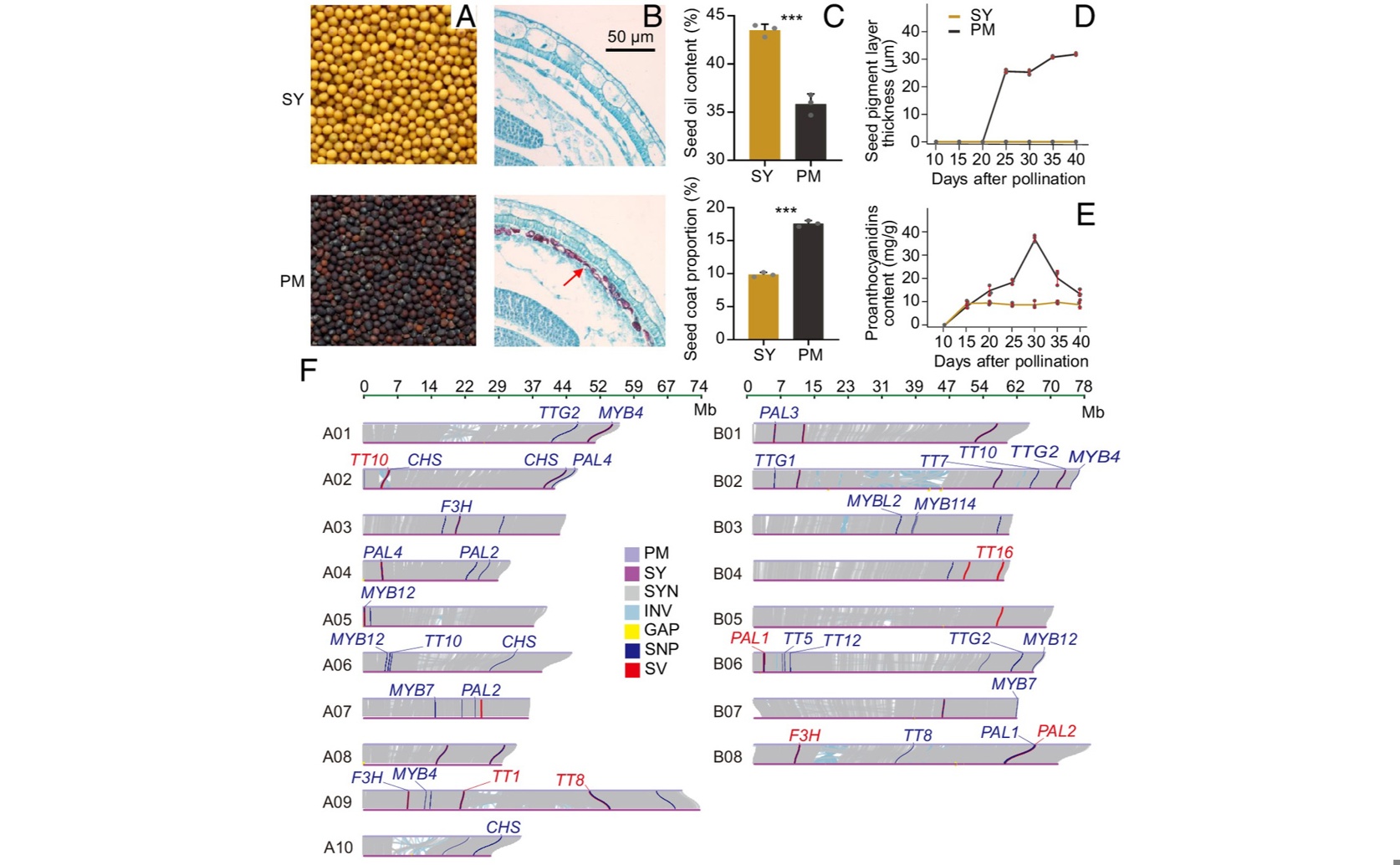
The yellow-seeded Indian mustard (Brassica juncea) variety Sichuan Yellow (SY) displays a thinner, unpigmented seed coat (a, b, d, e) and contains significantly more oil (c) than the black-seeded Purple-leaf Mustard (PM) variety, establishing the phenotypic basis for the study's genetic investigation (f).

Image adapted from: Qian et al. / CC BY (Source)

Key Findings

  • Researchers in China assembled the first complete genome of mustard (B. juncea) to study yellow seed traits
  • The TT8 gene was identified as key to yellow seed color, with mutations disrupting dark pigment production
  • TT8 and STK genes coevolved to enhance oil content, reduce seed coat fiber, and optimize seed traits for agriculture
Seed color is an important trait in oilseed crops like Brassica juncea (mustard), influencing oil content, seed quality, and germination rates. Yellow seeds are particularly valued for their higher oil content and reduced seed coat fiber compared to brown or black seeds. However, the genetic and molecular mechanisms behind these traits have remained unclear. A recent study conducted by researchers at Hunan Agricultural University[1] provides significant insights into this issue by assembling the first telomere-to-telomere (T2T) genome of B. juncea and exploring the genetic regulation and evolutionary history of yellow seeds. The study identified that the TRANSPARENT TESTA 8 (TT8) gene plays a central role in the development of yellow seeds. By analyzing allelic variation in TT8 across 1,002 global B. juncea accessions, the researchers traced the origin of yellow seeds to a single evolutionary event approximately 2,300 years ago in Southwestern China. They also discovered that the MADS-box gene SEEDSTICK (STK) coevolved with TT8 and works in coordination to regulate seed size, oil accumulation, and the proportion of seed coat in B. juncea. These findings not only clarify the genetic basis of yellow seed traits but also provide a foundation for breeding high-oil-content Brassica crops. Previous studies have laid the groundwork for understanding seed color in Brassica species. For example, microsatellite marker technology was used to identify loci controlling seed coat color in B. juncea, with specific markers (Na10-A08 and Ni4-F11) linked to seed color genes BjSC1 and BjSC2[2]. These markers were instrumental in diversifying yellow seed coat traits in Indian germplasm. While this research established the genetic linkage of seed color traits, it did not address the molecular mechanisms underlying oil content differences. Further insights into seed pigmentation came from transcriptome studies, which revealed that the deposition of proanthocyanidins (PAs) in the seed coat is a key factor in seed color. In brown-seeded B. juncea, genes involved in late flavonoid biosynthesis, such as dihydroflavonol reductase (DFR) and anthocyanidin reductase (ANR), are highly expressed, whereas these genes are largely inactive in yellow-seeded lines[3]. This suggests that the absence of PAs contributes to the yellow seed phenotype. However, these studies did not link seed pigmentation to oil content, leaving a gap in understanding the broader implications of seed color traits. The new study bridges these gaps by identifying TT8 as a central regulator of seed pigmentation and linking it to oil content and seed coat proportion. TT8 is a transcription factor known to regulate flavonoid biosynthesis, including PAs, which are responsible for the dark pigmentation in brown and black seeds. The researchers found that mutations in TT8 disrupt this pathway, leading to the yellow seed phenotype. Importantly, the coevolution of TT8 with STK appears to have optimized seed traits for agricultural purposes, such as increasing oil accumulation and reducing the proportion of the seed coat, which is rich in fiber and undesirable for oil extraction. These findings align with previous observations in related Brassica species. For instance, a major yellow-seed QTL on chromosome A09 in B. napus was found to simultaneously control seed color, oil content, and fiber content[4]. This QTL explained a significant portion of phenotypic variance and provided a genetic basis for breeding high-oil-content yellow-seeded varieties. The new study extends this understanding to B. juncea, demonstrating that similar genetic mechanisms underlie these traits across Brassica species. The evolutionary analysis conducted in the study also provides valuable context. By tracing the origin of yellow seeds to a single event in Southwestern China, the researchers highlight the historical and geographical significance of this trait. This finding underscores the potential for utilizing genetic diversity in global B. juncea accessions to further improve yellow-seeded varieties. In conclusion, the study by Hunan Agricultural University represents a major advancement in understanding the genetic and molecular basis of yellow seed traits in B. juncea. By identifying the roles of TT8 and STK and tracing the evolutionary history of yellow seeds, the research not only clarifies the mechanisms behind elevated oil content but also offers practical tools for breeding improved Brassica crops. This work builds on prior studies[2][3][4], integrating genetic, transcriptomic, and evolutionary insights to provide a comprehensive understanding of seed color and quality traits in B. juncea.

AgricultureGeneticsPlant Science

References

Main Study

1) Natural variations in TT8 and its neighboring STK confer yellow seed with elevated oil content in Brassica juncea.

Published 4th February, 2025 (future Journal edition)

https://doi.org/10.1073/pnas.2417264122


Related Studies

2) Mapping and tagging of seed coat colour and the identification of microsatellite markers for marker-assisted manipulation of the trait in Brassica juncea.

Journal: TAG. Theoretical and applied genetics. Theoretische und angewandte Genetik, Issue: Vol 111, Issue 1, Jun 2005


3) De novo transcriptome of Brassica juncea seed coat and identification of genes for the biosynthesis of flavonoids.

https://doi.org/10.1371/journal.pone.0071110


4) A major yellow-seed QTL on chromosome A09 significantly increases the oil content and reduces the fiber content of seed in Brassica napus.

https://doi.org/10.1007/s00122-022-04031-0


Related Articles

An unhandled error has occurred. Reload 🗙