Edge Complexity in Nature Pictures Influences Baby and Adult Preferences

Greg Howard
1st March, 2025

Edge Complexity in Nature Pictures Influences Baby and Adult Preferences

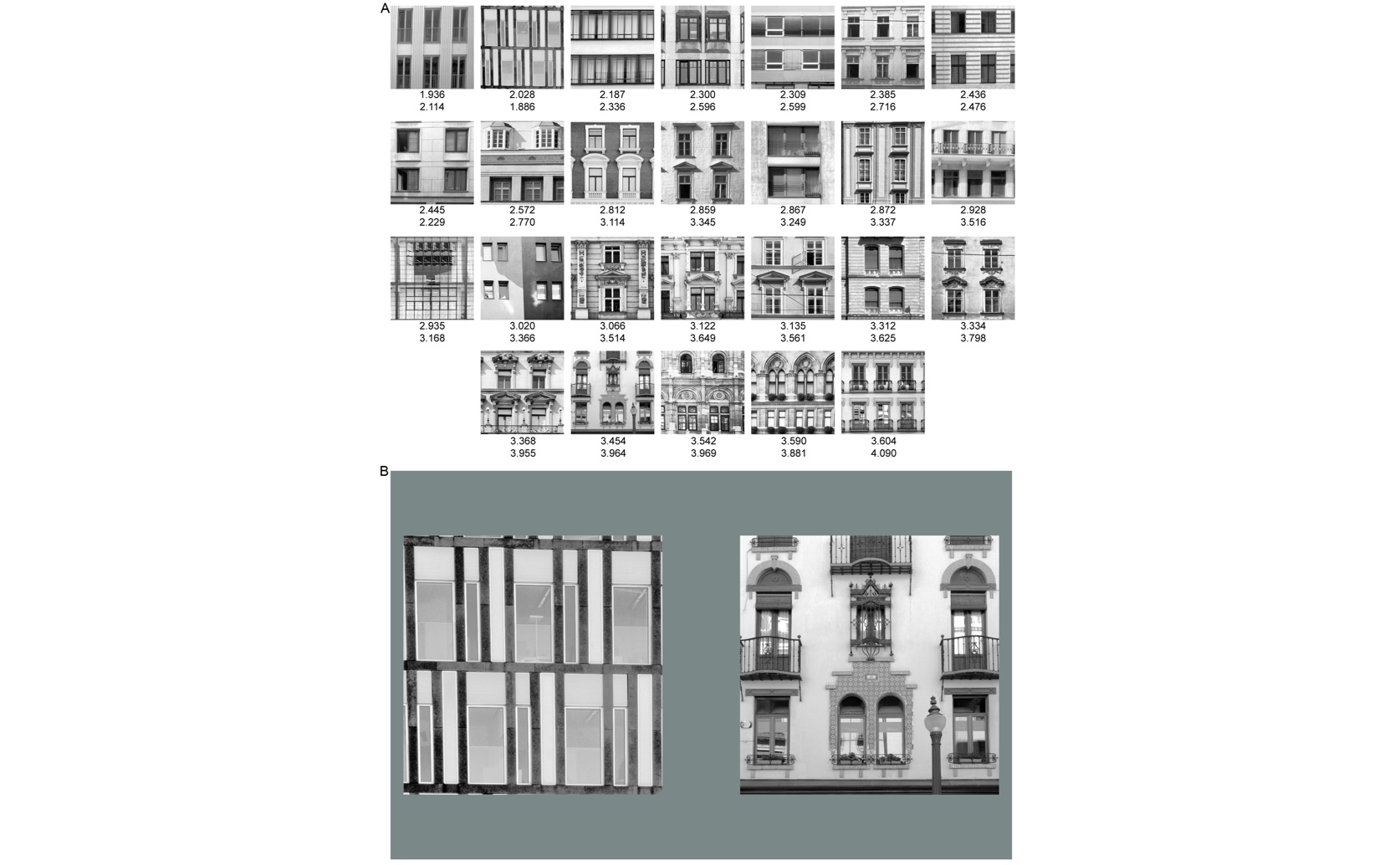
The building façade stimuli (a), presented to participants in pairs (b), were selected to represent a wide range of edge orientation entropy, demonstrating that façades with higher entropy (greater randomness in edge orientation) elicited longer looking times from infants and higher pleasantness ratings from adults.

Image adapted from: McAdams et al. / CC BY (Source)

Key Findings

  • A University of Sussex study found that both infants and adults prefer building designs with more varied and complex edge patterns
  • Infants spent more time looking at these complex designs, similar to how adults rated them as more pleasing
  • This suggests that our sense of what looks good is influenced by basic visual preferences established from infancy
Understanding why certain images appeal to us has long fascinated scientists. Recent research suggests that our aesthetic preferences may be rooted in the very way our visual system processes information from a young age. A new study from the University of Sussex[1] explores this idea by examining how both infants and adults respond to the statistical patterns of edges in natural scenes. The research builds on previous findings that indicate a connection between early visual preferences and adult aesthetic judgments. For instance, a study by Reber and colleagues[2] demonstrated that infants tend to look longer at colors that adults later prefer, especially when those colors are highly saturated. This suggests that our preferences for certain colors may be innate, shaped by the sensory mechanisms of our visual system from infancy. Further supporting this notion, another study conducted at the University of Sussex[3] found that infants and adults alike showed a preference for Van Gogh's landscape paintings that adults found more pleasant. The researchers identified specific chromatic and spatial image statistics, such as luminance and saturation, that influenced both groups' preferences. These findings highlight that basic visual features, present from early in life, play a significant role in shaping our aesthetic tastes. In addition to color preferences, research from Shahid Beheshti University[4] explored how infants process visual information. The study revealed that infants as young as six months old exhibit a cascade of associations from visual stimulus intensity to neural activity and ultimately to behavior. Specifically, more saturated colors generated greater cortical activity and longer looking times, reinforcing the idea that early sensory experiences influence visual preferences. Building on these insights, the University of Sussex investigated how the arrangement of edges in an image affects aesthetic preferences. They focused on a measure called Edge Orientation Entropy (EOE), which quantifies the randomness in the orientations of edges within a scene. High EOE indicates that edges are distributed more evenly across different angles, creating a more complex and less predictable visual pattern. In their study, 26 infants aged between four to nine months and 29 adults were shown pairs of building façades with varying levels of EOE. Both infants and adults showed a preference for images with high first-order EOE, where edge orientations were equally likely, and high second-order EOE, indicating low correlation of edge orientations across the image. These preferences suggest that both groups are drawn to images that exhibit a higher degree of randomness in edge orientations. Interestingly, there was a strong correlation between the infants' looking times and the adults' pleasantness ratings. This means that the buildings infants found more visually engaging were the same ones that adults later rated as more aesthetically pleasing. Such a finding underscores the continuity between early visual preferences and adult aesthetic judgments, reinforcing the idea that our taste in visual stimuli is influenced by fundamental sensory processes established in infancy. The study employed methods that involved presenting visual stimuli to both infants and adults while measuring their responses. For infants, looking time was used as an indicator of visual preference, while adults provided subjective ratings of pleasantness. Additionally, the researchers analyzed the images using spatial image statistics to quantify EOE, allowing for a direct comparison between the two groups' responses. By demonstrating that both infants and adults prefer images with higher Edge Orientation Entropy, the study suggests that our aesthetic preferences may be deeply rooted in the natural statistics of the environments we evolved in. Natural scenes typically feature a wide variety of edge orientations, and our visual system may be attuned to these patterns, finding them more engaging and pleasing. This research contributes to a broader understanding of aesthetics by highlighting the role of sensory biases in shaping our preferences. It aligns with theories that propose aesthetics results from the interaction of perceptual, emotional, and conceptual neural systems[3]. The findings from the University of Sussex offer evidence that even the perceptual component of this interaction is influenced by early sensory experiences and the fundamental ways our brains process visual information. Moreover, the study's emphasis on natural scene statistics provides a valuable perspective on how our environment shapes aesthetic judgments. By focusing on edge co-occurrence statistics, the research connects the structure of visual stimuli directly to both neural activity and behavioral responses, bridging the gap between sensory processing and higher-level aesthetic appreciation. In conclusion, the University of Sussex has successfully extended the understanding of aesthetic preferences by linking them to basic visual processing mechanisms present from infancy. The alignment between infant looking behavior and adult pleasantness ratings emphasizes that our tastes are not solely learned or culturally influenced but are also rooted in the innate properties of our visual system. This insight opens new avenues for exploring how our early sensory experiences continue to influence our perceptions and preferences throughout life.

EnvironmentEcology

References

Main Study

1) The edge orientation entropy of natural scenes is associated with infant visual preferences and adult aesthetic judgements

Published 26th February, 2025

https://doi.org/10.1371/journal.pone.0316555


Related Studies

2) Infants look longer at colours that adults like when colours are highly saturated.

https://doi.org/10.3758/s13423-019-01688-5


3) Chromatic and spatial image statistics predict infants' visual preferences and adults' aesthetic preferences for art.

https://doi.org/10.1167/jov.23.8.2


4) Visual stimulus structure, visual system neural activity, and visual behavior in young human infants.

https://doi.org/10.1371/journal.pone.0302852


Related Articles

An unhandled error has occurred. Reload 🗙