Understanding Soil Bacteria Around Citrus Trees with Disease-Fighting Genes

Greg Howard
16th July, 2024

Understanding Soil Bacteria Around Citrus Trees with Disease-Fighting Genes

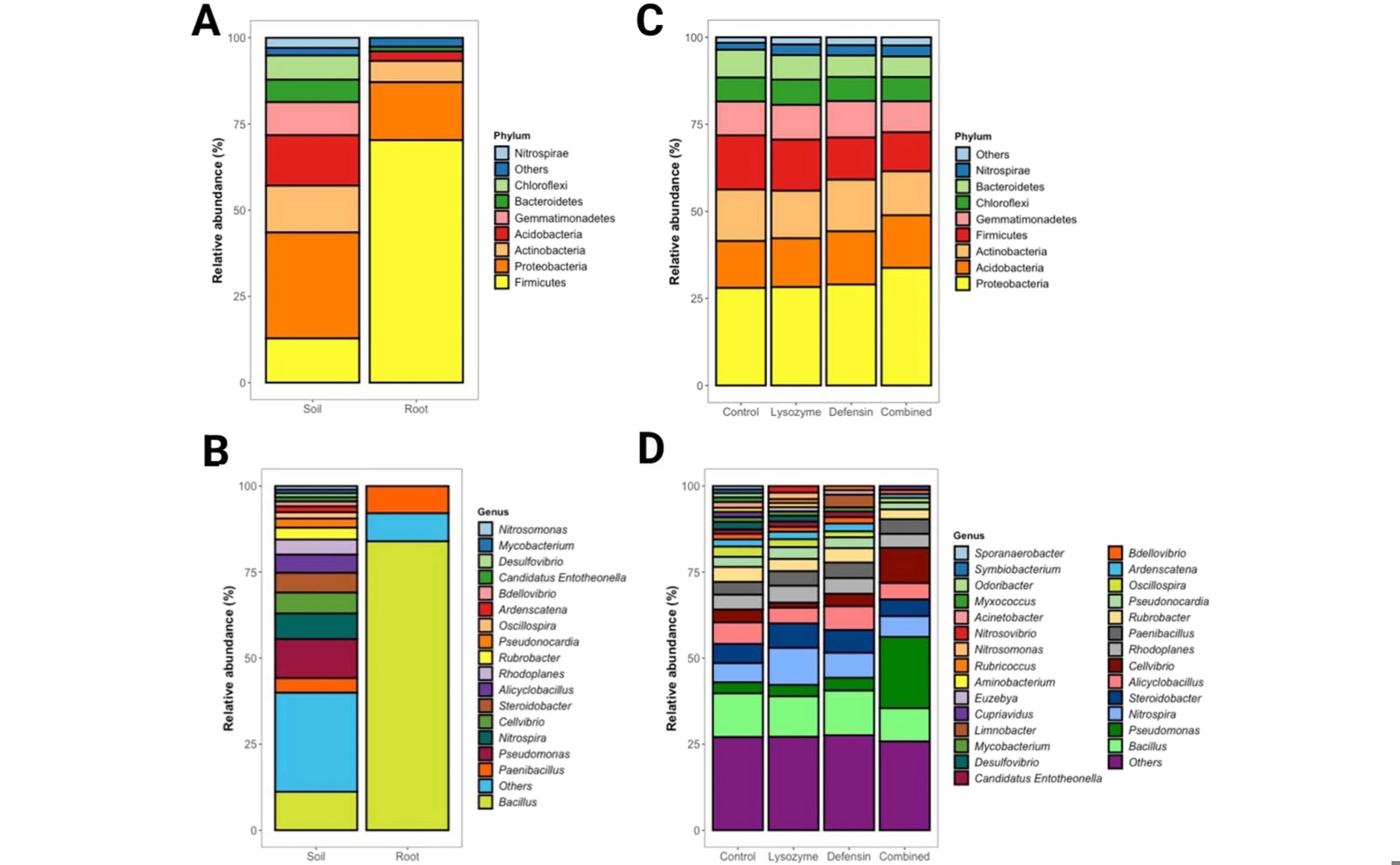
Analysis of bacterial communities in Mexican lime (Citrus aurantifolia) reveals a clear distinction between the diverse rhizosphere soil and the Firmicutes-dominated root microbiome (a, b), while also demonstrating that expressing phloem-directed antimicrobials had no significant effect on the relative abundance of major soil bacteria (c, d).

Image adapted from: Núñez-Muñoz et al. / CC BY (Source)

Key Findings

  • The study was conducted in an open-field citrus plantation in Tecomán, Colima, Mexico
  • Genetically modified citrus trees expressing phloem-targeted antimicrobials showed minimal impact on soil microbiota diversity
  • The introduction of these antimicrobials did not significantly alter the microbial diversity in the rhizosphere soil, suggesting a negligible ecological effect
Huanglongbing (HLB), also known as citrus greening, is one of the most destructive citrus diseases globally, causing severe economic losses and challenging citrus production. The disease is caused by the phloem-limited bacteria "Candidatus Liberibacter asiaticus" (CLas), which is transmitted by the Asian citrus psyllid[2][3]. Currently, there are no long-term commercialized control measures for HLB, making it imperative to explore innovative strategies for its management. A recent study conducted by researchers at Centro de Investigación y de Estudios Avanzados investigated a novel approach to control HLB by using genetically modified citrus trees expressing Citrus sinensis phloem protein of 16 kDa (CsPP16) fused to human lysozyme and β-defensin-2[1]. These antimicrobials are designed to target vascular tissues, where CLas resides, potentially offering a new avenue for managing the disease. The study focused on assessing the ecological impact of these genetically modified citrus trees on the soil microbiome diversity using 16S amplicon analysis. This method allows for a detailed examination of the microbial communities present in the soil. The researchers found no significant alterations in alpha diversity (the variety of species within a particular area), beta diversity (the difference in species between areas), phylogenetic diversity (the evolutionary relationships between species), differential abundance (the relative abundance of different species), or functional prediction (the potential functions of the microbial community) between the antimicrobial phloem-overexpressing plants and the control group. These findings suggest that the introduction of CsPP16 fused to human lysozyme and β-defensin-2 into citrus trees has minimal impact on the overall structure of the soil microbiota. This is a crucial consideration, as maintaining a healthy soil microbiome is essential for sustainable agriculture and environmental health. The study also revealed distinct bacterial assemblages between the rhizosphere soil (the soil surrounding plant roots) and root environments, indicating that different microbial communities inhabit these niches. Previous studies have explored various strategies to combat HLB, including the use of antibiotics, pesticides, and antimicrobial peptides[4]. Additionally, plant defense inducers such as β-aminobutyric acid (BABA), 2,1,3-benzothiadiazole (BTH), and 2,6-dichloroisonicotinic acid (INA) have shown promise in reducing HLB disease severity and improving fruit yield and quality[5]. However, these methods often come with concerns about environmental impact and long-term sustainability. The current study builds on these earlier findings by offering a targeted approach that minimizes disruption to the soil microbiome while potentially providing effective control of HLB. By focusing on phloem-targeted antimicrobials, the researchers aim to directly combat the pathogen within the plant's vascular system, where it causes the most damage. In conclusion, the study conducted by Centro de Investigación y de Estudios Avanzados highlights a promising strategy for managing HLB through the use of genetically modified citrus trees expressing phloem-targeted antimicrobials. This approach shows minimal impact on soil microbiota diversity, addressing a significant concern associated with other control methods. As the fight against HLB continues, integrating such innovative strategies with existing management practices could pave the way for more sustainable and effective disease control in the citrus industry.

GeneticsBiochemPlant Science

References

Main Study

1) Metagenomic Analysis of Rhizospheric Bacterial Community of Citrus Trees Expressing Phloem-Directed Antimicrobials

Published 15th July, 2024

https://doi.org/10.1007/s00248-024-02408-w


Related Studies

2) Citrus huanglongbing: a newly relevant disease presents unprecedented challenges.

https://doi.org/10.1094/PHYTO-12-12-0331-RVW


3) Huanglongbing Pandemic: Current Challenges and Emerging Management Strategies.

https://doi.org/10.3390/plants12010160


4) Controlling Citrus Huanglongbing: Green Sustainable Development Route Is the Future.

https://doi.org/10.3389/fpls.2021.760481


5) Field Evaluation of Plant Defense Inducers for the Control of Citrus Huanglongbing.

https://doi.org/10.1094/PHYTO-08-15-0196-R


Related Articles

An unhandled error has occurred. Reload 🗙