Nitrogen Compounds Boost Antioxidant Levels in Aging Apple Seed Embryos

Jenn Hoskins
13th July, 2024

Nitrogen Compounds Boost Antioxidant Levels in Aging Apple Seed Embryos

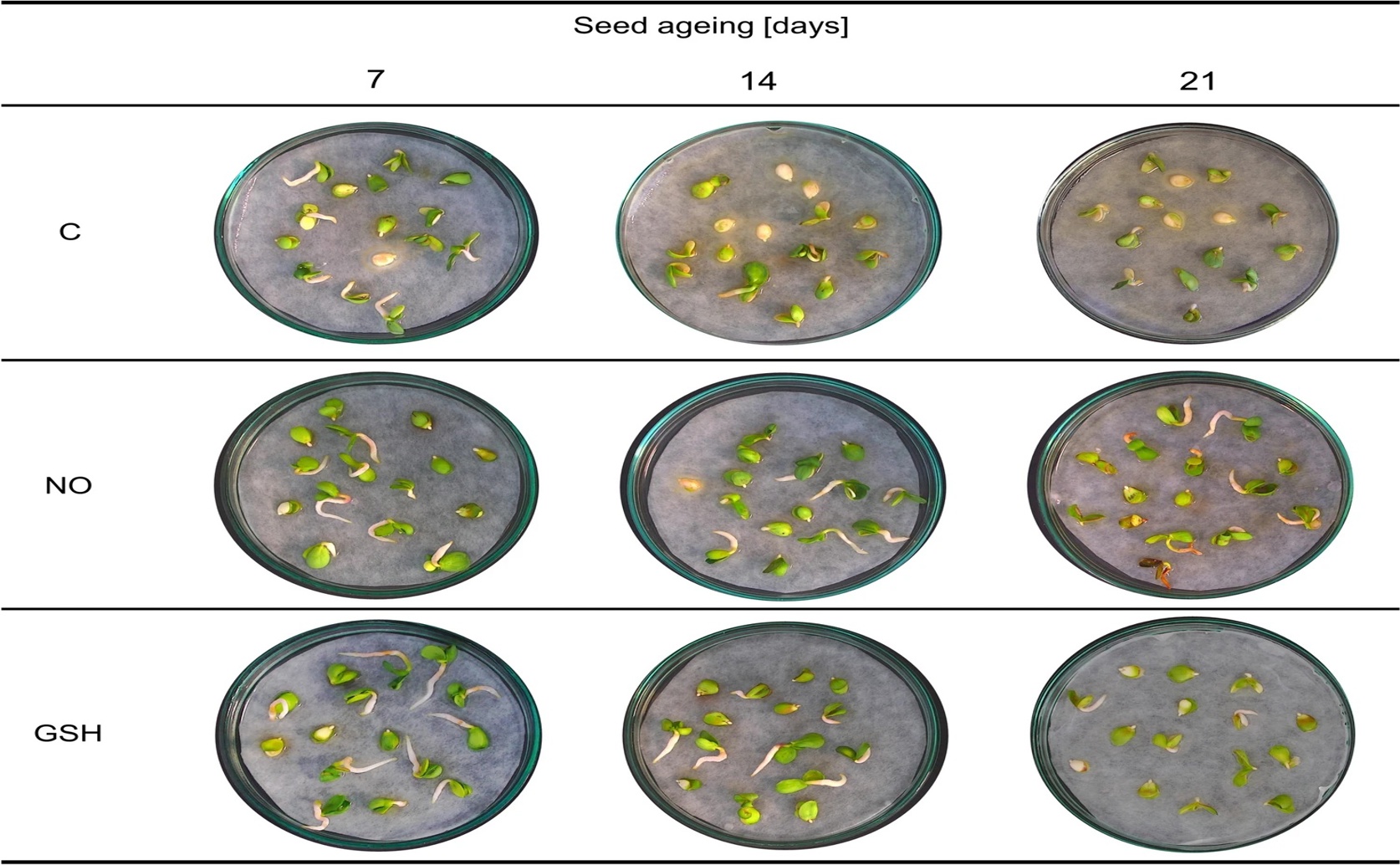
Treatment with nitric oxide derivatives (NO) visibly mitigates the developmental defects and tissue decay caused by accelerated ageing in apple (Malus domestica) seedlings, producing a restorative effect that is visually comparable to the direct application of glutathione (GSH).

Image adapted from: Marcin et al. / CC BY (Source)

Key Findings

  • Researchers at Warsaw University of Life Sciences studied how reactive nitrogen species (RNS) affect aging in apple seeds
  • Aging reduced the activity of enzymes that help maintain cell health, leading to potential damage
  • Treating aged seeds with nitric oxide compounds improved seed health by boosting antioxidant levels and enzyme activity
The recent study conducted by researchers at the Warsaw University of Life Sciences investigates the impact of reactive nitrogen species (RNS) on mitigating the deteriorative effects of accelerated seed aging in apple (Malus domestica Borkh.) embryos[1]. This study focuses on how RNS affects glutathione-related parameters, which are crucial for maintaining redox balance in cells. Seed aging is a significant problem in agriculture, leading to reduced seed viability and vigor. Reactive oxygen species (ROS) have been known to play a dual role in seed physiology, acting both as signaling molecules and as agents of oxidative damage[2]. During aging, excessive ROS can lead to cellular damage. However, the role of reactive nitrogen species (RNS) in this context has not been well explored until now. In this study, apple seeds were subjected to accelerated aging for periods of 7, 14, or 21 days. After aging, the embryos were isolated and treated with nitric oxide-derived compounds (NOx) for a short duration before being cultured for 48 hours. The researchers measured various parameters, including levels of reduced (GSH) and oxidized (GSSG) glutathione, activities of glutathione reductase (GR), and glutathione peroxidase-like (GPX-like) enzymes. Glutathione (GSH) is a vital antioxidant that helps maintain the redox potential within cells. It is involved in detoxifying harmful compounds and protecting cellular components from oxidative damage. GR and GPX-like enzymes play crucial roles in the glutathione cycle. GR converts GSSG back to GSH, while GPX-like enzymes use GSH to neutralize peroxides, converting it to GSSG in the process[3]. The study found that during the aging process, the levels of GSH and GSSG, as well as the half-cell reduction potential, remained stable in the axes of apple embryos. However, the activities of GR and GPX-like enzymes decreased, indicating a reduced capacity to maintain redox balance. This reduction in enzymatic activity could lead to an accumulation of oxidative damage, contributing to the decline in seed vigor. Interestingly, treatment with NOx compounds significantly improved the vigor of embryos isolated from seeds subjected to prolonged aging. This positive effect was linked to an increased total glutathione pool, particularly higher GSH content. Additionally, NOx treatment led to an increase in the levels of transcripts encoding GPX-like enzymes and stimulated their enzymatic activity. These findings suggest that RNS, particularly NOx, can mitigate the negative effects of accelerated seed aging by enhancing the glutathione pool and boosting the activities of key enzymes involved in maintaining redox balance. This aligns with previous studies that have highlighted the importance of glutathione in seed germination and quality[4][5]. In summary, the study provides new insights into the role of reactive nitrogen species in seed aging and highlights the potential of NOx treatments to preserve seed vigor by modulating glutathione-related parameters. This research opens up new avenues for improving seed storage and viability, which could have significant implications for agriculture.

GeneticsBiochemPlant Science

References

Main Study

1) Reactive nitrogen species act as the enhancers of glutathione pool in embryonic axes of apple seeds subjected to accelerated ageing.

Published 12th July, 2024

https://doi.org/10.1007/s00425-024-04472-5


Related Studies

2) The signalling role of ROS in the regulation of seed germination and dormancy.

https://doi.org/10.1042/BCJ20190159


3) Plant glutathione peroxidases: emerging role of the antioxidant enzymes in plant development and stress responses.

https://doi.org/10.1016/j.jplph.2014.12.014


4) Maturation of arabidopsis seeds is dependent on glutathione biosynthesis within the embryo.

Journal: Plant physiology, Issue: Vol 141, Issue 2, Jun 2006


5) Dormancy removal by cold stratification increases glutathione and S-nitrosoglutathione content in apple seeds.

https://doi.org/10.1016/j.plaphy.2019.02.026


Related Articles

An unhandled error has occurred. Reload 🗙