Birds delay alerting others when alone in mixed flocks

Jim Crocker
2nd February, 2026

Birds delay alerting others when alone in mixed flocks

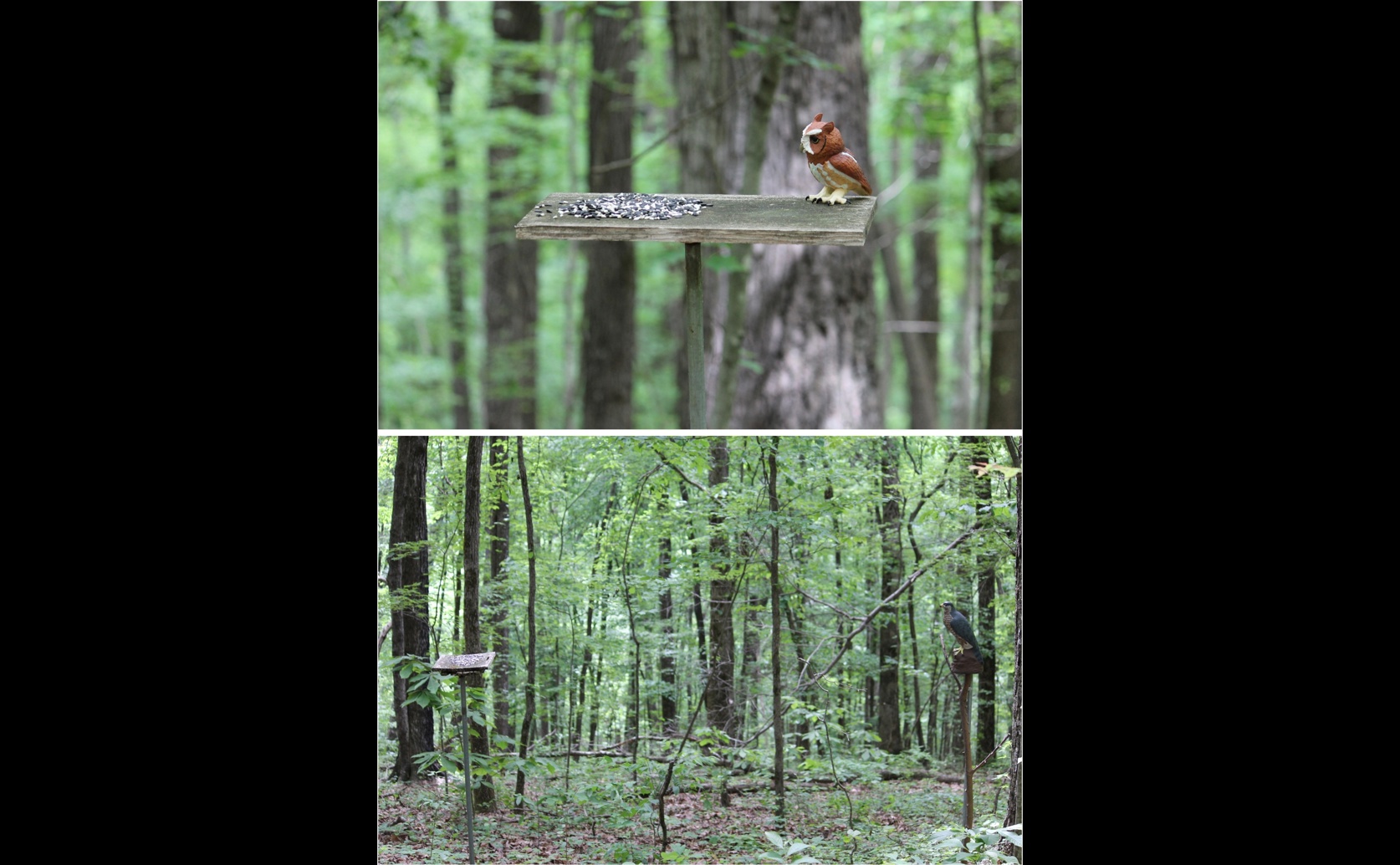
Field presentations of Eastern screech owl (Megascops asio) (top) and Cooper’s hawk (Accipiter cooperii) (bottom) models elicited significantly delayed antipredator signaling from solitary flock members compared to those with conspecifics, providing empirical support for the Oddity Effect Hypothesis.

Image adapted from: Selman et al. / CC BY (Source)

Key Findings

  • This study, conducted in Tennessee with Carolina chickadees, tufted titmice, and white-breasted nuthatches, investigated if single birds in a flock delay calling when a predator is present
  • Single birds of a species were found to take longer to vocalize an alarm call compared to when they were in a group of their own kind, supporting the idea that being different attracts attention
  • The study did not find evidence that birds call more when alone to attract others (recruitment) or that more birds of a species always call faster, strengthening the ‘oddity effect’ explanation
Being part of a group offers animals protection from predators, and access to resources like food. However, standing out in a group can be dangerous, as predators may single out individuals that look different. While this ‘oddity effect’ – where rare individuals are targeted – has been observed in fish, it’s less understood how it impacts bird behavior within mixed-species groups.[1] conducted by researchers at the Univ. of Tennessee and Univ. of Michigan, investigated this question, focusing on how the number of individuals of a particular species within a flock influences their response to a predator. The core idea behind the study is the Oddity Effect Hypothesis, which proposes that rare individuals will delay signaling, essentially trying to remain inconspicuous to avoid attracting attention. To test this, the researchers analyzed data from two existing field experiments. These experiments involved presenting a model predator to mixed-species flocks of Carolina chickadees, tufted titmice, and white-breasted nuthatches. The key measurement was the ‘latency to call’ – the time it took for a bird to vocalize after the predator model appeared. The study focused on comparing flocks where only one individual of a given species was present versus flocks with two or more. The researchers also considered two alternative explanations for calling behavior: the ‘probability of calling’ hypothesis (more individuals of a species means a higher chance someone will call quickly) and the ‘recruitment’ hypothesis (fewer individuals means a stronger motivation to alert others). The results strongly supported the Oddity Effect Hypothesis. In both experiments, single individuals took significantly longer to call than those in larger groups of their species. Specifically, chickadees delayed calling when alone in the first experiment, which used a screech owl model, and titmice and nuthatches showed the same pattern in the second experiment, using a Cooper’s hawk model. There was no evidence to support the alternative hypotheses; call latency wasn’t consistently shorter with more or fewer conspecifics. These findings align with earlier work on antipredator calls and their directionality[2]. That study showed birds can adjust their calls to communicate with both conspecifics and predators, sometimes broadcasting widely to alert others, and other times directing calls towards the predator itself. The current study builds on this by suggesting that even the decision to call can be altered by social context, specifically the risk of being singled out as different. Interestingly, the study also connects to research on mixed-species grouping and the benefits of diversity[3][4]. While diversity can improve food finding, this research suggests there are also potential costs for rare individuals. The benefit of being in a diverse flock may not be equal for all members, and the risk of predation could be higher for those who don’t blend in.[3] demonstrated that cryptic individuals benefit from associating with conspicuous ones, reducing their risk of predation. This study, however, highlights the opposite effect – the risk for the cryptic individual when they are alone. The researchers acknowledge that the small sample sizes used in the study warrant caution. Further research with larger groups and more diverse flock compositions is needed to confirm these findings and fully understand the interplay between rarity, signaling behavior, and predation risk in avian mixed-species groups.

WildlifeEcologyEvolution

References

Main Study

1) Tests of the Oddity Effect Hypothesis in mixed-species parid flocks

Published 30th January, 2026

https://doi.org/10.1371/journal.pone.0341779


Related Studies

2) Birds adjust acoustic directionality to beam their antipredator calls to predators and conspecifics.

https://doi.org/10.1098/rspb.2009.1519


3) Mixed-phenotype grouping: the interaction between oddity and crypsis.

https://doi.org/10.1007/s00442-012-2473-y


4) Diversity in mixed species groups improves success in a novel feeder test in a wild songbird community.

https://doi.org/10.1038/srep43014


Related Articles

An unhandled error has occurred. Reload 🗙