Combining fieldwork and community science to study salamander colour and social life

Jenn Hoskins
26th September, 2025

Combining fieldwork and community science to study salamander colour and social life

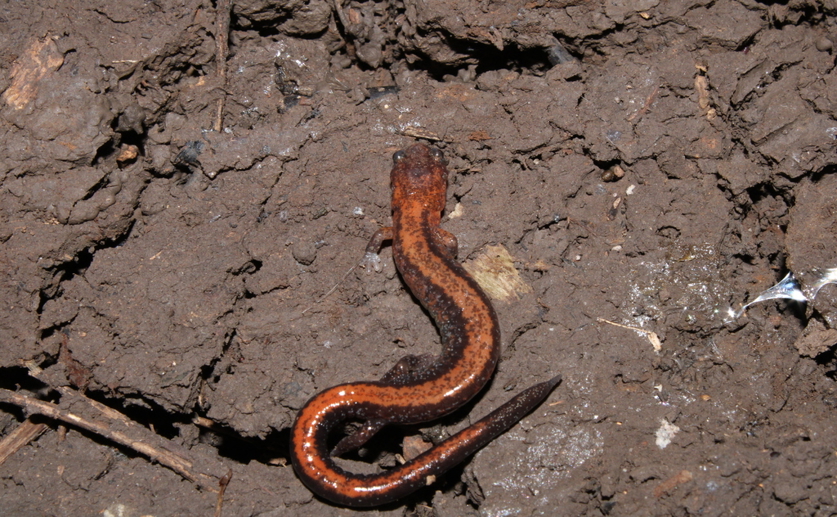
An Eastern Red-backed Salamander found in Canada.

Photo: Keith Wauthy / CC BY (Source)

Key Findings

  • This study in New Brunswick, Canada, examined the colouration and social behaviour of Eastern Red-backed Salamanders using both traditional surveys and citizen science data from iNaturalist
  • Adult salamanders commonly grouped together in spring and autumn, consistent with observations elsewhere, but iNaturalist data reported fewer groups and more unique individuals
  • iNaturalist observations revealed a previously undocumented colour morph – an amelanistic salamander – in New Brunswick, highlighting the platform’s value for discovering rare variations
Eastern Red-backed Salamanders (Plethodon cinereus) are a common forest-dwelling species in eastern North America, and are often used by ecologists to understand the health of forest ecosystems. However, studying these animals can be difficult due to their secretive nature and the large areas they inhabit. Traditionally, researchers have relied on intensive field surveys to collect data on salamander populations, but this process is time-consuming and expensive. Recently, data collected by citizen scientists – members of the public who voluntarily report observations – has become increasingly valuable in ecological research[1]. A recent study conducted by researchers at Mount Allison University investigated the patterns of salamander colouration and social behaviour in New Brunswick, Canada, utilizing both traditional ecological surveys and data from the online platform iNaturalist. The study focused on understanding two key aspects of salamander life: whether they tend to group together (aggregate), and the variation in their colouration, specifically the presence of different colour morphs (distinct colour variations within a population). Salamanders exhibit colour polymorphism, meaning individuals can differ in colour, and these differences can sometimes be linked to environmental factors or behaviours. The research team conducted surveys in 23 forests, directly observing and recording salamander behaviour and characteristics. Simultaneously, they extracted data from iNaturalist, leveraging observations submitted by the public across the entire province. One of the main findings was that adult salamanders were more likely to aggregate during the early spring and autumn, a pattern consistent with observations from other regions. However, a key difference emerged when comparing the data collection methods. Community-science observations from iNaturalist were less likely to report groups of salamanders, and more likely to report individual salamanders with unusual colourations. This is likely because observers are more prone to noticing and reporting unique individuals than common groups. Interestingly, the iNaturalist data revealed a previously undocumented colour morph in New Brunswick – an amelanistic salamander, meaning it lacked the typical dark pigmentation. The study also explored whether salamanders with different colour morphs or social behaviours preferred specific micro-environmental conditions, such as different levels of moisture or types of vegetation. Previous research on eastern red-backed salamanders has suggested links between colour morph proportions and environmental variables[2], leading some to propose using colour morphs as indicators of climate change. However, the Mount Allison University team found no evidence of such preferences in New Brunswick. This contrasts with observations from other populations of the species, where colour morphs have been correlated with habitat characteristics. This discrepancy highlights a challenge in using colour morph proportions as a reliable bioindicator, as demonstrated in another study which found that climatic and geographic variables did not influence colour morph proportions in P. cinereus populations[2]. The current study builds on this by showing that even within the same species, environmental preferences can vary geographically. Furthermore, the findings echo research on monarch butterflies, where differences in larval colouration were initially thought to be adaptations to local solar exposure[3]. However, a subsequent study utilizing data from citizen scientists revealed that captive-reared larvae differed significantly from wild populations in colouration, suggesting that environmental factors play a crucial role and that innate differences may not be observable in nature[3]. Similarly, the Mount Allison University study emphasizes the importance of considering the context of data collection – whether it’s from controlled experiments or natural environments – when interpreting ecological patterns. The study also demonstrates the value of using platforms like iNaturalist for ecological research, as shown in a study on Convolvulus arvensis flower colour polymorphism[4]. While acknowledging the biases inherent in community-science data, the researchers found it to be a valuable source of information, particularly for documenting rare morphs and expanding the geographic scope of the study. The trade-offs between the controlled nature of ecological surveys and the broader reach of community-science data are important considerations for future research.

WildlifeEcologyEvolution

References

Main Study

1) Integrating ecological and community science data to understand patterns of colour polymorphism and social behaviour at the northern range limit of a plethodontid salamander

Published 23rd September, 2025

https://doi.org/10.1371/journal.pone.0332501


Related Studies

2) Questioning the use of an amphibian colour morph as an indicator of climate change.

https://doi.org/10.1111/gcb.12744


3) Revisiting geographic variation in melanism of monarch butterfly larvae in North America using iNaturalist photos.

https://doi.org/10.1016/j.jtherbio.2022.103374


4) Spatial patterns of flower colour variation in native and introduced ranges of Convolvulus arvensis (Convolvulaceae) revealed by citizen-science data and machine learning.

https://doi.org/10.1111/plb.13537


Related Articles

An unhandled error has occurred. Reload 🗙