How Frogs Survive Despite Population Declines

Jenn Hoskins
24th September, 2025

How Frogs Survive Despite Population Declines

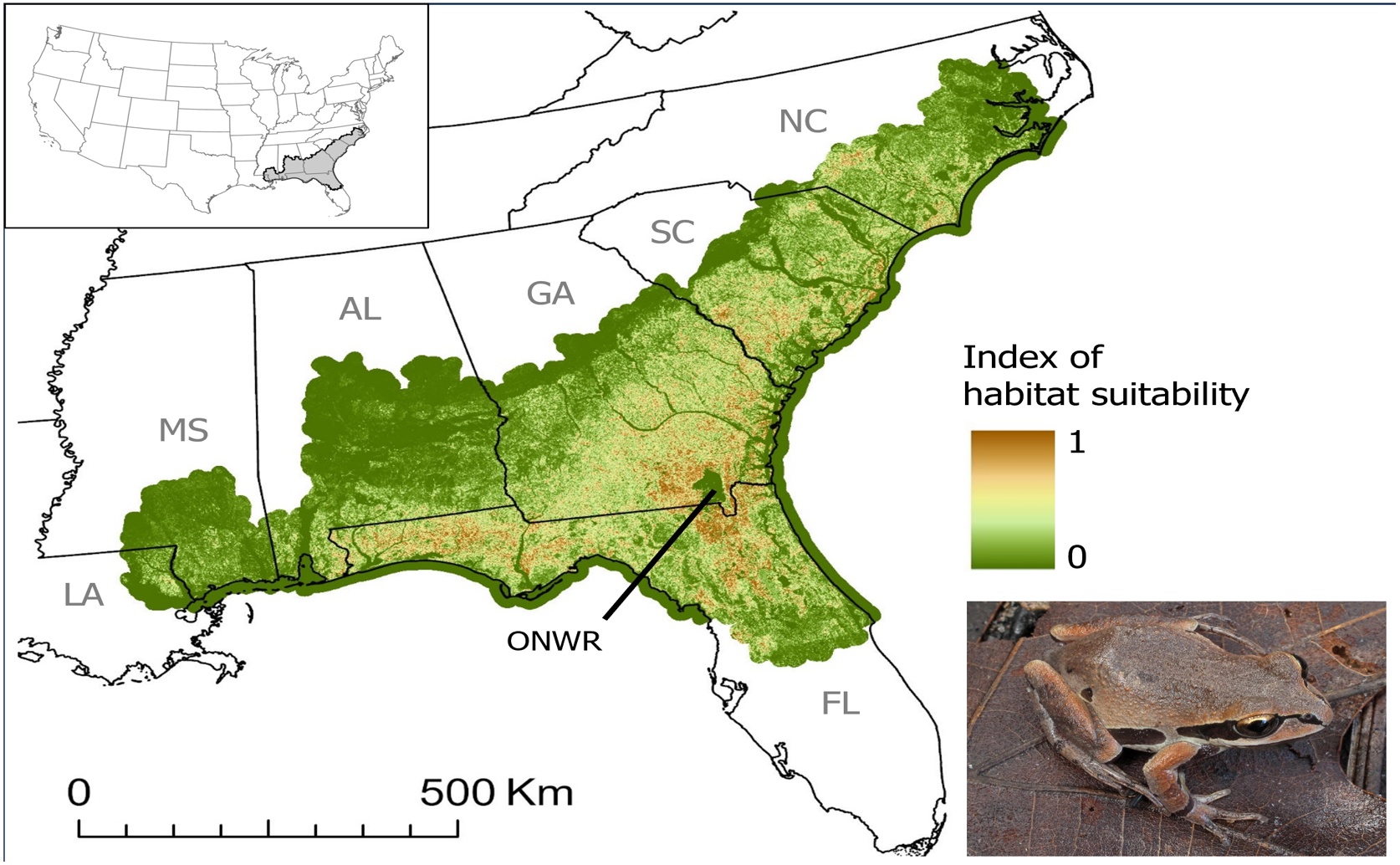
This maximum entropy model illustrates the spatial distribution of relative habitat suitability for Pseudacris ornata across the southeastern United States, highlighting regions of high suitability (brown) characterized by sandy soils and coniferous forests that are positively associated with population persistence.

Image adapted from: Koen et al. / CC0 1.0 (Source)

Key Findings

  • This study, focusing on the Ornate Chorus Frog across seven southeastern US states, found over 36% of historical populations may be extinct
  • Populations in northwestern Florida, southeastern Alabama, and southern Georgia are most likely to persist, highlighting these areas as crucial for conservation
  • Habitat quality and sufficient winter rainfall positively correlated with population persistence, while urbanization negatively impacted survival prospects
The decline of amphibian populations globally is a significant conservation concern, with many species facing extinction due to habitat loss, climate change, and disease. Assessing the current status of species and identifying areas of population decline is crucial for effective conservation planning. While anecdotal evidence often points to local disappearances of species, a comprehensive understanding of range-wide trends is frequently lacking. This is particularly true for species like the Ornate Chorus Frog ( Pseudacris ornata), where observations suggest declines but a clear picture of its overall population health has been missing.[1] A recent study undertaken by researchers at Cherokee Nation System Solutions, University of Florida, U.S. Geological Survey, Florida Fish and Wildlife Conservation Commission, and Shiraz University, aimed to address this knowledge gap. The study focused on estimating the probability of persistence – essentially, the likelihood that a historical population of Ornate Chorus Frogs still exists today – across its entire range. Researchers compiled 2227 verified records of frog presence, grouping these into 407 distinct populations. This data was then analyzed using a modified Cormack-Jolly-Seber survival analysis, a statistical method commonly used in ecology to estimate survival rates, adapted here to estimate population persistence. The analysis projected persistence probabilities up to the year 2024. The results revealed a concerning trend: over 36% of the historical populations are considered possibly extirpated, meaning there’s less than a 50% chance they still exist. Conversely, 33% of populations were found to have a high probability of persistence – greater than 90%. Importantly, the remaining populations weren’t evenly distributed; a significant number of those still thriving were located in northwestern Florida, southeastern Alabama, and southern Georgia. This highlights the importance of these regions for the species’ long-term survival. Several factors were identified that influenced persistence probability. Habitat suitability – a measure of how well the environment meets the frog’s needs – had a positive effect, meaning populations in higher-quality habitats were more likely to persist. Similarly, mean winter precipitation also showed a positive correlation, suggesting that adequate winter rainfall is important for the frog’s survival. Conversely, the amount of urban impervious surface (areas covered by concrete and asphalt) had a negative impact, indicating that urbanization is detrimental to population persistence. This aligns with broader findings about the negative impacts of human development on biodiversity[2]. The study also examined the effectiveness of protected areas. Populations located within protected areas demonstrated a higher average probability of persistence compared to those outside of them. This reinforces the importance of establishing and maintaining protected areas as a key conservation strategy. However, it’s important to note that[3] suggests current protected areas are not always ecologically representative, meaning they don’t necessarily encompass all areas critical for biodiversity conservation. The research fills a critical knowledge gap by pinpointing areas where Ornate Chorus Frog populations are likely doing well and, crucially, areas where they may already be extinct. This information is vital for prioritizing conservation efforts and directing resources to the most vulnerable populations. The findings also underscore the importance of considering habitat quality, winter precipitation, and the impacts of urbanization when developing conservation plans. This study builds upon earlier work[2] that identified small-ranged species as being disproportionately threatened, as the Ornate Chorus Frog, with its fragmented populations, fits this vulnerable profile.

WildlifeEcologyEvolution

References

Main Study

1) Persistence of a declining anuran species across its distribution

Published 22nd September, 2025

https://doi.org/10.1371/journal.pone.0332991


Related Studies

2) The biodiversity of species and their rates of extinction, distribution, and protection.

https://doi.org/10.1126/science.1246752


3) Has the Earth's sixth mass extinction already arrived?

https://doi.org/10.1038/nature09678


Related Articles

An unhandled error has occurred. Reload 🗙