Dwarfism and differing traits in male and female lizards and toads

Jim Crocker
29th December, 2025

Dwarfism and differing traits in male and female lizards and toads

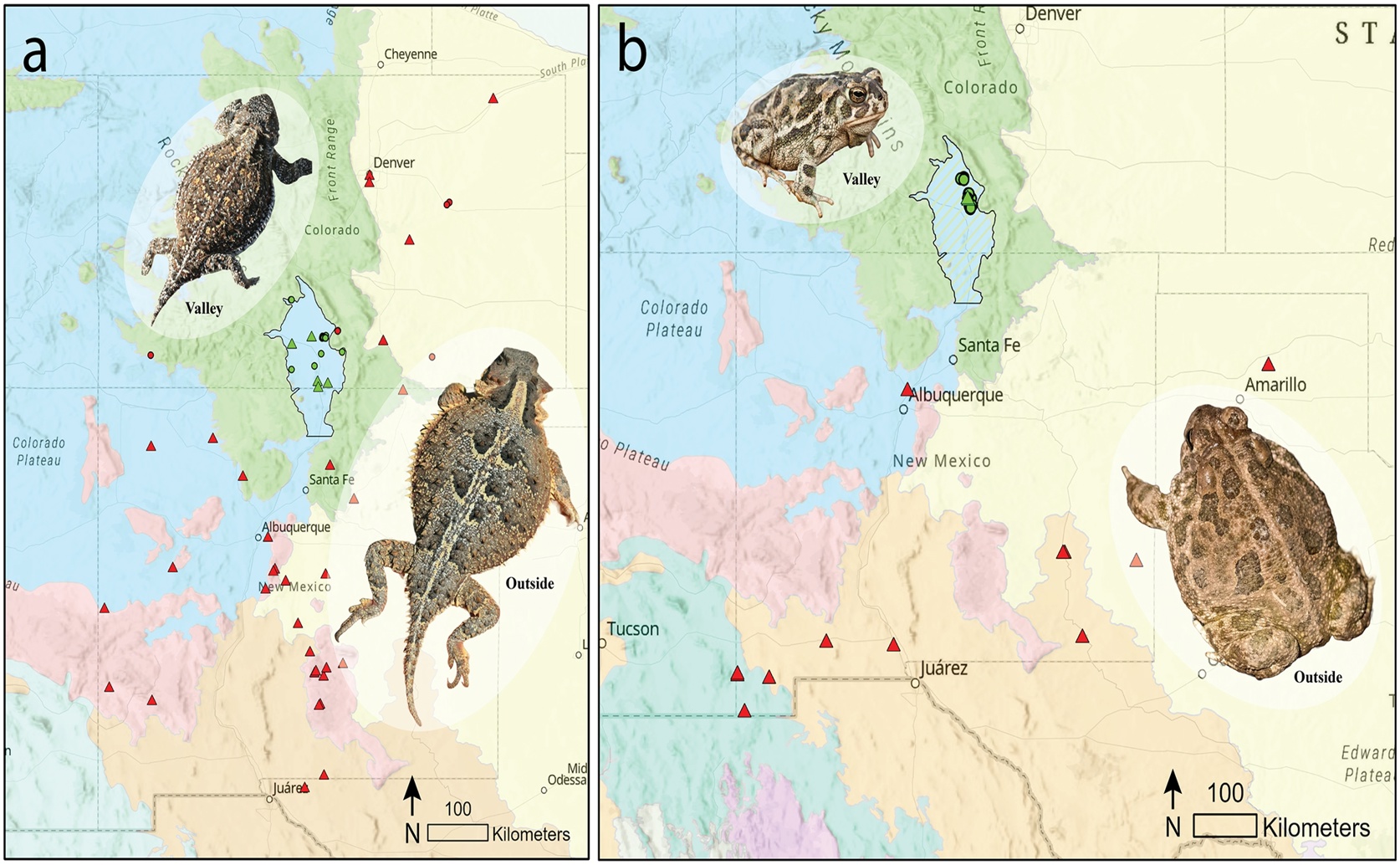
This study compared populations of the greater short-horned lizard (Phrynosoma hernandesi, a) and the Great Plains toad (Anaxyrus cognatus, b) from the geographically isolated San Luis Valley (green) to surrounding populations (red), demonstrating significant mainland dwarfism within the valley.

Image adapted from: Lahti et al. / CC BY (Source)

Key Findings

  • This study examined lizards and toads in the San Luis Valley, Colorado, and found both species were over 30% smaller than populations outside the valley
  • The reduced body size, termed dwarfism, has persisted in these populations for nearly one million years, suggesting it’s a stable trait
  • Female lizards maintained their larger size relative to males despite overall dwarfism, while toads showed a potential emergence of size differences between sexes only within the valley
Body size is a fundamental characteristic of any animal, influencing its physiology, behaviour, and role within an ecosystem. While body size generally varies predictably across geographical areas on continents – a phenomenon known as clinal variation – dramatic shifts are unusual, typically occurring on islands where unique environmental pressures exist[2]. A recent study by researchers at Utah State University and CONICET (Argentina)[1] documents a rare case of significant body size reduction in two mainland species, the greater short-horned lizard (Phrynosoma hernandesi) and the Great Plains toad (Anaxyrus cognatus), inhabiting the San Luis Valley in North America. The study focused on populations of these two species living within the San Luis Valley and compared them to those outside of it. The researchers found that lizards from the Valley were, on average, 33.7% smaller than their counterparts in other areas. Similarly, toads from the Valley were 32.9% smaller than those living outside of the Valley. This reduction in size is termed ‘dwarfism’ and is often associated with changes in climate and resource availability, as well as lower genetic diversity. A key aspect of body size is its relationship to sexual size dimorphism (SSD), which refers to differences in size between males and females within a species. The greater short-horned lizard typically exhibits female-biased SSD, meaning females are larger than males. The study found this pattern was maintained in the Valley lizard populations for certain body measurements – head length and width – but not consistently for others, such as the radius, hand, and femur length. This suggests that the dwarfism is not affecting all body parts equally, and the usual SSD pattern is being disrupted in some ways. The Great Plains toad presented a more complex picture. Outside of the Valley, toads showed no significant SSD. However, within the Valley, the researchers found a weak presence of SSD in the morphology of the parotoid gland – a prominent gland on the toad’s skin. This indicates that SSD is absent in the wider populations, but emerging within the Valley population, and only for certain features. Interestingly, the study highlights a departure from patterns observed in amphibians more broadly[3]. While island ecosystems often demonstrate shifts in body size, typically towards gigantism (larger size) in smaller animals, this study documents dwarfism in a mainland setting. Furthermore, previous research on anurans (frogs and toads) has revealed considerable variation in body size evolution, with numerous transitions to both gigantic and miniature forms, but this variation is often geographically or ecologically driven[3]. The Valley populations, however, represent a localized phenomenon of dwarfism, raising questions about the specific selective pressures at play. The mechanisms driving this dwarfism remain unknown. It could be due to natural selection favouring smaller body sizes in the Valley environment, potentially due to resource limitations or specific climatic conditions. Alternatively, the observed changes could be a result of phenotypic plasticity – where the environment directly influences an organism’s physical characteristics – or a combination of genetic adaptation and plasticity[4]. The disruption of SSD in both species also warrants further investigation. SSD is often linked to reproductive success and mate choice, so changes in this pattern could have significant evolutionary consequences. The findings of this study are particularly noteworthy because of the rarity of mainland dwarfism. While island ecosystems provide well-documented examples of body size evolution[5], understanding the drivers of such changes in continental settings is crucial. The research provides a valuable case study for investigating the interplay between environmental pressures, genetic factors, and the evolution of body size and sexual dimorphism.

WildlifeEcologyEvolution

References

Main Study

1) Isolated dwarfism and sexual dimorphism in a mainland population of the greater short-horned lizard (Phrynosoma hernandesi) and the Great Plains toad (Anaxyrus cognatus)

Published 26th December, 2025

https://doi.org/10.1371/journal.pone.0339275


Related Studies

2) Body size in ecological networks.

Journal: Trends in ecology & evolution, Issue: Vol 20, Issue 7, Jul 2005


3) Two-hundred million years of anuran body-size evolution in relation to geography, ecology and life history.

https://doi.org/10.1111/jeb.13679


4) Shrinking before our isles: the rapid expression of insular dwarfism in two invasive populations of guttural toad (Sclerophrys gutturalis).

https://doi.org/10.1098/rsbl.2020.0651


5) The island rule explains consistent patterns of body size evolution in terrestrial vertebrates.

https://doi.org/10.1038/s41559-021-01426-y


Related Articles

An unhandled error has occurred. Reload 🗙