How weather and butterfly traits shape daily activity, revealed by volunteers

Jim Crocker
23rd November, 2025

How weather and butterfly traits shape daily activity, revealed by volunteers

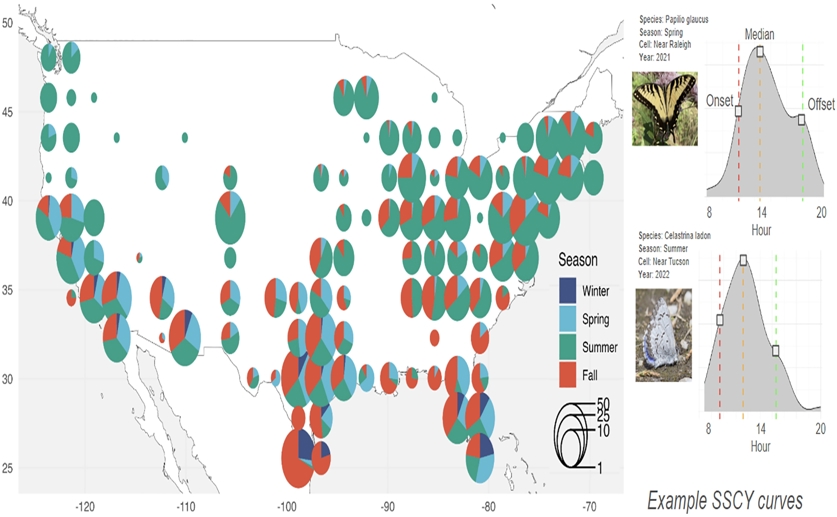
Spatial distribution of butterfly species-season-cell-year combinations across the contiguous United States, revealing a higher prevalence of activity in the south during fall and winter and in the north during summer, with urban areas exhibiting the most sampling effort and species richness.

Image adapted from: Idec et al. / CC BY (Source)

Key Findings

  • This study, across the US, used butterfly observations from citizen scientists to understand daily activity patterns
  • Both longer days and warmer temperatures increase how long butterflies are active each day, aligning with insect biology
  • Larger butterflies tend to be active later in the day, likely because their size offers some protection against overheating
Understanding when animals are active is crucial for understanding how they interact with their environment, and how they might cope with changes to it. This is particularly true for insects, which are highly sensitive to temperature and play vital roles in ecosystems. Determining the daily activity patterns – known as diel activity – of species has historically been difficult due to the sheer effort required to collect enough data. A recent study from researchers at the Florida Museum of Natural History[1] has overcome this challenge by utilizing a vast dataset of butterfly observations contributed by citizen scientists. The study focused on hundreds of butterfly species across the continental United States, analyzing data gathered through the iNaturalist platform. iNaturalist is a website and app where people can record their observations of nature, creating a massive, publicly available database. While valuable, data from platforms like iNaturalist can be affected by biases – for example, some areas are visited by observers more often than others. The researchers developed methods to account for these biases, ensuring the data accurately reflected butterfly activity rather than simply observer effort. The core question the study addressed was how factors like temperature, day length, and a butterfly’s size influence when and for how long it is active each day. Butterflies, being cold-blooded (ectothermic), rely on external sources of heat to regulate their body temperature. This means their activity is strongly linked to temperature. The researchers predicted that longer days and warmer temperatures would lead to longer periods of activity. They also hypothesized that smaller butterflies would be more affected by temperature fluctuations, needing to be more careful about avoiding extreme heat or cold. The analysis confirmed that both day length and temperature do indeed increase the duration of butterfly activity. This aligns with existing knowledge about insect phenology – the timing of life cycle events – and how it’s being altered by climate change[2]. Interestingly, the study also found that larger butterflies tend to be active later in the day, when temperatures are at their highest. This suggests a strategy where larger size provides some buffer against overheating, allowing them to exploit the warmest parts of the day. However, a surprising result was that body size didn’t interact with temperature sensitivity. This means that larger butterflies didn’t show a different response to temperature changes than smaller butterflies; both groups exhibited the same patterns regardless of the climate they lived in. This contrasts with some expectations, and suggests that thermoregulatory constraints related to body size may be less important than previously thought. This research builds upon earlier work highlighting the importance of understanding the internal biological clocks of insects[3]. That study, focusing on butterflies in a controlled environment, found a strong tendency for foraging to peak around solar noon, suggesting an endogenous (internally driven) rhythm. The current study expands on this by demonstrating how this internal rhythm interacts with external factors like temperature and day length across a much broader geographical scale. Furthermore, the findings resonate with research emphasizing individual variation in activity patterns[4]. While this study focused on species-level trends, acknowledging that individuals within a species may exhibit different behaviors is crucial. The observed patterns at the species level could be a result of averaging out these individual differences. The study also contributes to our understanding of how insects are responding to climate change, particularly in relation to the timing of their activity periods[5]. The finding that butterflies are extending their activity duration in response to warming temperatures is consistent with broader trends observed in insect phenology. However, the lack of interaction between body size and temperature sensitivity suggests that the response to warming may be more uniform across species than previously anticipated. The success of this study underscores the potential of “citizen science” – data collected by volunteers – for addressing large-scale ecological questions. By harnessing the power of iNaturalist, the researchers were able to analyze data that would have been impossible to collect through traditional research methods. This opens up exciting possibilities for future research, allowing scientists to investigate ecological patterns and processes at unprecedented scales.

WildlifeEcologyEvolution

References

Main Study

1) Using citizen science data to estimate trait and climate drivers of daily activity patterns in temperate butterflies

Published 21st November, 2025

https://doi.org/10.1371/journal.pone.0335856


Related Studies

2) Complex responses of insect phenology to climate change.

https://doi.org/10.1016/j.cois.2016.07.002


3) Butterfly foraging is remarkably synchronous in an experimental tropical macrocosm.

https://doi.org/10.1098/rsbl.2022.0555


4) A case for considering individual variation in diel activity patterns.

https://doi.org/10.1093/beheco/arx122


5) Climate drivers of adult insect activity are conditioned by life history traits.

https://doi.org/10.1111/ele.13889


Related Articles

An unhandled error has occurred. Reload 🗙