Blueberry bacteria show surprising diversity, offering clues for better farming

Jim Crocker
16th January, 2026

Blueberry bacteria show surprising diversity, offering clues for better farming

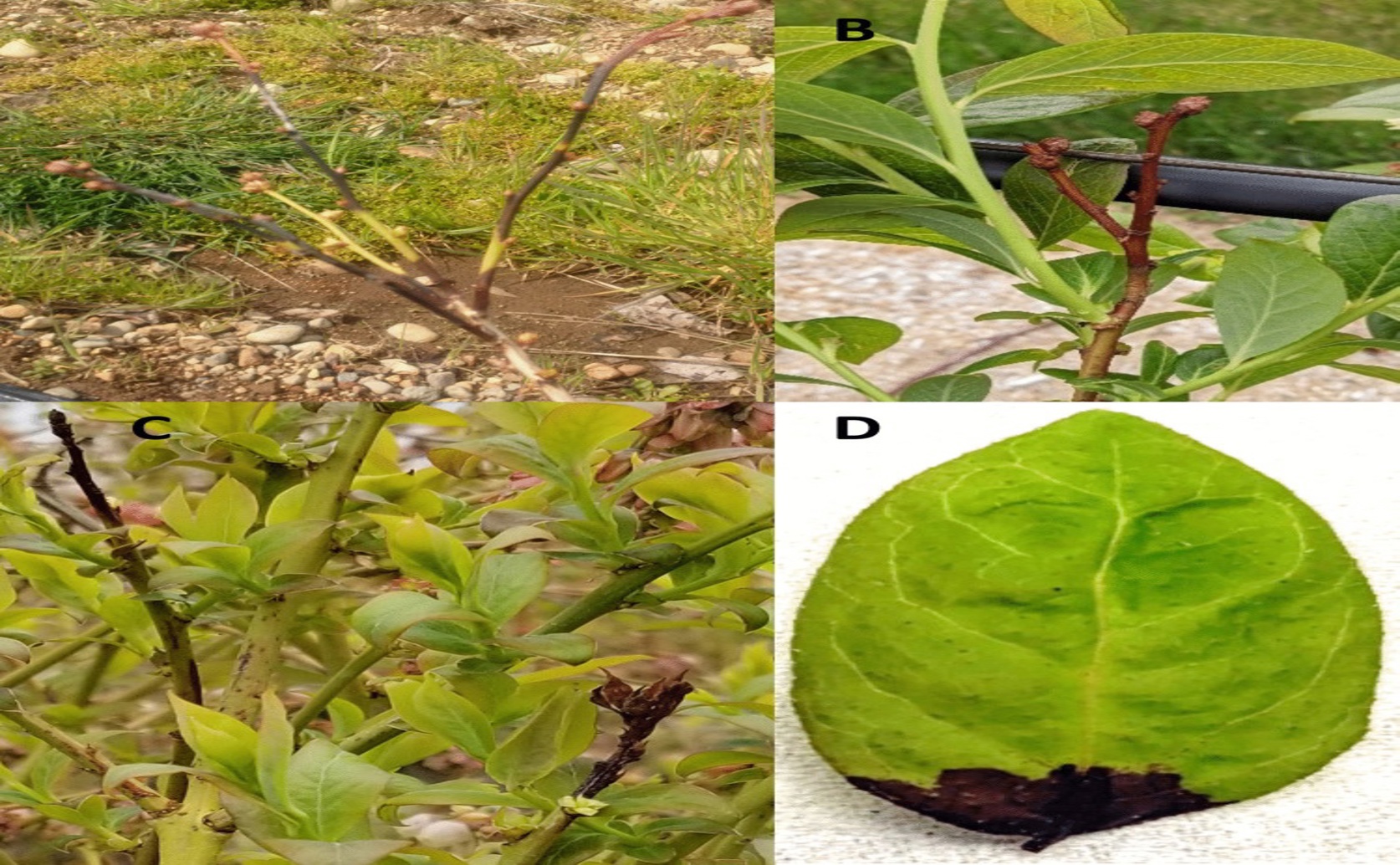
Bacterial blight on highbush blueberry (Vaccinium corymbosum) plants presents in the field as severe stem cankers and necrosis on buds and leaves (a–c), with the pathogenicity of the isolated Pseudomonas syringae complex confirmed by the formation of necrotic lesions on inoculated leaves (d).

Image adapted from: Latchman et al. / CC BY (Source)

Key Findings

  • Bacterial blight is widespread in British Columbia blueberry farms, affecting 88% of fields surveyed between 2017-2020
  • Researchers identified two new bacterial species, Pseudomonas avellanae and Pseudomonas viridiflava, contributing to blueberry blight
  • Genetic analysis revealed high diversity within the Pseudomonas populations infecting blueberry plants, varying by location and variety
Bacterial blight poses a significant threat to highbush blueberry production in Canada and the Pacific Northwest of the USA, causing economic losses for growers. While known to be caused by the Pseudomonas syringae complex (Psc), a comprehensive understanding of the specific strains involved and their distribution within the region was lacking. Researchers at Agriculture and Agri-Food Canada recently undertook a detailed survey to address this gap in knowledge[1]. The study involved collecting 380 strains of Pseudomonas bacteria from blueberry plants exhibiting symptoms of the disease across 32 fields in British Columbia. Initial screening using specific genetic markers identified 197 strains belonging to the P. syringae group. Further analysis, employing sequencing of four key genes, revealed a more complex picture than previously understood, identifying four distinct phylogenomic species – P. syringae, Pseudomonas avellanae, Pseudomonas viridiflava, and a phylogenomic species A. Importantly, P. avellanae and P. viridiflava were identified as new species contributing to bacterial blight in highbush blueberry. This finding expands upon earlier work characterizing the diversity within the P. syringae complex[2]. That study highlighted the numerous genetic lineages within the complex, extending beyond agricultural contexts to include strains from diverse environmental habitats. The researchers in[2] demonstrated the utility of analyzing the citrate synthase (cts) gene for rapid strain classification, a technique that could potentially be applied to further refine the identification of Psc species in blueberry production areas. The current study also revealed patterns in the distribution of these species across different geographical locations and blueberry varieties. Furthermore, genetic fingerprinting showed a remarkably high level of diversity within the Pseudomonas populations, varying not only between locations but also among different blueberry varieties and the identified phylogenomic species. Biochemical tests classified the majority of isolates as belonging to Pseudomonas Group Ia. The identification of P. avellanae and P. viridiflava as new pathogens associated with blueberry blight is a key contribution of this research. The narrow host range observed in studies of P. syringae pv. actinidiae phages[3] suggests that developing targeted biocontrol strategies, potentially using phages specific to these newly identified species, may be a viable approach to disease management. Similarly, understanding the genetic diversity within these populations, as highlighted in, is crucial for developing effective resistance strategies. The study's findings provide valuable information for improved disease diagnosis and the exploration of options for managing bacterial blight in highbush blueberry, including identifying potential sources of disease resistance within blueberry cultivars.

AgricultureGeneticsPlant Science

References

Main Study

1) Characterization and genetic diversity of pseudomonads population from highbush blueberry in western Canada

Published 12th January, 2026

https://doi.org/10.1007/s00253-025-13676-y


Related Studies

2) A user's guide to a data base of the diversity of Pseudomonas syringae and its application to classifying strains in this phylogenetic complex.

https://doi.org/10.1371/journal.pone.0105547


3) Identification of bacteriophages for biocontrol of the kiwifruit canker phytopathogen Pseudomonas syringae pv. actinidiae.

https://doi.org/10.1128/AEM.00062-14


Related Articles

An unhandled error has occurred. Reload 🗙