Bean root bacteria show surprising diversity with potential for improved growth

Jenn Hoskins
5th January, 2026

Bean root bacteria show surprising diversity with potential for improved growth

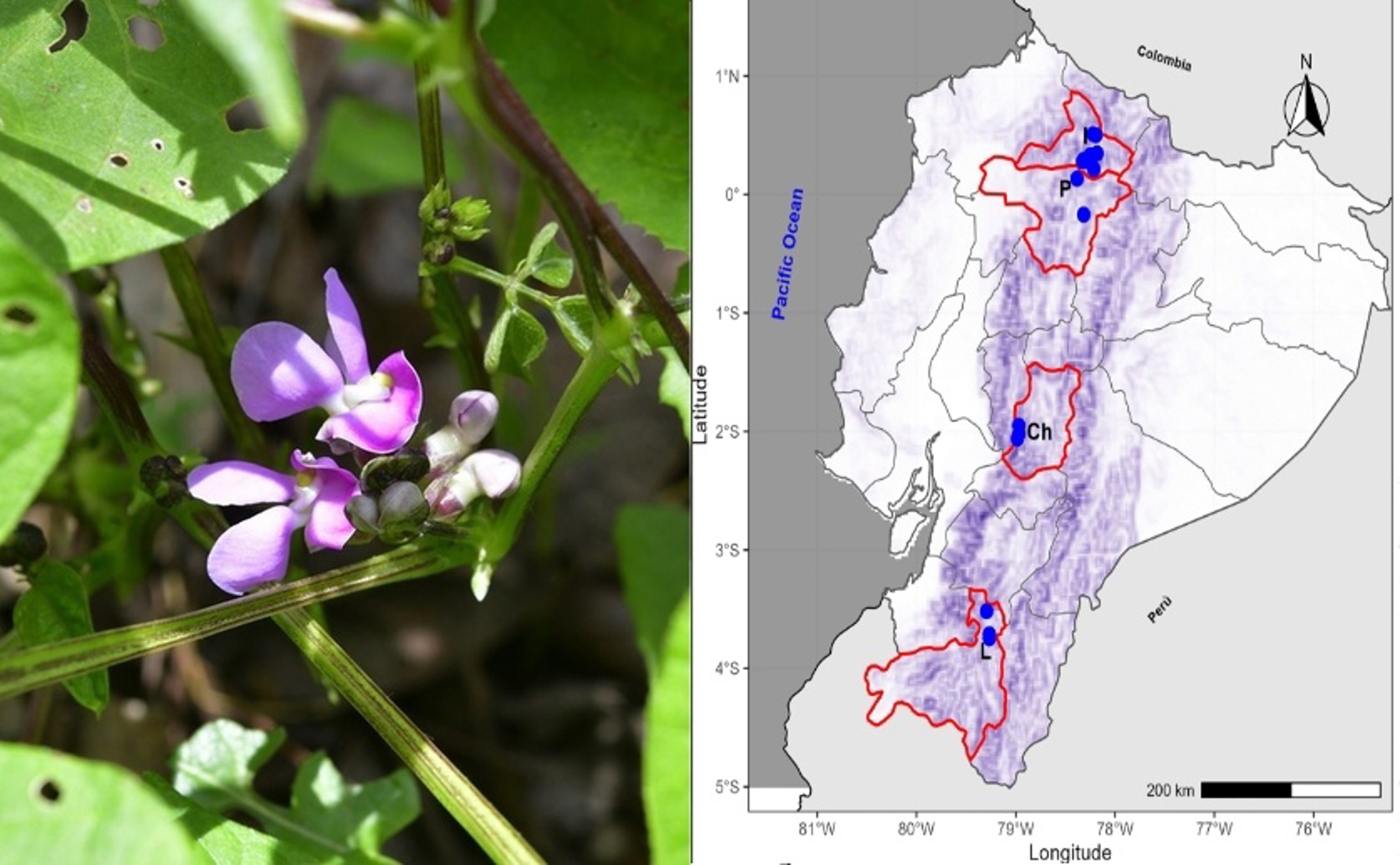
To investigate the geographic diversity of symbiotic bacteria in Ecuador, native Rhizobium were isolated from the Common bean (Phaseolus vulgaris) (shown left), with the study map (right) illustrating the specific sampling sites (blue dots) across a gradient of altitudes (purple shading) within the four Andean provinces sampled (red outlines).

Composite: Natural Science News / CC BY. [Sources]

Key Findings

  • This Ecuadorian Andean study identified diverse Rhizobium bacteria associated with common bean plants in Imbabura, Pichincha, Chimborazo, and Loja provinces
  • Analysis revealed four main Rhizobium clusters, with one (C1) closely related to the native species Rhizobium ecuadorense being most common in northern Ecuador
  • Several native Rhizobium strains induced significantly more root nodules on bean plants than a widely used commercial inoculant, suggesting potential for improved biofertilizers
Phaseolus vulgaris, the common bean, relies on bacteria from the genus Rhizobium to convert atmospheric nitrogen into a usable form for plant growth, a process called biological nitrogen fixation (BNF)[2]. While beans originated in the Americas and are now grown globally, the specific types of Rhizobium bacteria present in different regions, and how well they perform, are often not well understood. This knowledge is crucial for developing effective bioinoculants – essentially, natural fertilizers containing beneficial bacteria – to improve crop yields and reduce reliance on synthetic chemicals. Researchers at Universidad Central del Ecuador, along with collaborators from INIAP, investigated the native Rhizobium diversity in Ecuador’s Andean region[1]. Ecuador is considered a key area for bean diversification, yet its rhizobial populations remained largely uncharacterized. The study focused on collecting and analyzing Rhizobium strains from root nodules in four provinces: Imbabura, Pichincha, Chimborazo, and Loja. The team isolated 46 different Rhizobium strains from bean plants growing in these regions. To understand their relationships, they partially sequenced a gene called recA. This revealed nine distinct groups (R1-R9) falling into two main genetic lineages: one containing Rhizobium ecuadorense, Rhizobium leguminosarum, Rhizobium etli, and Rhizobium phaseoli; and the other consisting of R. tropici. Further analysis using multilocus sequence analysis (MLSA) – examining multiple housekeeping genes (recA, glnII, dnaK) from 19 representative isolates – refined these groupings into four phylogenetic clusters (C1-C4). The results showed clear geographic patterns. Cluster C1, related to R. ecuadorense, was most common in northern Ecuador. A distinct cluster, C2, was found specifically in Chimborazo province. Cluster C3 was sporadically present in Imbabura and Chimborazo, while cluster C4, related to R. tropici, was limited to the Amotape–Huancabamba Zone in Loja and exhibited unique characteristics. This suggests that different Rhizobium groups have adapted to specific environmental conditions within Ecuador. The ability of these native strains to fix nitrogen was tested in greenhouse experiments using two local bean varieties. All isolates were able to form nodules on both varieties, demonstrating their compatibility. Importantly, several of the native strains induced significantly more nodules than UMR1899, a commercially available inoculant containing Rhizobium tropici IIB CIAT 899T. This finding is significant because it indicates that locally adapted Rhizobium strains can be more effective at promoting plant growth than widely used commercial products. These findings build upon earlier research demonstrating the broad range of Rhizobium species capable of nodulating common beans[3]. While Rhizobium is the most common genus, species from Ensifer and Pararhizobium can also participate in the symbiosis, and even some from the beta-Proteobacteria have been observed[3]. The promiscuity of bean plants – their ability to nodulate with diverse Rhizobium types – highlights the potential for finding beneficial strains in various environments. Furthermore, the study complements work showing that rhizobia undergo significant physiological changes when living within root nodules[4], adapting to low oxygen levels and relying on carbon sources provided by the plant. The research also connects to the broader context of agricultural sustainability[2]. Modern agriculture often relies on synthetic nitrogen fertilizers, which can have negative environmental impacts. Utilizing BNF through effective bioinoculants offers a more sustainable alternative. The reduction in genetic diversity observed in domesticated beans[5] underscores the importance of preserving and utilizing diverse rhizobial populations to ensure long-term agricultural resilience. This study represents a step towards identifying and harnessing the potential of Ecuador’s native Rhizobium strains for improved bean production and soil health.

AgricultureGeneticsPlant Science

References

Main Study

1) Updating the description of Rhizobium diversity associated with common bean cultivars in the Ecuadorian Andes: A phylogenetic and functional perspective

Published 2nd January, 2026

https://doi.org/10.1371/journal.pone.0339774


Related Studies

2) Rhizobium as Biotechnological Tools for Green Solutions: An Environment-Friendly Approach for Sustainable Crop Production in the Modern Era of Climate Change.

https://doi.org/10.1007/s00284-023-03317-w


3) The promiscuity of Phaseolus vulgaris L. (common bean) for nodulation with rhizobia: a review.

https://doi.org/10.1007/s11274-020-02839-w


4) How Rhizobia Adapt to the Nodule Environment.

https://doi.org/10.1128/JB.00539-20


5) Molecular analysis of the parallel domestication of the common bean (Phaseolus vulgaris) in Mesoamerica and the Andes.

https://doi.org/10.1111/j.1469-8137.2012.04377.x


Related Articles

An unhandled error has occurred. Reload 🗙