Sweet potato’s wild relatives reveal genes key to stress response

Greg Howard
1st January, 2026

Sweet potato’s wild relatives reveal genes key to stress response

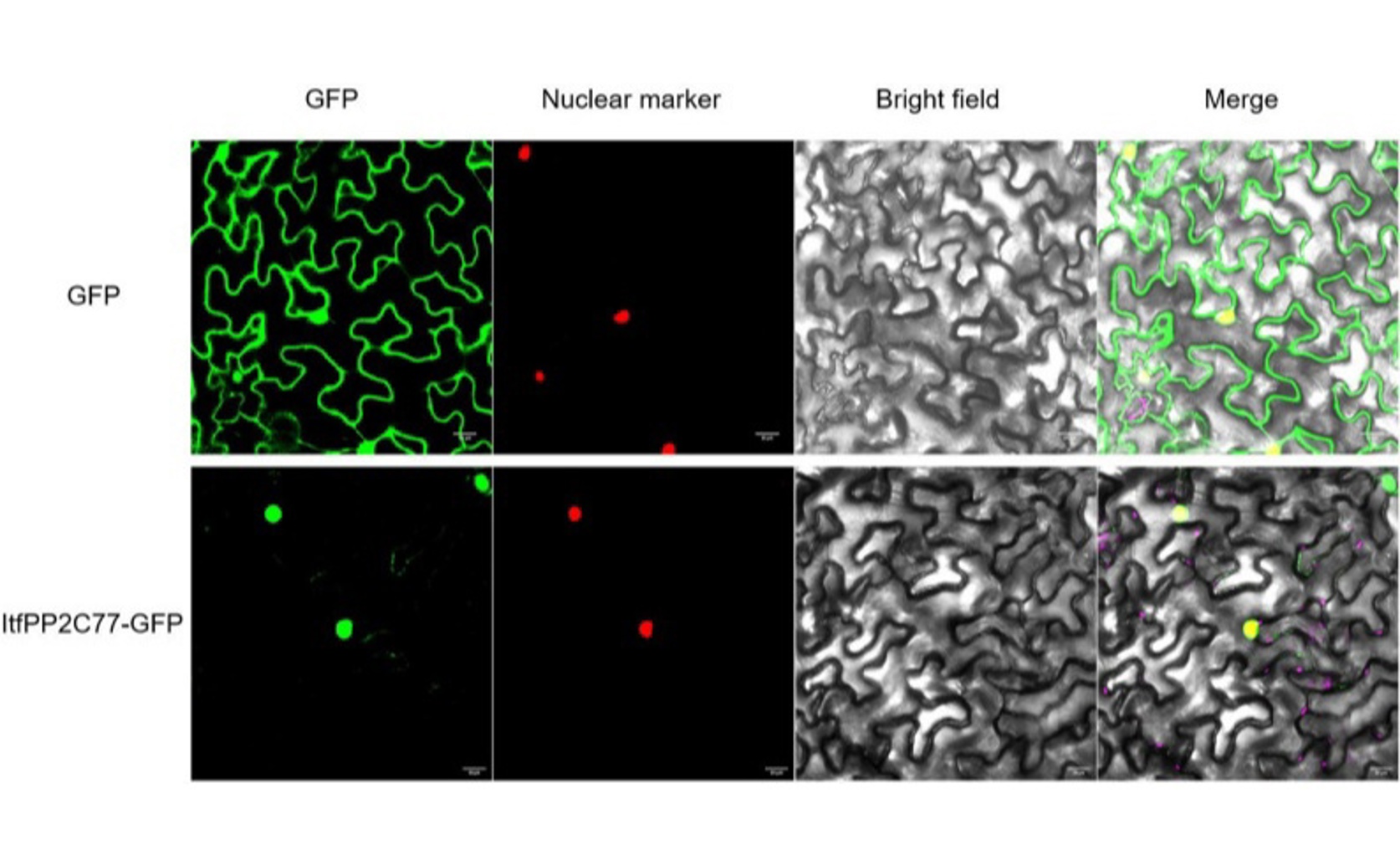
The key stress-responsive protein ItfPP2C77 is localized exclusively to the cell nucleus, supporting its predicted function in regulating stress-signaling pathways in Ipomoea trifida.

Image adapted from: Li et al. / CC BY (Source)

Key Findings

  • This study identified 91 PP2C genes in Ipomoea trifida, a wild sweet potato relative, providing a foundation for understanding stress response in this species
  • Several ItfPP2C genes, particularly ItfPP2C15, 16, 30, and 77, showed increased activity under drought conditions, suggesting a role in drought resistance
  • ItfPP2C30 and ItfPP2C77 are promising candidates for improving both drought and nematode resistance, potentially by interacting with key proteins in stress signaling pathways
Plant growth and survival depend on their ability to respond to environmental stresses like drought and pest attacks. A key part of this response involves a family of proteins called Protein Phosphatase 2C (PP2C) which act as regulators in plant signaling pathways[2]. However, in many important plant species, the specific roles of individual PP2C proteins aren't fully understood. This limits our ability to improve crop resilience through targeted breeding or genetic engineering. Researchers at the Cereal Crop Research Institute, Henan Academy of Agricultural Sciences, recently undertook a detailed investigation of PP2C genes in Ipomoea trifida, a wild relative of sweet potato[1]. This study aimed to identify all PP2C genes in this species, understand their evolutionary relationships, and predict their potential functions in stress responses. The team identified 91 PP2C genes, named ItfPP2C1 to ItfPP2C91, distributed across all 15 chromosomes of I. trifida. These genes were grouped into 13 subfamilies, with subfamilies E, A, and D being the largest. Further analysis of the genes’ structure and conserved motifs – essential building blocks of proteins – revealed patterns specific to each subfamily. A particular motif, motif 2, was consistently found across all genes, suggesting its importance for PP2C function. The researchers also examined the regions of DNA that control gene activity, called promoters. They found numerous “cis-acting elements” within these promoters, which are like switches that turn genes on or off in response to hormones and stress signals. This suggests that the PP2C genes are responsive to a variety of environmental cues. To get a sense of where these genes are active, the team looked at their expression levels in different tissues. Some genes were found to be active in all tissues examined, while others showed more specific patterns, indicating specialized roles in different parts of the plant. Crucially, the study investigated how PP2C gene expression changed under drought conditions. Most of the genes showed increased activity, with ItfPP2C15, 16, 30, and 77 (from subfamily A) exhibiting the most significant increases. This suggests these genes are likely key players in the plant’s drought response. Similarly, when the plant was exposed to stem nematode infection, the expression of ItfPP2C30, ItfPP2C77, and ItfPP2C89 differed between varieties that were resistant to the nematode and those that were susceptible. This points to a potential role for these genes in disease resistance. The gene ItfPP2C90 was particularly notable, showing a strong increase in activity in resistant varieties within 12 hours of infection. To understand how these PP2C proteins might function, the researchers used computational methods to predict which other proteins they interact with. This analysis highlighted potential interactions with ABA receptors (PYLs) and kinases (SnRK2s). This is significant because PP2Cs are known to be negative regulators of the ABA signaling pathway, a crucial system for responding to drought and other stresses[3]. The interaction with SnRK2s, which are protein kinases, further suggests a role in regulating the signaling cascade. This finding aligns with research showing that PP2Cs function by dephosphorylating proteins, effectively switching signaling pathways on or off[2]. The study also builds on previous work in cucumber[3] and eelgrass[4], both of which identified numerous PP2C genes and their responses to various stresses. Like these studies, the I. trifida research found a diverse PP2C gene family with tissue-specific expression patterns and stress-responsive genes. The eelgrass study, for example, also identified salt-responsive PP2C genes and predicted the involvement of the PYL-PP2C-SnRK2 signaling module, which was also observed in I. trifida. The identification of ItfPP2C30 and ItfPP2C77 as promising candidates for improving drought and nematode resistance is a significant outcome of this research. The predicted interactions with PYL and SnRK2 proteins provide a starting point for further investigation into their precise roles in stress-related signaling pathways.

AgricultureGeneticsPlant Science

References

Main Study

1) Genome-wide identification and functional characterization of PP2C genes in the wild relative of sweet potato Ipomoea trifida

Published 29th December, 2025

https://doi.org/10.1186/s12870-025-07764-4


Related Studies

2) Protein phosphatases and their targets: Comprehending the interactions in plant signaling pathways.

https://doi.org/10.1016/bs.apcsb.2022.11.003


3) Genome-wide identification and expression analysis of the cucumber PP2C gene family.

https://doi.org/10.1186/s12864-022-08734-y


4) Genome-Wide Identification and Expression Analysis of PP2C Gene Family in Eelgrass.

https://doi.org/10.3390/genes16060657


Related Articles

An unhandled error has occurred. Reload 🗙