Study finds how hillsides fail under added weight and pressure

Jenn Hoskins
7th January, 2026

Study finds how hillsides fail under added weight and pressure

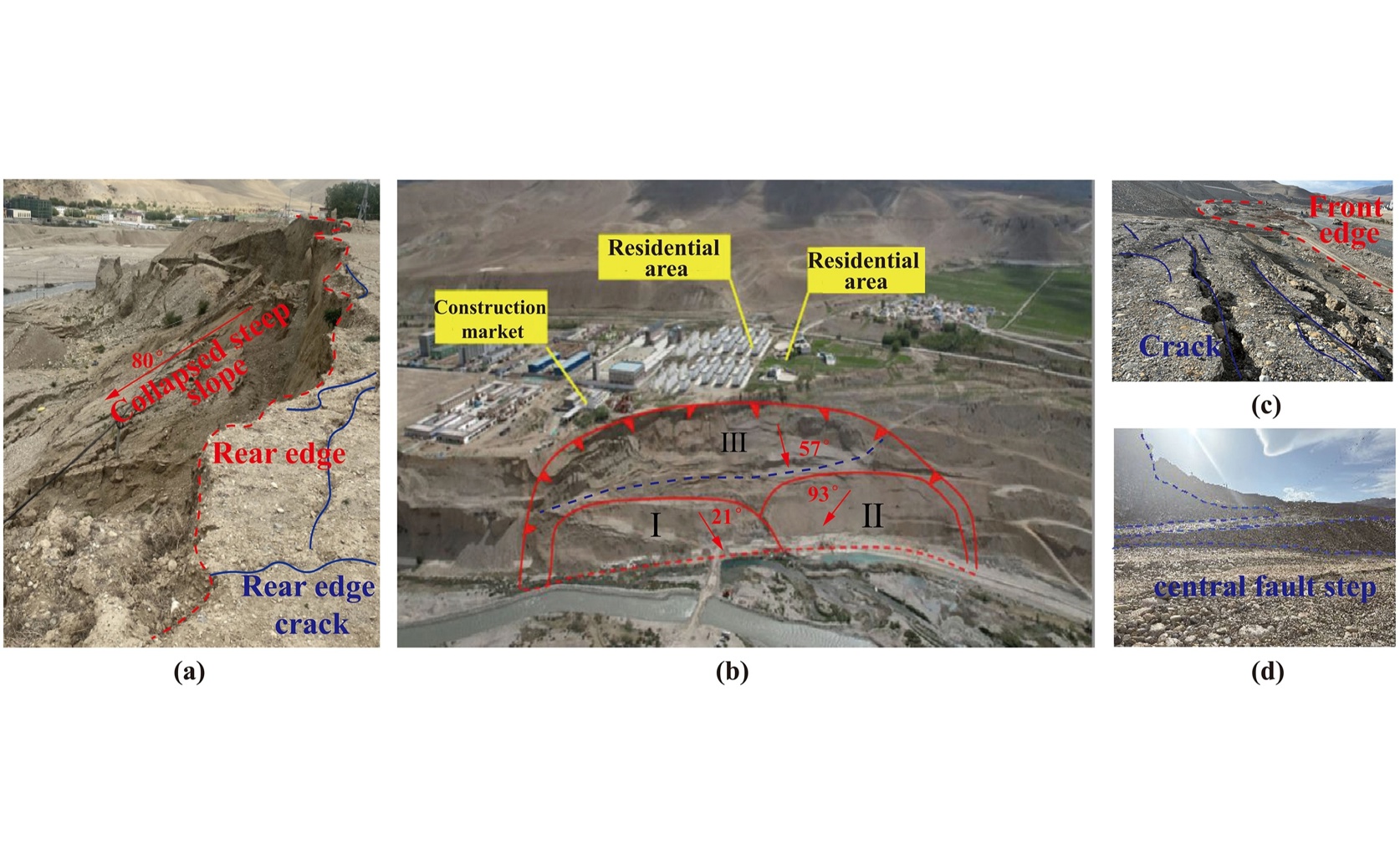
The studied colluvial slope exhibits key field characteristics of instability, including a rear-edge collapse scarp with unloading cracks (a), an overall bench-like structure (b), cracks at the toe boundary (c), and dense step-like scarps (d), which are real-world manifestations of the progressive failure mechanisms analyzed in this research.

Image adapted from: Zuan et al. / CC BY (Source)

Key Findings

  • This study, conducted in Tibet, investigated how colluvial slopes behave under heavy loads like construction, a common cause of landslides
  • Slopes don’t fail immediately under load; they go through stages of stabilization, cracking, sliding, and eventual overall failure
  • Monitoring cracks at the rear edge and bulging at the slope toe are key indicators of potential landslide hazards, suggesting early warning is possible
Landslides triggered by artificial loading, such as from construction or increased weight on slopes, are a significant hazard, particularly in areas with colluvial deposits – accumulations of loose rock and soil debris. Understanding how these slopes behave under load is crucial for predicting and preventing landslides. Researchers at Chengdu University of Technology and Jazan University[1] have recently conducted a study to investigate the mechanical response and failure processes of colluvial slopes subjected to large-scale loading, focusing on a typical colluvial slope in Tibet. The study utilized physical model tests, recreating a slope in a laboratory setting, alongside computer simulations using FLAC3D software. A key challenge in these types of studies is accurately representing the real-world soil material. To overcome this, the researchers developed an analogous material using a mixture of river sand, barite powder, calcium carbonate powder, and water. Establishing the correct proportions of this mixture is vital; the strength characteristics of the material – specifically cohesion and internal friction angle – directly impact the model’s accuracy. They employed multiple regression analysis to create equations that predict these characteristics based on the mix ratios, achieving a high level of similarity between the model material and natural colluvial soil (Ra2 values of 0.8732–0.9326). This approach builds upon previous work in creating similar materials for geotechnical testing. For example, studies have demonstrated the feasibility of using cement-gypsum bonded materials with bentonite as a water-sensitive regulator to simulate rock-like materials that degrade with water exposure[2]. Similarly, other research has focused on formulating coal system rocky similar materials using yellow sand, heavy calcium carbonate, cement, and gypsum[3][4]. These earlier studies highlight the importance of carefully selecting and mixing materials to replicate the desired mechanical properties of natural soils and rocks. The research team’s focus on barite powder and calcium carbonate, combined with river sand, appears to be tailored to the specific characteristics of the Tibetan colluvial slope they were modelling. The physical model tests revealed that under loading, the slope experienced maximum vertical and horizontal displacements of 40mm and 50mm respectively. Stress measurements showed that shear stress (stress caused by forces acting parallel to a surface) concentrated along the loading boundary, while vertical stress penetrated deeper into the slope than horizontal stress. Importantly, the slope didn’t fail all at once; it underwent a progressive failure process. This process unfolded in several stages: initial stabilization under the load, followed by cracking at the rear edge of the slope, sliding of the upper soil mass, extrusion and bulging at the front edge, propagation of the sliding surface, and ultimately, overall failure. This progressive failure is a critical observation, as it suggests opportunities for early detection of potential landslides. The researchers also noted a pronounced “failure sensitivity” in the colluvial slope under loading. This meant that certain features – rear-edge tensile cracking, toe bulging, and the formation of deep shear bands (zones of concentrated deformation within the soil) – were particularly indicative of impending failure. These features, they suggest, should be closely monitored in real-world slopes to identify potential landslide hazards. The findings from clarify the typical failure mechanisms of accumulation-body slopes, providing a scientific basis for early landslide identification and hazard mitigation strategies. This research expands on previous work in similar material development[2][3][4][5] by focusing on a specific geological context – Tibetan colluvial slopes – and identifying key indicators of progressive failure that can be used for monitoring and risk assessment.

AgricultureEnvironmentEcology

References

Main Study

1) Mechanisms of deformation and failure in colluvial slope under artificial surcharge loading

Published 5th January, 2026

https://doi.org/10.1371/journal.pone.0339772


Related Studies

2) Experimental study on the reasonable proportions of rock-like materials for water-induced strength degradation in rock slope model test.

https://doi.org/10.1038/s41598-023-36511-8


3) Study on Proportioning Scheme of Coal System Rocky Similar Material Based on Orthogonal Test.

https://doi.org/10.3390/ma16227113


4) New Type of Similar Material for Simulating the Processes of Water Inrush from Roof Bed Separation.

https://doi.org/10.1021/acsomega.0c03535


5) Evaluating the slope behavior for geophysical flow prediction with advanced machine learning combinations.

https://doi.org/10.1038/s41598-025-90882-8


Related Articles

An unhandled error has occurred. Reload 🗙