Smart parrots can learn to trade rewards based on their weight

Jim Crocker
23rd December, 2025

Smart parrots can learn to trade rewards based on their weight

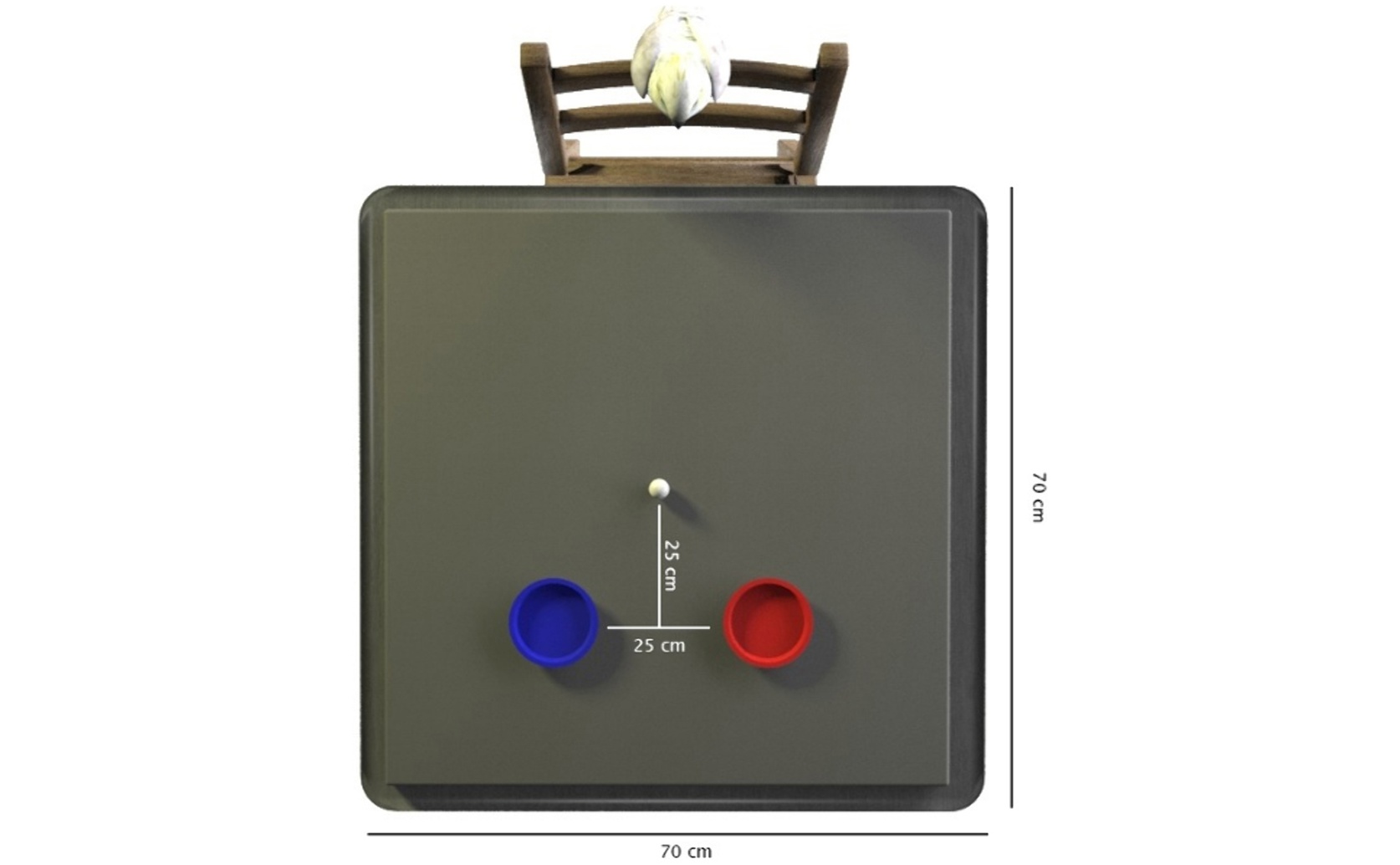
In the experimental setup for the conditional discrimination task, a Goffin's cockatoo (Cacatua goffiniana) was required to place a single weighted object into one of two colored trays.

Image adapted from: Lambert et al. / CC BY (Source)

Key Findings

  • This study, conducted with Goffin’s cockatoos, investigated their ability to sort objects by weight, a skill previously shown to be relatively easy for them
  • Unlike their success in a simpler weight discrimination task, the cockatoos did not perform above chance levels in this more complex conditional discrimination task
  • The difficulty of the task suggests conditional discriminations require more cognitive effort than simple discriminations, a finding consistent with results from chimpanzee studies
Discrimination learning – the ability to tell things apart – is a fundamental cognitive skill used by animals to navigate their environment. Researchers at the University of Veterinary Medicine Vienna and the University of Tuscia recently investigated this ability in Goffin’s cockatoos, focusing on how they learn to differentiate objects based on weight[1]. This research stemmed from an earlier observation: Goffin’s cockatoos appeared remarkably adept at weight discrimination in a straightforward task, even exceeding the performance of some primates. However, it wasn’t clear whether this success was due to an inherent cognitive advantage in cockatoos, or simply a result of the specific way the initial experiment was designed. The core issue is that there are different types of discrimination tasks, varying in complexity. A ‘simple discrimination’ involves learning to associate a single stimulus with a reward. A ‘conditional discrimination’, however, requires learning two associations: stimulus A leads to reward X, and stimulus B leads to reward Y. Conditional discriminations are generally considered more challenging, demanding more cognitive resources. To address this, the researchers designed a weight-based conditional discrimination task for a group of Goffin’s cockatoos. The task required the birds to associate heavier objects with one reward and lighter objects with another. This task was intentionally similar to one previously used with chimpanzees[2]. In that earlier study, chimpanzees struggled with auditory discrimination tasks, performing better with visual cues, and the conditional position discrimination task proved particularly difficult, taking them a considerable number of trials to learn. The results of the current study were striking. Unlike the earlier simple discrimination experiment with Goffin’s cockatoos, none of the birds achieved above-chance levels of performance in the conditional discrimination task. This contrasted sharply with the chimpanzees’ performance in their first 15 sessions of a similar task[2]. The researchers interpret this as evidence that conditional discriminations are indeed more cognitively demanding than simple discriminations. This finding doesn't necessarily mean that cockatoos are less intelligent than primates when it comes to weight discrimination. Instead, it suggests that the type of task plays a crucial role. The initial success of the cockatoos might have been due to the relative simplicity of the original experiment, which didn't require the complex associative learning needed for a conditional discrimination. This aligns with observations from other species, such as pigs, where active-choice tasks (similar to conditional discriminations) yield clearer results than those relying on latency measurements[3]. Interestingly, a study on sticklebacks demonstrated that populations of the same species can learn different cues faster depending on their local ecology[4]. While not directly applicable to the cockatoo study, it highlights the importance of considering the environmental context and potential pre-existing biases in learning. Furthermore, research on bonobos, gorillas, and orangutans revealed that apes learn color discrimination faster than weight discrimination[5]. This suggests that visual discrimination is generally easier for these primates, which could explain the chimpanzees’ better performance in visual tasks[2]. The cockatoo study, however, focused specifically on weight discrimination, and the researchers acknowledge the need for further investigation using simpler discrimination formats to fully understand the birds’ capabilities. The researchers emphasize that more research is needed, particularly using the simpler discrimination setups that initially demonstrated the cockatoos’ aptitude for weight discrimination. This will help determine whether the observed difference in performance is due to a genuine cognitive difference between birds and primates, or simply a methodological artifact.

WildlifeAnimal ScienceEvolution

References

Main Study

1) Testing weight-based conditional discrimination in Goffin’s cockatoos, Cacatua goffiniana

Published 19th December, 2025

https://doi.org/10.1371/journal.pone.0338604


Related Studies

2) Visual and auditory conditional position discrimination in chimpanzees (Pan troglodytes).

https://doi.org/10.1016/j.beproc.2009.03.010


3) Successive and conditional discrimination learning in pigs.

https://doi.org/10.1007/s10071-013-0621-3


4) Intraspecific variation in cue-specific learning in sticklebacks.

https://doi.org/10.1016/j.anbehav.2018.01.003


5) Great apes' performance in discriminating weight and achromatic color.

https://doi.org/10.1007/s10071-009-0216-1


Related Articles

An unhandled error has occurred. Reload 🗙