New material boosts light-based water purification efficiency

Jim Crocker
10th December, 2025

New material boosts light-based water purification efficiency

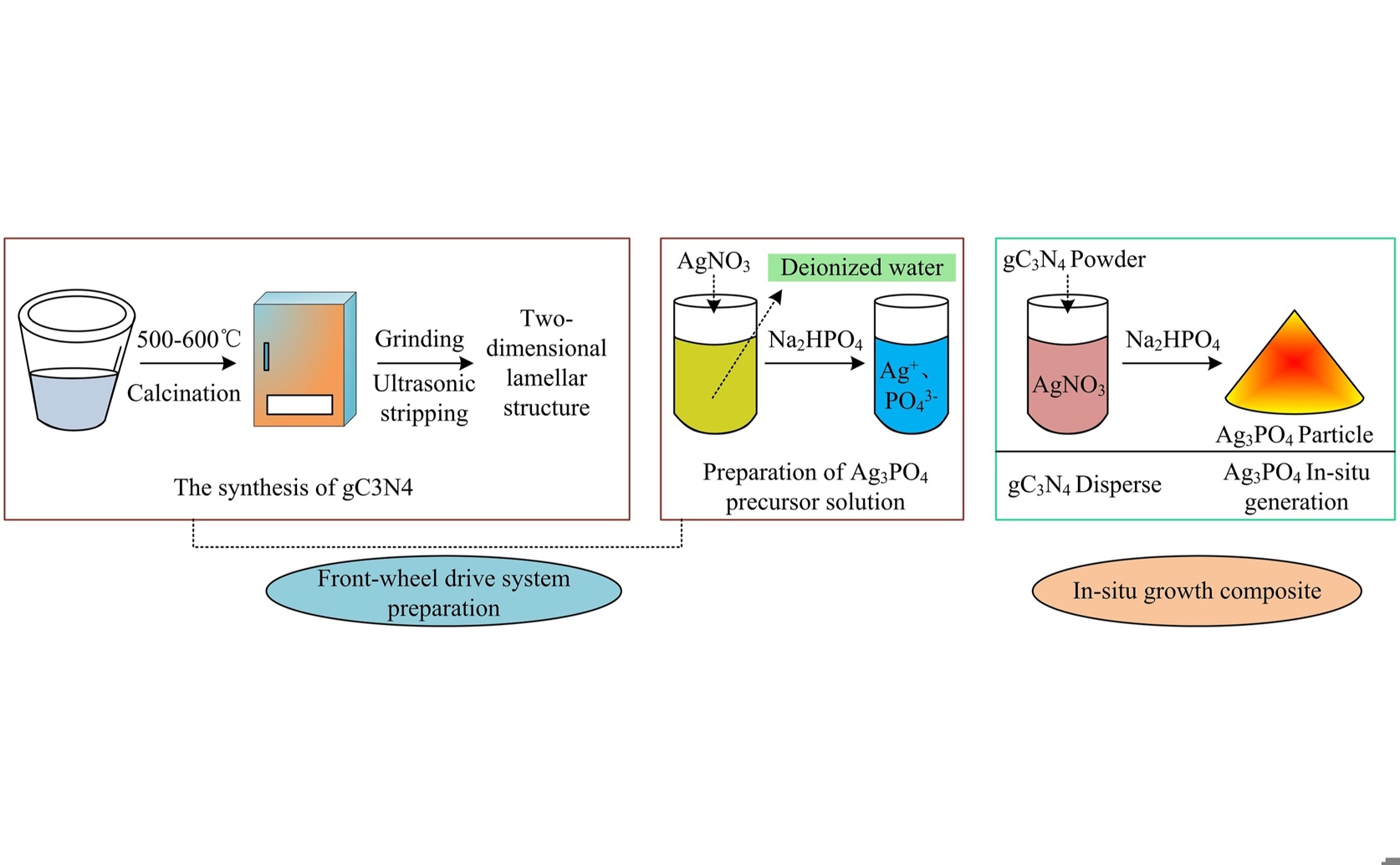
The Ag3PO4/g-C3N4 photocatalyst is fabricated via an in-situ growth method where silver phosphate nanocrystals are precipitated directly onto graphitic carbon nitride nanosheets to create a tightly bonded heterojunction.

Image adapted from: Wen et al. / CC BY (Source)

Key Findings

  • Researchers in China developed a new photocatalyst material, Ag3PO4/g-C3N4, to efficiently break down pollutants in water
  • This material combines silver phosphate and graphitic carbon nitride with a strong connection between them, improving charge separation and pollutant degradation
  • The new fabrication method, called in-situ growth, creates a more stable and effective photocatalyst than previous methods, degrading pollutants like methylene blue within 15 minutes
Photocatalysis, the acceleration of chemical reactions using light, is a promising technology for environmental remediation, particularly in water purification. A major challenge in this field is developing materials that can efficiently capture light and convert that energy into the breakdown of pollutants. Traditional photocatalysts often suffer from limitations like rapid recombination of light-generated charges, reducing their overall effectiveness. Researchers at Henan Finance University, Zhengzhou University, and the University of Cagliari[1] have addressed these issues with a novel approach to creating a highly effective photocatalyst. The team focused on building a heterojunction – a structure combining two different semiconductor materials – composed of silver phosphate (Ag3PO4) and graphitic carbon nitride (g-C3N4). Existing methods for creating these heterojunctions frequently involve complicated procedures and result in weak connections between the materials, hindering performance. To overcome this, the researchers developed a process of in-situ growth, meaning the Ag3PO4 formed directly on the surface of the g-C3N4 during the fabrication process. This resulted in an “atomic-level tight interfacial bonding” between the two components. This strong bonding is crucial because it facilitates the efficient transfer of charges between the two materials. When light strikes the heterojunction, it generates electrons and “holes” – positively charged vacancies – within both Ag3PO4 and g-C3N4. The researchers found that the way these materials are arranged creates an internal electric field, driving the movement of electrons from the conduction band of g-C3N4 to the valence band of Ag3PO4. This process is a key component of what’s known as a Z-scheme heterojunction, where the charge separation is enhanced, reducing the likelihood of those charges recombining and being lost as heat. To demonstrate the effectiveness of their approach, the team tested the photocatalyst’s ability to degrade two common pollutants: methylene blue (MB) and rhodamine B (RhB). The results were striking. The Ag3PO4/g-C3N4 heterojunction completely degraded MB within just 15 minutes, even without the addition of any “scavengers” – chemicals often used to accelerate the reaction by trapping certain reactive species. In contrast, a similar composite material using titanium carbide (Ti3C2) instead of Ag3PO4 took 50 minutes to achieve 98% degradation of MB. For RhB, the Ag3PO4/g-C3N4 heterojunction reached over 96% degradation in 62 minutes, while the Ti3C2/g-C3N4 composite only achieved 63% degradation in a significantly longer 133 minutes. Further analysis revealed the underlying reasons for this improved performance. Graphitic carbon nitride, on its own, exhibits strong fluorescence when exposed to light, indicating that much of the energy is lost through rapid recombination of photogenerated electrons. The heterojunction structure effectively suppressed this recombination, channeling the energy towards the degradation of pollutants. The stability of the materials was also assessed, and the Ag3PO4/g-C3N4 composite showed a significantly lower weight loss rate at high temperatures compared to the Ti3C2/g-C3N4 composite, suggesting it is more robust. These findings build upon earlier research demonstrating the benefits of combining materials with complementary properties to enhance photocatalytic activity[2]. For instance, studies have shown that coupling black phosphorus nanosheets with BiOBr nanosheets, creating a layered nano-heterojunction, improves charge separation and boosts the production of reactive oxygen species, leading to more efficient pollutant degradation. The success of the Ag3PO4/g-C3N4 heterojunction, however, lies in the in-situ growth method, which creates a much stronger interface than previously achieved, and the resulting atomic-level bonding. This approach provides a promising pathway for designing more efficient and durable Z-scheme heterojunction photocatalysts for a variety of environmental applications.

EnvironmentBiotechBiochem

References

Main Study

1) Fabrication of Ag3PO4/g-C3N4 heterojunction photocatalyst via in-situ growth and its photocatalytic performance

Published 9th December, 2025

https://doi.org/10.1371/journal.pone.0337123


Related Studies

2) Novel BP/BiOBr S-scheme nano-heterojunction for enhanced visible-light photocatalytic tetracycline removal and oxygen evolution activity.

https://doi.org/10.1016/j.jhazmat.2019.121690


Related Articles

An unhandled error has occurred. Reload 🗙