Enzymes from heat-loving bacteria can break down biodegradable plastics

Jenn Hoskins
18th November, 2025

Enzymes from heat-loving bacteria can break down biodegradable plastics

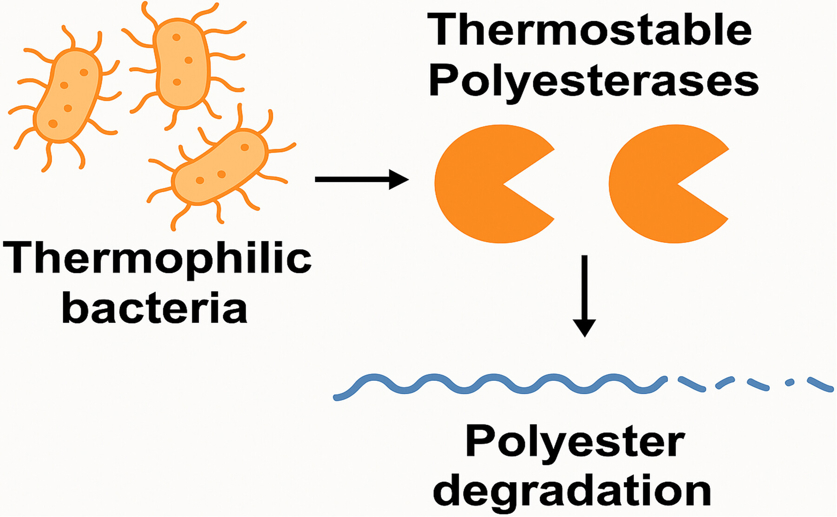
Main study highlights that there is a broader diversity of enzymes with polyester depolymerase activity to be discovered from nature, beyond the well-known PETases.

Image adapted from: Hafna et al. / CC BY (Source)

Key Findings

  • This study, conducted by CSIRO Environment, identified new enzymes from bacteria capable of breaking down plastics
  • These enzymes effectively degrade PBAT and PBSA plastics, commonly used in compostable bags and food packaging, but show limited ability to break down PET
  • The discovered enzymes are naturally heat-stable, potentially reducing the need for costly engineering to make them suitable for industrial recycling processes
The global accumulation of plastic waste presents a significant environmental challenge. Traditional plastics, particularly polyesters, are slow to break down, leading to pollution and ecosystem damage. Finding effective ways to recycle these plastics is therefore crucial. One promising approach involves using enzymes – biological molecules that can speed up chemical reactions – to break down plastics into their building blocks, allowing them to be reused. Current research in this area has largely focused on enzymes that degrade polyethylene terephthalate (PET), a common plastic used in bottles and packaging. Researchers at CSIRO Environment[1] have been investigating a different avenue: exploring a family of enzymes called Lipase Family 1.5 for their ability to degrade other types of polyesters. These enzymes are related to those previously found in bacteria like Clostridium botulinum and Pelosinus fermentans that can break down polybutylene succinate co-terephthalate (PBAT), a biodegradable plastic often used in films and compostable bags. The team hypothesized that within this enzyme family, there might be undiscovered enzymes with useful properties for industrial plastic recycling. The study began with a comprehensive analysis of the genetic sequences of esterases – enzymes that break down ester bonds, common in polyesters – from various thermophilic bacteria, meaning bacteria that thrive in high temperatures. This approach builds on earlier work that demonstrated the power of sequence analysis for identifying and understanding the function of proteins[2]. By comparing the genetic information, researchers can identify enzymes with similar structures and, potentially, similar functions. This is particularly useful when dealing with a large number of potential candidates, as it allows for a focused screening process. The researchers successfully identified several previously uncharacterized enzymes from this family and were able to produce them in the laboratory using Escherichia coli bacteria. They then tested these enzymes to see if they could break down PBAT and two other polyesters: polybutylene succinate co-butylene adipate (PBSA) and PET. The results showed that while the enzymes had limited ability to degrade PET, they were effective at breaking down PBAT and, surprisingly, even more effective at degrading PBSA. Specifically, three of the enzymes completely dissolved 5 milligrams of PBSA per milliliter of solution within two days, using a very low concentration of enzyme (100 nanomoles). This is a significant finding because PBSA is a plastic increasingly used in food packaging and other applications. The enzymes’ ability to function effectively at low concentrations is also important for potential industrial applications, as it reduces costs. A key advantage of these newly discovered enzymes is their origin from thermophilic bacteria. This means they are naturally stable at high temperatures, a crucial requirement for many industrial recycling processes. Traditionally, enzymes often require “protein engineering” – modifying their structure to improve their stability and activity – to make them suitable for industrial use. However, these enzymes already possess the necessary thermal stability, potentially reducing the need for costly and time-consuming engineering processes. The study highlights the potential of exploring diverse bacterial sources for novel enzymes with industrial applications[3]. The ability to rapidly compare sequences, as facilitated by tools like BLAST[2], allows researchers to efficiently identify promising candidates for further investigation. Furthermore, the use of sequence similarity networks[4] could be employed to visualize relationships within the Lipase Family 1.5, potentially revealing further insights into enzyme function and identifying even more effective polyester-degrading enzymes.

EnvironmentBiotechBiochem

References

Main Study

1) Thermostable Bacterial Esterases From Lipase Family 1.5 Degrade Compostable Polyesters PBAT and PBSA

Published 14th November, 2025

https://doi.org/10.1002/mbo3.70144


Related Studies

2) Basic local alignment search tool.

Journal: Journal of molecular biology, Issue: Vol 215, Issue 3, Oct 1990


3) The radiophiles of Deinococcaceae family: Resourceful microbes for innovative biotechnological applications.

https://doi.org/10.1016/j.crmicr.2022.100153


4) Using sequence similarity networks for visualization of relationships across diverse protein superfamilies.

https://doi.org/10.1371/journal.pone.0004345


Related Articles

An unhandled error has occurred. Reload 🗙