How farm dogs behave around different animals and people

Jim Crocker
29th November, 2025

How farm dogs behave around different animals and people

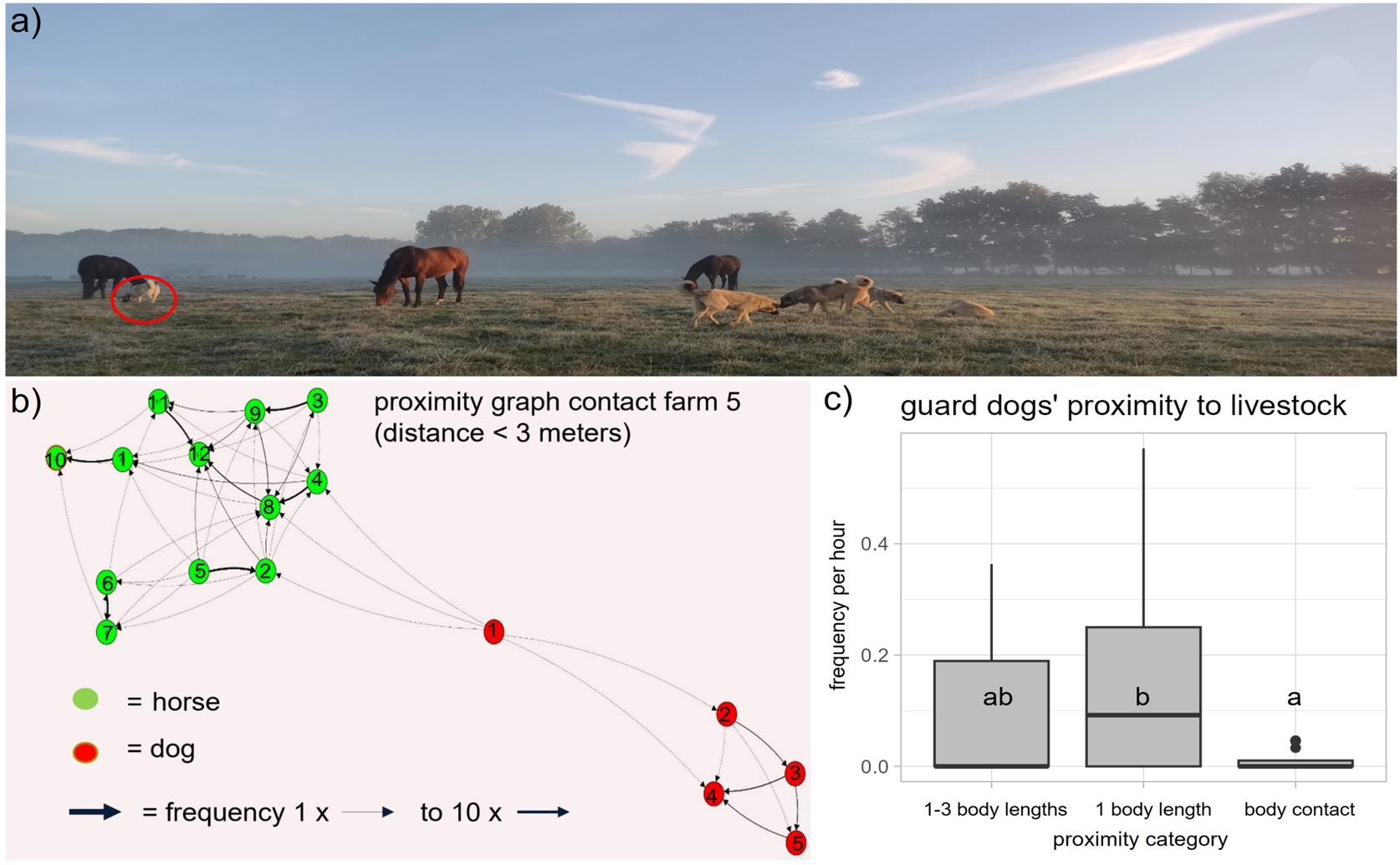
Guard dogs maintain a close but safe protective distance from livestock, as they were observed to stay preferentially within one body length of goats and horses rather than in direct physical contact (a–c).

Image adapted from: Krueger et al. / CC BY (Source)

Key Findings

  • In Germany, guard dogs effectively protect livestock—goats and horses—by staying close, typically within one animal’s length
  • Guard dogs generally displayed friendly behaviour towards farm personnel and cautious, dominant stances towards strangers and other dogs, ensuring both protection and safety
  • Older, experienced dogs and those in mixed-sex groups proved most effective at monitoring for threats, highlighting the importance of training and social dynamics
The return of large predators to Europe presents challenges for agriculture, particularly livestock farming. While conservation efforts have successfully increased populations of species like wolves, lynx, and bears[2], this resurgence can lead to conflict with human interests, specifically livestock depredation. Traditional methods of predator control can be controversial, prompting a search for non-lethal alternatives. One such approach is the use of livestock guard dogs. A recent study by researchers at Nuertingen-Geislingen University[1] investigated the effectiveness and management of guard dogs on farms across Germany. The research focused on understanding how these dogs interact with livestock – specifically goats and horses – and people, in areas with frequent public access. The study addressed a gap in knowledge regarding the practical application of guard dogs in a modern, human-dominated landscape. Farmers in Germany have begun employing these dogs, but faced initial resistance from the public unfamiliar with this preventative measure. The study employed a two-pronged approach. Firstly, researchers directly observed the behaviour of 113 guard dogs while they interacted with goats and horses. Secondly, they collected reports from students of equine science and agriculture, as well as official herd management commissioners, during their farm visits. These individuals, trained in animal behaviour observation, documented their experiences with the guard dogs, including their behaviour and details about farm management practices. The findings revealed that guard dogs readily adapt to protecting a variety of livestock species. They consistently positioned themselves close to goats and horses, typically within one animal body length, demonstrating a protective vigilance. Importantly, the dogs displayed appropriate behaviour towards different individuals: friendliness towards farm owners and familiar people, and a more dominant, watchful stance towards strangers and other dogs. This differentiation is crucial for ensuring both effective protection and public safety. The study also highlighted the importance of training and socialization. Older dogs, and those kept in mixed-sex groups, were particularly effective at monitoring for external threats. This suggests that experience and social dynamics within the guard dog group contribute to their protective capabilities. The success of the farmers’ training methods indicates that guard dogs can be successfully integrated into farm management systems. These findings build upon earlier research demonstrating a general trend of increasing large carnivore populations in Europe[2]. However, as populations recover, conflicts with humans inevitably arise, as highlighted in studies on attitudes towards wolves[3]. The research suggests that proactive, non-lethal methods, like the use of guard dogs, can mitigate these conflicts. While[3] points to negative attitudes towards wolves in areas where they have historically existed, the implementation of effective preventative measures could potentially improve public perception by reducing livestock losses. Furthermore, the study indirectly addresses the broader context of human-wildlife coexistence. The successful integration of guard dogs into German farms demonstrates that it is possible for humans and predators to share landscapes, a point emphasized by the conservation success stories of large carnivores in Europe[2]. The study by Nuertingen-Geislingen University provides practical insights into how this coexistence can be achieved at a local level, offering a valuable tool for farmers and a potential pathway towards reducing conflict.

AgricultureEcologyAnimal Science

References

Main Study

1) Guard dog behaviour (Canis lupus familiaris) towards various animal species and humans on farms in Germany

Published 25th November, 2025

https://doi.org/10.1371/journal.pone.0337432


Related Studies

2) Recovery of large carnivores in Europe's modern human-dominated landscapes.

https://doi.org/10.1126/science.1257553


3) Living with wolves: A worldwide systematic review of attitudes.

https://doi.org/10.1007/s13280-024-02036-1


Related Articles

An unhandled error has occurred. Reload 🗙