Enzyme controls key step in bacterial metabolism and response to nutrients

Greg Howard
26th November, 2025

Enzyme controls key step in bacterial metabolism and response to nutrients

The study identifies NagS as a novel enzyme that senses N-acetylglucosamine-6-phosphate, triggering a metabolic pathway regulating development and antibiotic production in Streptomyces bacteria.

Image adapted from: Li et al. / CC BY (Source)

Key Findings

  • Streptomyces bacteria, known for antibiotic production, utilize a previously unknown pathway involving the enzyme NagS to sense the sugar GlcNAc
  • NagS converts GlcNAc-6P into a toxic byproduct, 6P-chromogen I, which is further processed into a compound resembling ribose, potentially disrupting nucleic acid synthesis
  • This toxicity pathway, regulated by NagS and NagA, appears crucial for coordinating bacterial development and initiating antibiotic production by selectively allowing tolerant cells to proceed
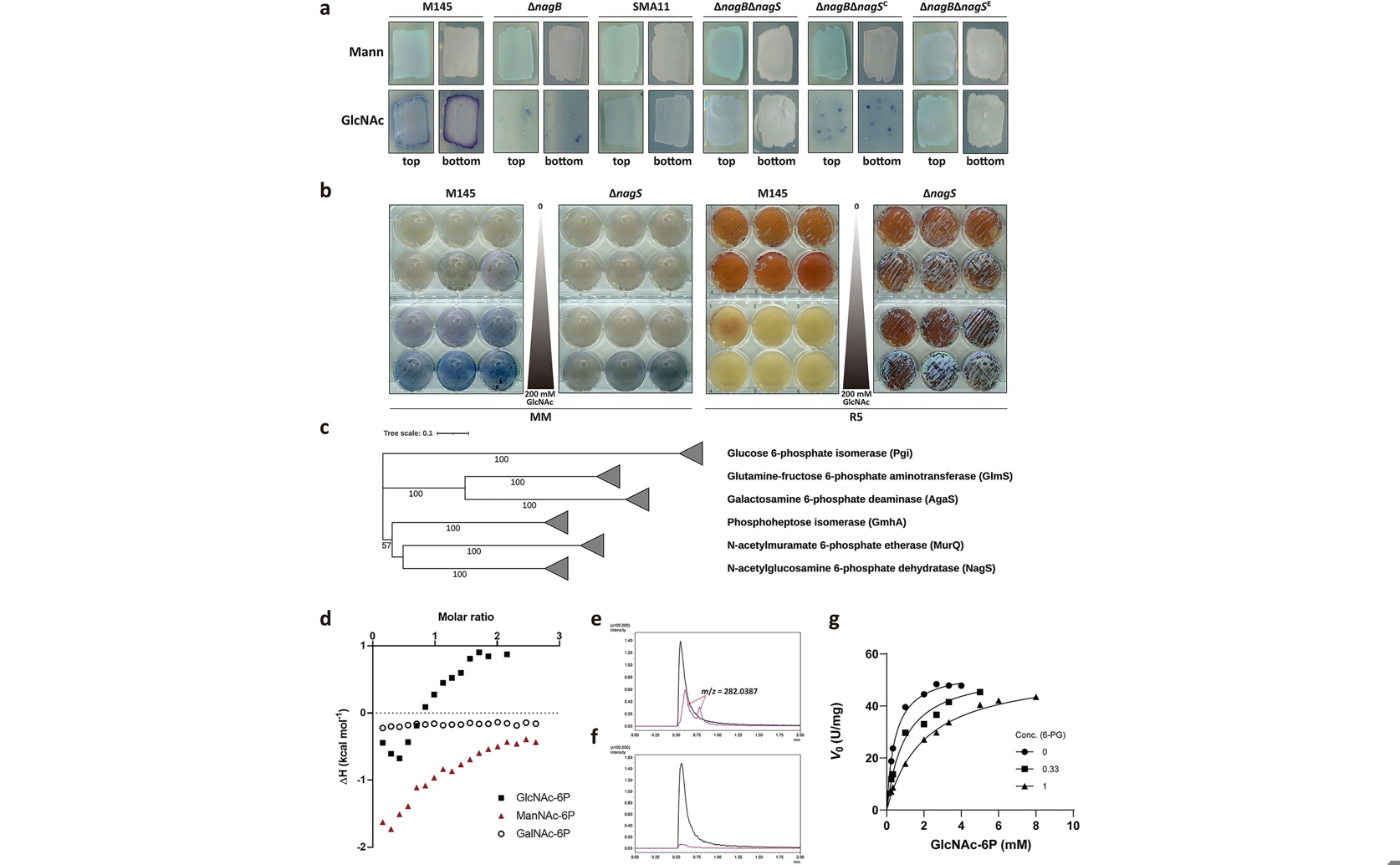
Streptomyces bacteria are single-celled organisms that can coordinate their behaviour to form complex, multicellular structures[2]. This ability is particularly important because these bacteria are prolific producers of antibiotics – over two-thirds of clinically used antibiotics originate from them[3]. Understanding how Streptomyces develop and initiate antibiotic production is therefore crucial for discovering new medicines. A key step in this process is the breakdown of the original bacterial network, called the substrate mycelium, which releases a chemical signal, N-acetylglucosamine (GlcNAc). This signal acts as a checkpoint, indicating the bacteria are ready to start producing antibiotics. Researchers from Leiden University, Anhui Agricultural University, Leiden University Medical Center, Leiden University, University of Edinburgh, Leiden Institute of Chemistry, University of Tübingen, University of Liège, Basel University, Paul Scherrer Institute, Netherlands Institute of Ecology, and Johns Hopkins University School of Medicine have recently investigated how Streptomyces sense this GlcNAc signal[1]. They discovered that sensing GlcNAc involves a previously unknown toxicity pathway, centered around an enzyme called GlcNAc-6P dehydratase (NagS). This pathway works in an unusual way. NagS converts GlcNAc-6P into a molecule called 6P-chromogen I. This reaction hadn’t been observed before in basic metabolic processes and is unique to the Streptomycetaceae family of bacteria. The 6P-chromogen I is then converted into a molecule resembling ribose, a sugar essential for building RNA, by another enzyme, NagA. However, this conversion isn’t perfect, and the build-up of intermediate products creates a toxic environment for the bacteria. The researchers found that this toxicity is relieved by simply adding ribose to the bacteria’s growth medium. This suggests that the bacteria are essentially being poisoned by a byproduct of sensing GlcNAc, and providing ribose bypasses the problem. This links to earlier observations that bacteria often adopt multicellular behaviours for ecological reasons[2], and this toxicity pathway could be a mechanism to ensure coordinated development – only bacteria that can handle the initial toxicity signal will successfully transition to antibiotic production. To understand how NagS works, the team studied its structure and function. They identified specific parts of the enzyme that interact with GlcNAc-6P. They also discovered that another molecule, 6-phosphogluconate, inhibits NagS, effectively shutting down the pathway. This suggests a feedback mechanism, where the pathway can be regulated to prevent excessive toxicity. This research reveals a novel metabolic pathway in Streptomyces that connects nutrient sensing with toxicity and development. It highlights the importance of NagS, an enzyme previously not known to be involved in such a process. The discovery of this pathway could provide new targets for manipulating Streptomyces to increase antibiotic production or to engineer bacteria with novel metabolic capabilities.

GeneticsBiochemPlant Science

References

Main Study

1) The novel GlcNAc 6-phosphate dehydratase NagS governs a metabolic checkpoint that controls nutrient signaling in Streptomyces

Published 25th November, 2025

https://doi.org/10.1371/journal.pbio.3003514


Related Studies

2) Bacterial solutions to multicellularity: a tale of biofilms, filaments and fruiting bodies.

https://doi.org/10.1038/nrmicro3178


3) Taxonomy, Physiology, and Natural Products of Actinobacteria.

https://doi.org/10.1128/MMBR.00019-15


Related Articles

An unhandled error has occurred. Reload 🗙