CEPR2 Protein Senses Plant Signals to Control Immune Responses

Jenn Hoskins
23rd September, 2025

CEPR2 Protein Senses Plant Signals to Control Immune Responses

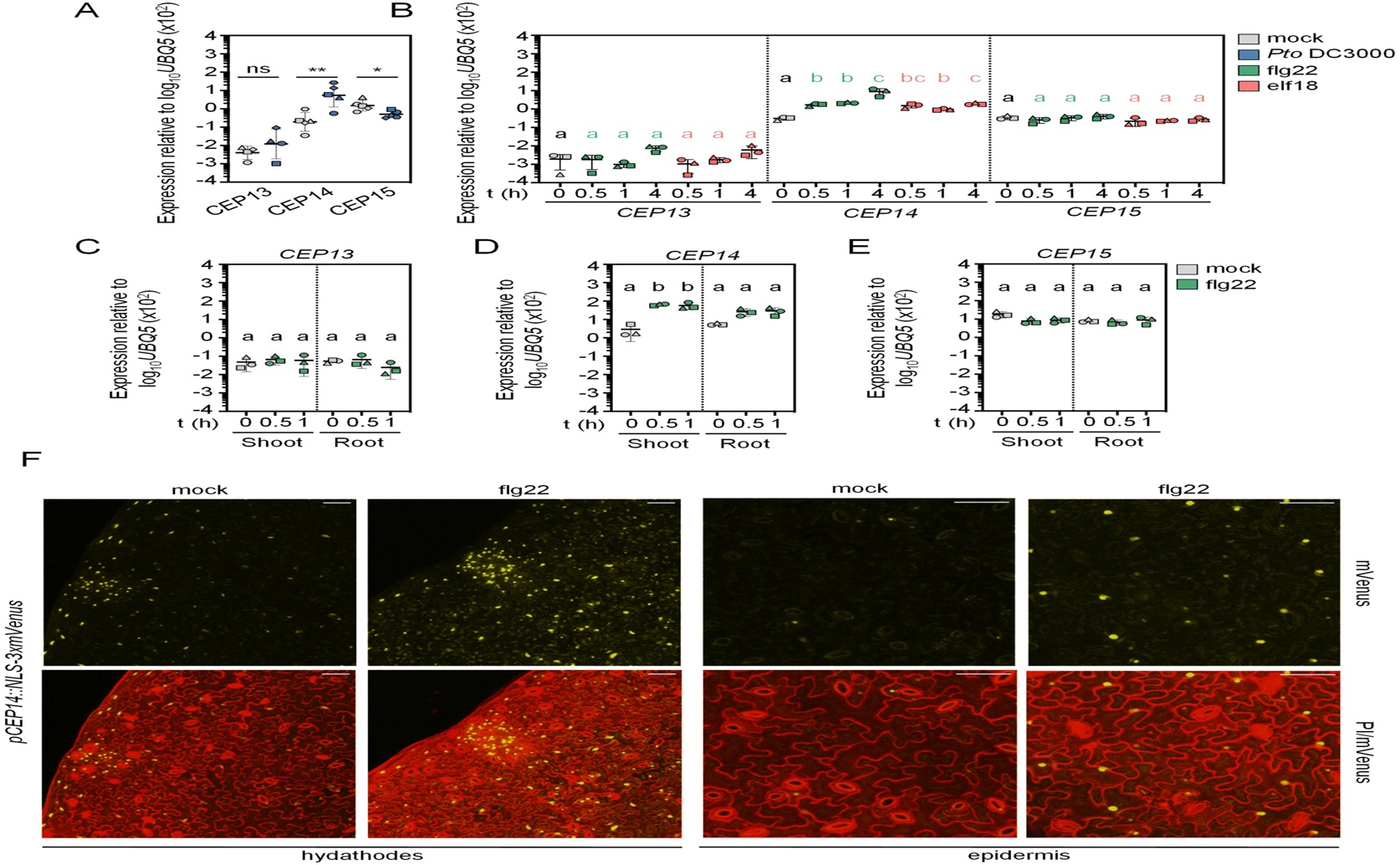
Transcriptional analysis reveals that CEP14 is uniquely induced among group II CEPs following Pseudomonas syringae infection and treatment with microbe-associated molecular patterns (a–e), with fluorescence imaging confirming increased promoter activity in leaf tissues during the immune response (f).

Image adapted from: Rzemieniewski et al. / CC BY (Source)

Key Findings

  • Plants in this study, specifically Arabidopsis thaliana, use internal signaling molecules called C-TERMINALLY ENCODED PEPTIDES (CEPs) to coordinate immunity and nutrient uptake
  • Group II CEPs, particularly CEP14, expression increases significantly when Arabidopsis is under bacterial attack, suggesting a role in defense responses
  • CEP14 and related peptides activate plant immune pathways and require a modification called proline hydroxylation to function effectively, working with another peptide, PEP1, to strengthen defense
Plants, like animals, possess an immune system to defend against pathogens[2]. This system relies on recognizing specific molecular signatures from microbes – known as microbe-associated molecular patterns (MAMPs) – and also from damage within the plant itself, called damage-associated molecular patterns (DAMPs)[3]. Recognition of these signals triggers a defensive response known as pattern-triggered immunity (PTI)[2]. A key component of this recognition process involves receptors on the plant cell surface[2]. Recent research from scientists at Technical University of Munich, Ulm University, and Northwest A&F University[1] has uncovered new details about how plants fine-tune their immune responses using internally produced signaling molecules called C-TERMINALLY ENCODED PEPTIDES (CEPs). These CEPs are not responding to external threats directly, but instead act as internal regulators, coordinating immunity with other vital processes like nitrogen uptake. The study focuses on two major groups of CEPs: group I and group II. Previous work had established that group I CEPs play a role in linking immune responses to nitrogen levels in Arabidopsis thaliana (thale cress), a common model plant. This requires three receptor proteins – CEPR1, CEPR2, and RLK7 – to function effectively. The current research expands on this understanding by investigating the role of group II CEPs during biotic stress, specifically bacterial infection. The researchers found that when Arabidopsis is under attack from bacteria, the expression of a specific group II CEP peptide, CEP14, increases significantly. Further investigation revealed that CEP14, along with related peptides CEP13 and CEP15, activate key immune signaling pathways. Importantly, this activation depends on a specific modification of the CEP peptides called proline hydroxylation, suggesting a level of regulation beyond simple production of the peptides. Genetic experiments demonstrated that group II CEPs contribute to the plant’s ability to defend against bacterial pathogens. These peptides aren’t simply acting in isolation; they interact with the existing immune system infrastructure. The study showed that perception of group II CEPs primarily relies on the CEPR2 receptor protein, one of the receptors already known to be involved in group I CEP signaling. This suggests a shared, but potentially specialized, receptor network for the two CEP groups. Interestingly, the findings highlight that CEP14 and related peptides cooperate with another endogenous peptide, PEP1, to amplify the immune response triggered by flagellin, a well-studied MAMP recognized by the FLS2 receptor[4]. This cooperation suggests a complex interplay between different internal signaling molecules, working together to strengthen the plant’s defense. The discovery of PIP1 and PEP1, and their interaction with RLK7, demonstrated that plants produce their own elicitors of immunity[4]. The current study builds upon this by showing that CEPs, particularly group II CEPs, are also key players in this endogenous immune modulation. The research team found that overexpression of prePIP1 and prePIP2, or the application of synthetic PIP1 and PIP2 peptides, enhanced immune responses[4]. This is similar to the effect observed with CEP14, indicating a common theme of internal peptide signaling boosting immunity. In essence, this study reveals a more nuanced picture of plant immunity. It’s not just about recognizing external threats, but also about internal communication and coordination of responses. The identification of group II CEPs and their reliance on CEPR2 adds another layer of complexity to the CEP signaling network, demonstrating that sequence-divergent CEPs are perceived by specific endogenous receptors. This complexity allows plants to fine-tune their immune responses based on the specific stress they are experiencing and other physiological conditions.

GeneticsBiochemPlant Science

References

Main Study

1) CEPR2 perceives group II CEPs to regulate cell surface receptor-mediated immunity in Arabidopsis

Published 22nd September, 2025

https://doi.org/10.1371/journal.ppat.1013115


Related Studies

2) Molecular mechanisms of early plant pattern-triggered immune signaling.

https://doi.org/10.1016/j.molcel.2021.07.029


3) A renaissance of elicitors: perception of microbe-associated molecular patterns and danger signals by pattern-recognition receptors.

https://doi.org/10.1146/annurev.arplant.57.032905.105346


4) The secreted peptide PIP1 amplifies immunity through receptor-like kinase 7.

https://doi.org/10.1371/journal.ppat.1004331


Related Articles

An unhandled error has occurred. Reload 🗙