How Fruit Fly Cells Build Their Outer Shells Using Different Methods

Greg Howard
9th September, 2025

How Fruit Fly Cells Build Their Outer Shells Using Different Methods

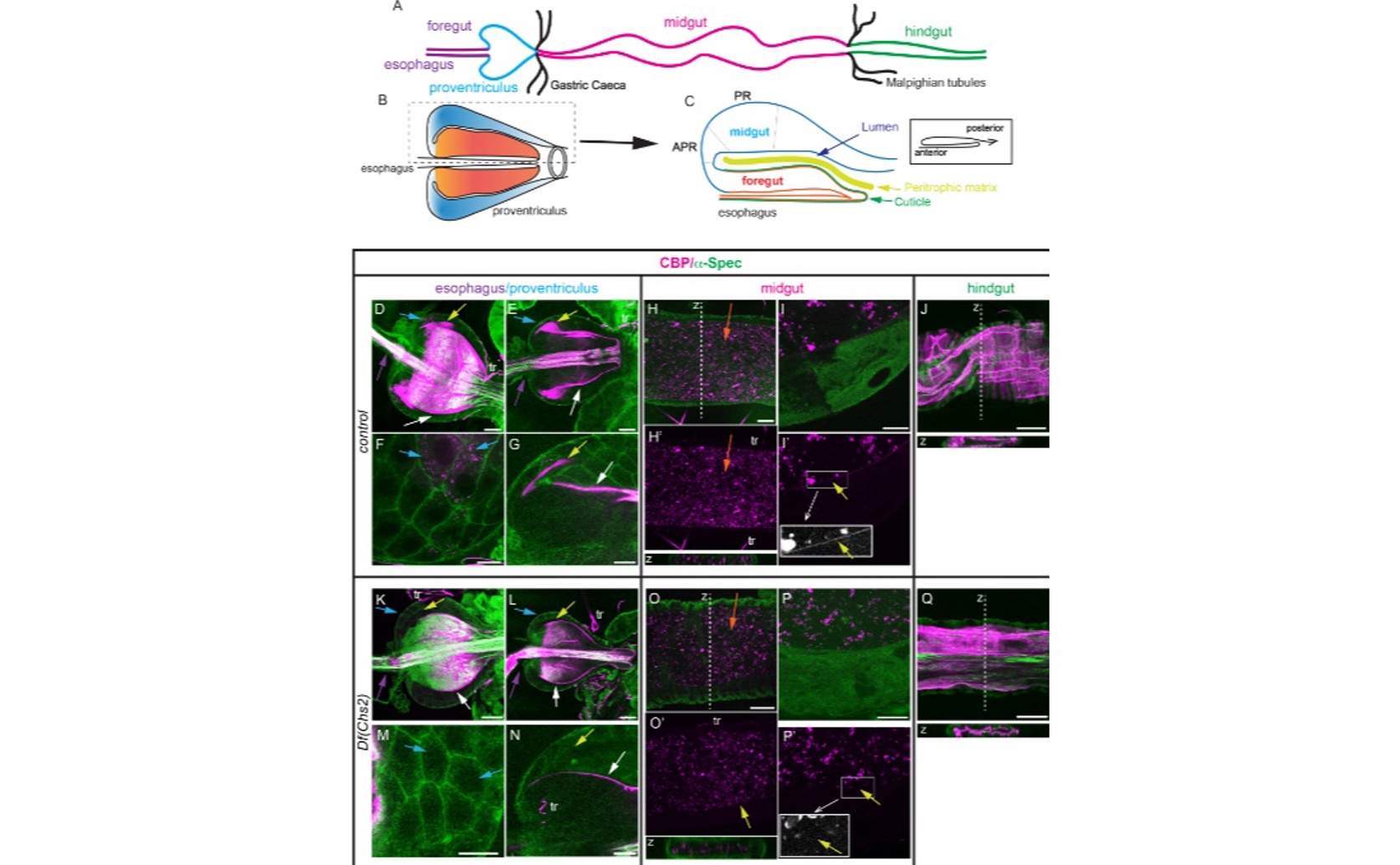
Fluorescence imaging of the Drosophila melanogaster larval digestive tract (a–c) identifies Chs2 as the enzyme responsible for synthesizing the peritrophic matrix, evidenced by the specific loss of chitin in the proventriculus and midgut of Chs2-deficient mutants (k–p) compared to controls (d–i), while ectodermal chitin deposition in the hindgut remains unaffected (j, q).

Image adapted from: Bertran-Mas et al. / CC BY (Source)

Key Findings

  • In fruit flies, two chitin synthase types, Kkv and Chs2, are specifically active in different tissues: Kkv in the exoskeleton and Chs2 in the gut’s peritrophic matrix
  • Kkv and Chs2 are not interchangeable, as expressing one in the other’s tissue fails to produce functional exoskeleton or peritrophic matrix structures
  • Chs2 and Kkv rely on different auxiliary proteins for their function, suggesting distinct mechanisms for chitin deposition despite both being involved in chitin synthesis
Chitin is a remarkably versatile biopolymer – a naturally occurring large molecule – found extensively in the natural world, particularly in insects[2]. It forms a crucial part of their exoskeletons (external skeletons) and the peritrophic matrix, a protective lining in their midguts. Beyond its biological role, chitin is attracting attention for potential applications in fields like medicine and biotechnology due to its unique properties. The synthesis of chitin is carried out by enzymes called chitin synthases, and understanding how these enzymes work is key to both fundamental biological research and the development of new technologies. Insects typically possess two main types of chitin synthase: type A and type B[3]. Type A synthases are believed to be responsible for building the exoskeleton, while type B synthases are thought to create the peritrophic matrix. However, the precise mechanisms dictating which synthase builds which structure have remained elusive. A recent study by researchers at the Institut de Biologia Molecular de Barcelona, Institut Curie, and University of Michigan[1] aimed to address this question, using the common fruit fly, Drosophila melanogaster, as a model organism. The researchers began by confirming that Chs2, the type B chitin synthase in Drosophila, is specifically active in the larval proventriculus – a region of the gut responsible for peritrophic matrix production. This finding reinforces the previously established link between type B synthases and the peritrophic matrix[3][4]. They then investigated whether Chs2 and Kkv (the type A chitin synthase) could perform each other’s functions. This is a common experimental approach to understand the specific roles of enzymes. Their experiments revealed that Chs2 and Kkv are not interchangeable. Attempts to have one synthase take over the role of the other did not result in proper matrix or exoskeleton formation. This suggests that the two enzymes possess distinct characteristics that enable them to build different chitin-based structures. Further investigation into the location of the enzymes within cells and their interaction with other proteins provided further clues. Chitin synthases don’t work in isolation; they require the assistance of ‘auxiliary proteins’ to function effectively[3]. The study showed that Chs2 and Kkv interact with different sets of these auxiliary proteins, and that these interactions are crucial for their specific functions. This is consistent with the broader understanding that chitin laminae and composites are formed through the association of chitin fibres with proteins[2]. The researchers also observed differences in where each synthase operates within the cells of different tissues. The findings of this study demonstrate that the specificity of insect chitin synthases isn’t simply a matter of location, but is instead rooted in fundamental differences in their cellular mechanisms and protein interactions. This suggests that the two types of chitin synthase produce chitin polymers with differing properties, ultimately leading to extracellular matrices with distinct physiological roles. This builds upon the earlier recognition that chitin-containing matrices are dynamically modified and under developmental control[4]. Understanding these differences could open avenues for targeted pest control strategies, as chitin synthase is absent in mammals, birds and plants[3], making it an attractive insecticidal target.

GeneticsBiochemPlant Science

References

Main Study

1) Distinct cellular and molecular mechanisms contribute to the specificity of the two Drosophila melanogaster chitin synthases in chitin deposition

Published 8th September, 2025

https://doi.org/10.1371/journal.pgen.1011847


Related Studies

2) Chitin: Structure, Chemistry and Biology.

https://doi.org/10.1007/978-981-13-7318-3_2


3) Advances in understanding insect chitin biosynthesis.

https://doi.org/10.1016/j.ibmb.2023.104058


4) Biosynthesis, Turnover, and Functions of Chitin in Insects.

https://doi.org/10.1146/annurev-ento-010715-023933


Related Articles

An unhandled error has occurred. Reload 🗙