Symmetry Analysis Reveals Patterns in Electrical Activity of Actin Filaments

Jim Crocker
11th September, 2025

Symmetry Analysis Reveals Patterns in Electrical Activity of Actin Filaments

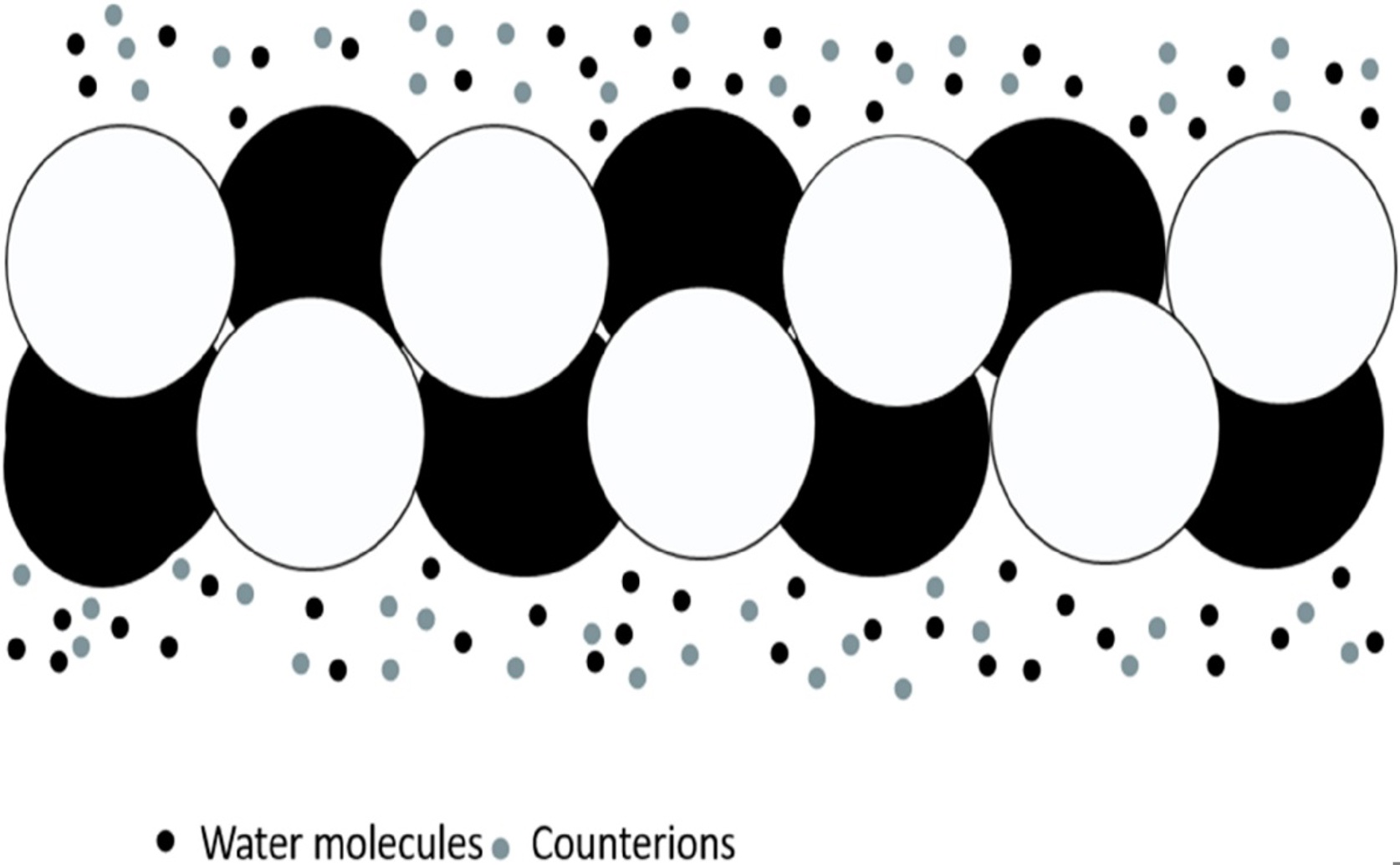
The depiction of F-actin surrounded by water molecules and counterions illustrates the physical environment necessary for determining the effective electrical parameters—resistance, inductance, and capacitance—that underpin the study's dynamical model.

Image adapted from: Beenish et al. / CC BY (Source)

Key Findings

  • Researchers modeled actin filaments as electrical circuits to study ion flow within cells, specifically focusing on dynamics at Quaid-I-Azam University and partner institutions
  • Using advanced mathematical techniques, the study found quasi-periodic oscillations in ion flow when an external force is applied to the actin filament
  • The model exhibits sensitivity to initial conditions, meaning small changes in starting values can lead to significantly different ion flow patterns
Actin filaments are key structural components within cells, playing a role in cell shape, movement, and division. Recent research has begun to explore a less understood function of these filaments: their ability to transmit electrical signals in the form of ion flows. This is significant because traditional understanding of electrical signalling in cells focuses on neurons and dedicated ion channels, leaving the potential role of actin filaments largely unexplored. Understanding how actin filaments conduct ions could reveal new signalling pathways, particularly within neurons and other cell types where rapid communication is essential. Researchers at Quaid-I-Azam University, Imam Mohammad Ibn Saud Islamic University (IMSIU), and Federal University of Technology - Parana[1] have investigated the dynamics of these ion flows, specifically focusing on the mathematical properties of the equations that describe this process. The core of their work centers on finding solutions to these complex equations, which govern how ionic waves propagate along the actin filaments. The challenge lies in the nonlinear nature of these equations, meaning the relationship between the input (force applied to the filament) and the output (ion flow) isn’t a simple straight line. This complexity often makes finding analytical solutions – precise mathematical formulas describing the behaviour – extremely difficult. To overcome this, the research team employed the Lie symmetry approach. This method identifies underlying symmetries within the equation, allowing them to simplify it by reducing the number of variables needed to describe the system. This simplification transforms a higher-dimensional equation into a more manageable second-order differential equation. Further simplification was achieved through a Galilean transformation, converting the second-order equation into a system of first-order differential equations. This technique is commonly used in physics to analyze motion and simplifies the mathematical treatment. Following this, the researchers examined the ‘bifurcation structure’ of the system. Bifurcations are points where small changes in conditions lead to dramatic shifts in the system’s behaviour – essentially, identifying thresholds where the ion flow changes qualitatively. They also conducted a ‘sensitivity analysis’, determining how the system responds to variations in initial conditions. Interestingly, the study found that when an external force is applied to the actin filament, the system exhibits ‘quasi-periodic’ behaviour. This means the ion flow oscillates with multiple, almost regular, frequencies, falling short of true periodicity but not being entirely random. This was identified using tools from ‘chaos analysis’, a branch of mathematics that studies unpredictable behaviour in complex systems. The team also established ‘conservation laws’ associated with the equation. These laws represent quantities that remain constant over time, providing valuable insights into the system’s fundamental properties. A ‘stability analysis’ was then performed to understand how the model responds to small disturbances, ensuring the solutions obtained are realistic and not overly sensitive to minor fluctuations. To find concrete solutions, the researchers used the ‘tanh method’, a technique known for its effectiveness in solving nonlinear differential equations. This yielded exact solutions that were then visualized using 3D and 2D graphs, allowing for a deeper understanding of the ion flow patterns under different conditions. These findings build upon earlier work that also sought to model actin filaments as electrical transmission lines[2]. That study proposed that each actin monomer (the building block of the filament) possesses electrical properties – capacitance, inductance, and resistance – due to its molecular structure and the surrounding fluid. Using Kirchhoff’s laws, they derived a nonlinear partial differential equation for the propagation of ionic waves, finding solutions in terms of Jacobi elliptic functions and Fisher-Kolmogorov modes. The current study complements this work by focusing on the symmetry properties of the governing equation and exploring the system’s dynamic behaviour under external forces, something not fully addressed in the earlier model. Furthermore, research into similar nonlinear evolution equations has demonstrated the power of methods like the modified generalized exponential rational function method in securing exact solitary wave solutions[3]. These ‘solitary waves’ – self-reinforcing waves that maintain their shape as they travel – are common in various physical systems, including elastic materials. The ability to find such solutions in the context of actin filaments could provide insights into the efficient transmission of signals along their lengths. The study ’s focus on exact solutions and visualization aligns with this broader effort to understand nonlinear wave dynamics in complex systems.

GeneticsBiochemPlant Science

References

Main Study

1) Lie symmetry approach to the dynamical behavior and conservation laws of actin filament electrical models

Published 9th September, 2025

https://doi.org/10.1371/journal.pone.0331243


Related Studies

2) Ionic wave propagation along actin filaments.

Journal: Biophysical journal, Issue: Vol 86, Issue 4, Apr 2004


3) Solitary wave solutions and sensitivity analysis to the space-time β-fractional Pochhammer-Chree equation in elastic medium.

https://doi.org/10.1038/s41598-024-79102-x


Related Articles

An unhandled error has occurred. Reload 🗙