New technology helps unlock secrets of plant cell growth and development

Jenn Hoskins
22nd November, 2025

New technology helps unlock secrets of plant cell growth and development

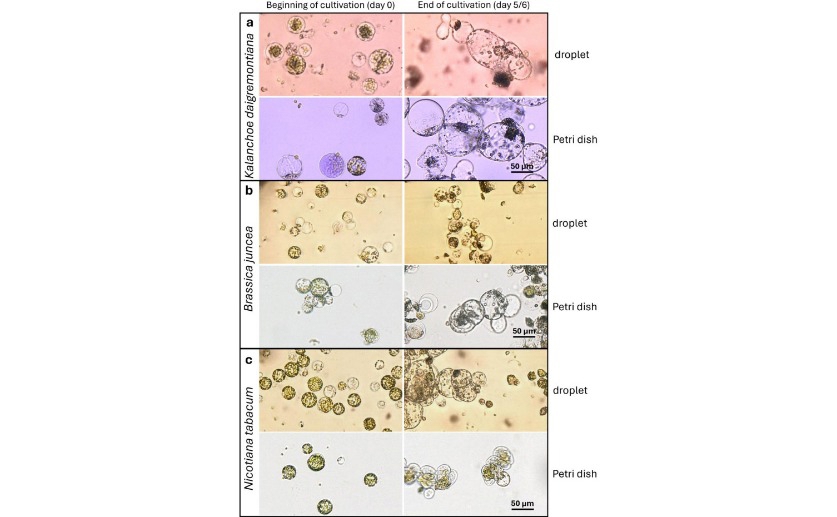
This figure from the study compares the development of protoplasts from Kalanchoe daigremontiana, Brassica juncea, and Nicotiana tabacum cultured in droplet microfluidics versus traditional Petri dishes, revealing species-specific responses to the cultivation method.

Image adapted from: Marczakiewicz-Perera et al. / CC BY (Source)

Key Findings

  • This study developed a new method using droplet-based microfluidics to study plant cells, offering precise control and reducing material needs
  • Tobacco protoplasts thrived in the microfluidic system, while mustard protoplasts showed poor survival, highlighting species-specific responses
  • Low concentrations of plant hormones (cytokinins and auxins) significantly improved tobacco protoplast survival and growth in the system
Plant cells, unlike animal cells, have rigid cell walls, making them more difficult to study individually. Researchers often use protoplasts – plant cells that have had their cell walls removed – to overcome this challenge. However, studying protoplasts traditionally involves large sample sizes and lacks precise control over the environment each cell experiences. This limits our understanding of how individual plant cells behave and respond to different conditions. A recent study from Technische Universität Ilmenau[1] addresses this limitation by developing a new method for studying plant protoplasts using droplet-based microfluidics. Microfluidics involves manipulating tiny volumes of fluids – often on the scale of millionths of a liter – within narrow channels. This allows for highly controlled experiments and reduces the amount of material needed. The researchers created a system where individual protoplasts are encapsulated within tiny droplets of liquid, essentially creating miniature, self-contained growth chambers for each cell. This approach builds upon earlier work demonstrating the power of droplet-based microfluidics for encapsulating and analyzing cells[2]. While previous studies successfully applied this technology to animal and bacterial cells, adapting it to plant cells proved more challenging due to their unique characteristics. The new system developed by the Ilmenau team overcomes these hurdles, enabling long-term observation of plant cell development at a resolution approaching that of single-cell analysis. The study tested the system using protoplasts from three different plant species: tobacco, Brassica juncea (mustard), and Kalanchoe daigremontiana (mother of thousands). They found that the viability – the ability of the cells to survive – varied depending on the species, with tobacco protoplasts performing best in the microfluidic environment. This highlights the importance of optimizing conditions for each plant species when using this technology. The ability to encapsulate protoplasts in droplets allows for precise control over their environment. Researchers can dynamically track the fate of individual cells within their droplets, observing how they grow, divide, or respond to different stimuli. The study demonstrated this by quantifying how tobacco protoplasts responded to varying concentrations of plant hormones called cytokinins and auxins. These hormones are crucial for plant growth and development, and understanding their effects at the single-cell level is vital for plant biotechnology. The researchers found that low concentrations of these hormones (20–80 micrograms per liter) significantly improved cell survival and growth, while higher concentrations offered no additional benefit. This finding is important for optimizing protoplast culture protocols, which are often used in plant genetic engineering and breeding. This work expands on previous research that focused on incorporating plant protoplasts into agarose microbeads[3], offering a different approach to controlling the physical environment of individual plant cells. While the microbead method provides a stable, gel-like environment, the droplet-based system allows for dynamic control and easier manipulation of the chemical environment. Furthermore, the Ilmenau team’s system allows for high-throughput analysis, processing a large number of cells quickly. This is a significant improvement over traditional methods, which are often time-consuming and low-throughput, as noted in earlier work on phenotyping plant systems using microfluidics[4]. The study also touches upon the complex processes involved in plant cell totipotency – the ability of a single cell to regenerate into a whole plant[5]. By providing a controlled environment for studying protoplast development, this microfluidic platform could contribute to a better understanding of the molecular mechanisms underlying this fundamental plant property. The ability to screen different chemical conditions, as demonstrated with the hormone experiments, opens up possibilities for identifying factors that promote totipotency and improve plant regeneration efficiency.

AgricultureBiotechPlant Science

References

Main Study

1) Droplet-based microfluidics platform for investigation of protoplast development of three exemplary plant species

Published 18th November, 2025

https://doi.org/10.1038/s41598-025-28956-w


Related Studies

2) Droplet-based microfluidics systems in biomedical applications.

https://doi.org/10.1002/elps.201900047


3) Microbead encapsulation of living plant protoplasts: A new tool for the handling of single plant cells.

https://doi.org/10.3732/apps.1500140


4) Droplet-based microfluidic analysis and screening of single plant cells.

https://doi.org/10.1371/journal.pone.0196810


5) Characterization of the early events leading to totipotency in an Arabidopsis protoplast liquid culture by temporal transcript profiling.

https://doi.org/10.1105/tpc.113.109538


Related Articles

An unhandled error has occurred. Reload 🗙