Improving textile printing with treated plant-based thickeners

Greg Howard
13th November, 2025

Improving textile printing with treated plant-based thickeners

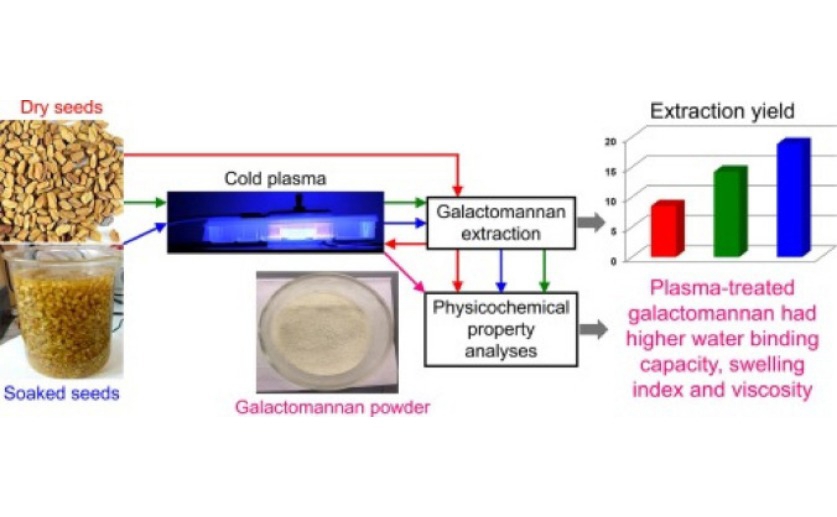
Cold plasma treatment of fenugreek galactomannan.

Image adapted from: Ahmed et al. / CC BY (Source)

Key Findings

  • Researchers in Cairo used cold plasma to improve galactomannan extraction from fenugreek seeds, increasing yield
  • Plasma treatment significantly enhanced the thickening properties of the extracted galactomannan, making it a viable eco-friendly alternative for textile printing
  • The plasma process boosted the galactomannan’s antibacterial activity, potentially expanding its use in food preservation and medicine
Fenugreek seeds have long been used as a source of galactomannan, a natural substance valued for its thickening properties, particularly in industries like textiles[2]. Traditional methods of extracting galactomannan from these seeds can be slow and inefficient, limiting its wider application. Researchers at the National Research Centre, Cairo, have investigated a new approach to improve this process, utilizing a technology called dielectric barrier discharge (DBD) atmospheric cold plasma[1]. The core of the study involved exposing dried fenugreek seeds to this cold plasma – essentially, an ionized gas created using electrical energy – under different conditions. The plasma was generated using either air or oxygen gas, and the power and duration of exposure were varied. The aim was to see if this ‘pretreatment’ could make it easier to extract galactomannan from the seeds. DBD atmospheric cold plasma is a relatively new area of analytical chemistry, gaining traction due to its simplicity and low energy requirements[3]. It works by creating a non-equilibrium environment where molecules are broken down into reactive species, altering the seed’s structure without using harsh chemicals or high temperatures. Following plasma treatment, the galactomannan was extracted and then used to create thin films, allowing for detailed analysis of its properties. The results showed that the plasma treatment significantly impacted the galactomannan extraction process. The treatment effectively broke down the seed structure, increasing the yield of galactomannan obtained. This aligns with earlier research demonstrating that enzymatic activity during seed germination can alter galactomannan structure, increasing its solubility[4]. The plasma treatment appears to mimic, and potentially accelerate, some of the beneficial changes seen during germination. Further analysis focused on the properties of the extracted galactomannan. The researchers investigated its ‘rheological’ properties – essentially, how it flows and behaves as a liquid. This is crucial for its use as a thickening agent in textile printing pastes. They found that the plasma-treated galactomannan solutions exhibited desirable thickening characteristics, suggesting they could be a viable, eco-friendly alternative to synthetic thickeners currently used in the textile industry. Beyond thickening, the study also examined the antibacterial activity of the treated galactomannan. The plasma treatment enhanced the galactomannan’s ability to inhibit bacterial growth. This is significant because atmospheric cold plasma itself is known for its antimicrobial properties, and has been successfully used to decontaminate food products[5]. The combination of galactomannan’s natural properties with the added antibacterial effect from the plasma treatment could open up new applications in areas requiring both thickening and preservation. The research builds on the understanding of galactomannans as versatile materials[2]. While guar gum and locust bean gum are commonly used, fenugreek galactomannan is gaining attention due to its unique properties. The study demonstrates a novel method to enhance the extraction and functionality of this particular galactomannan, potentially making it more commercially viable. The ability to produce low molecular weight galactomannans, as seen with germination[4], is also achievable through plasma treatment, offering tailored properties for specific applications.

AgricultureBiotechPlant Science

References

Main Study

1) Plasma-induced modification of fenugreek galactomannan thickener film via dielectric barrier discharge for textile printing

Published 10th November, 2025

https://doi.org/10.1038/s41598-025-24053-0


Related Studies

2) Properties of galactomannans and their textile-related applications-A concise review.

https://doi.org/10.1016/j.ijbiomac.2022.11.276


3) Review: Miniature dielectric barrier discharge (DBD) in analytical atomic spectrometry.

https://doi.org/10.1016/j.aca.2020.11.034


4) Study on structure and properties of galactomannan and enzyme changes during fenugreek seeds germination.

https://doi.org/10.1016/j.carbpol.2023.121653


5) Factors influencing the antimicrobial efficacy of Dielectric Barrier Discharge (DBD) Atmospheric Cold Plasma (ACP) in food processing applications.

https://doi.org/10.1080/10408398.2020.1743967


Related Articles

An unhandled error has occurred. Reload 🗙