Plant bacteria boost growth and offer clues to better farming

Jim Crocker
14th October, 2025

Plant bacteria boost growth and offer clues to better farming

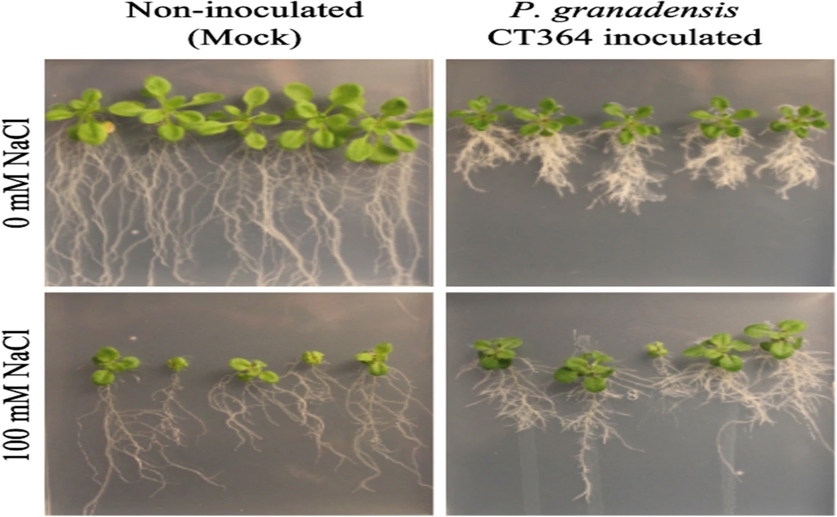
Inoculation with P. granadensis CT364 enhances the formation of lateral roots and root hairs in Arabidopsis seedlings compared to mock-treated plants, an effect that persists even under salt stress conditions.

Image adapted from: Torrescassana et al. / CC BY (Source)

Key Findings

  • Researchers isolated Pseudomonas granadensis CT364 from olive tree roots and found it easily grows in the lab
  • This bacterium promotes root development in olive trees, rapeseed, mung bean, and cowpea, and survives stressful conditions like high salt and water scarcity
  • Genomic analysis reveals CT364 possesses genes enabling it to colonize plants and enhance growth, making it a promising bioinoculant for sustainable agriculture
Plant growth and crop yield are fundamental to global food security, but modern agricultural practices often rely on chemical fertilizers that can have detrimental environmental consequences. An alternative approach gaining traction is the use of plant-associated microorganisms – bacteria and fungi that live within or around plant roots – to enhance plant growth and resilience naturally. However, identifying and effectively utilizing these microorganisms has been challenging due to difficulties in studying them outside of their natural plant environment. Researchers at Newcastle University have identified a bacterium, Pseudomonas granadensis strain CT364, isolated from the soil surrounding olive tree roots (the rhizosphere), as a promising candidate for a bioinoculant, a beneficial additive to improve plant growth[1]. This bacterium stands out because it is relatively easy to grow in the laboratory, a significant advantage over many other plant-associated microbes. Crucially, it demonstrated the ability to promote root development in several plant species, including olive trees, rapeseed, mung bean, and cowpea. The study began with a detailed analysis of the bacterium’s genome – its complete genetic code. This revealed 564 genes potentially involved in helping the bacterium thrive in the rhizosphere, colonize plant tissues, and directly promote plant growth. These genes pointed to capabilities like movement (motility), the ability to form protective layers (biofilm formation), and sensing signals released by plants. Subsequent experiments confirmed these predicted abilities, demonstrating that P. granadensis CT364 is indeed motile, forms biofilms, and responds to plant-derived signals. To confirm its ability to live inside plants, the researchers tested its colonization of Arabidopsis, a common model plant used in biological research. They found that P. granadensis CT364 successfully colonized the rhizosphere (soil around the roots), the rhizoplane (root surface), and even internal plant tissues, solidifying its classification as an endophyte – an organism living within a plant without causing harm. This is important as some bacteria can colonize plants but be pathogenic, however this strain showed no signs of causing disease. The true test of a bioinoculant lies in its ability to improve plant performance. Inoculation experiments – where plants were grown with and without the bacterium – showed significant positive effects on root architecture and overall plant biomass, measured as the size of the plant and the area covered by its leaves (rosette area). Importantly, these benefits were maintained even when plants were subjected to stressful conditions like high salt levels (salinity) and water scarcity (osmotic stress). This suggests P. granadensis CT364 can help plants cope with challenging environmental factors. The study also investigated the bacterium’s tolerance to stress. Genomic analysis and experiments confirmed its resistance to both osmotic stress and heavy metal toxicity, indicating it can survive in harsh environments where many other microorganisms would struggle. This resilience is a key characteristic for a successful bioinoculant, as it needs to remain viable and effective in a variety of soil conditions. The use of chemical fertilizers can lead to environmental problems such as waterway pollution and soil degradation[2]. P. granadensis CT364 offers a potential solution by improving nutrient availability through natural processes. This aligns with the broader goal of utilizing Phosphate Solubilizing Microorganisms (PSM) to reduce reliance on conventional fertilizers[2]. While the mechanisms by which PSM release phosphorus are complex, the genomic analysis of P. granadensis CT364 provides a starting point for understanding how it might contribute to nutrient cycling in the rhizosphere. The researchers emphasize that P. granadensis CT364 is not only a promising bioinoculant but also a valuable tool for studying the intricate interactions between plants and bacteria. The identification of specific genes involved in plant sensing and colonization provides targets for further research into the molecular mechanisms underlying these beneficial relationships. The genetic tractability of the strain – meaning it’s relatively easy to manipulate its genes – further enhances its potential as a model organism.

AgricultureBiotechPlant Science

References

Main Study

1) Genomic and functional analyses reveal Pseudomonas granadensis CT364 is a plant growth-promoting endophyte

Published 10th October, 2025

https://doi.org/10.1186/s12866-025-04308-6


Related Studies

2) Microbial Phosphorus Solubilization and Its Potential for Use in Sustainable Agriculture.

https://doi.org/10.3389/fmicb.2017.00971


Related Articles

An unhandled error has occurred. Reload 🗙