Simple tool quickly spots diseases in corn plants

Jenn Hoskins
19th November, 2025

Simple tool quickly spots diseases in corn plants

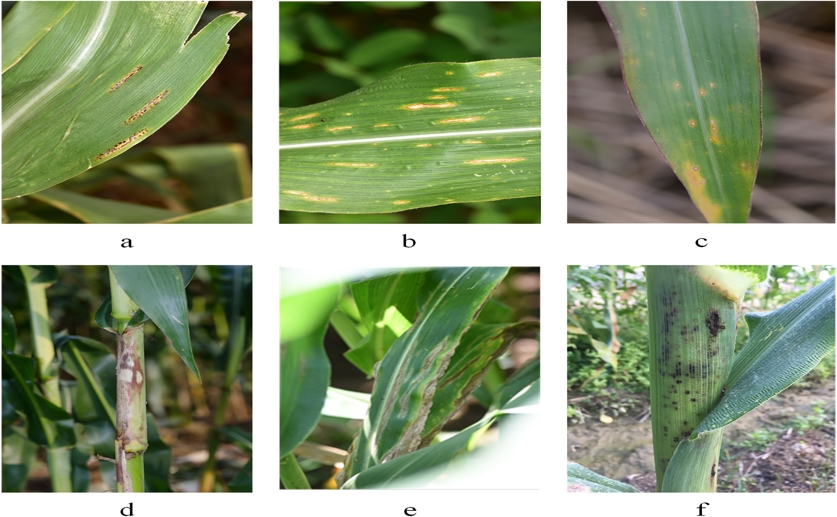
Six common corn diseases: Common rust, Bipolaris maydis, Curvularia lunata leaf spot, Northern leaf blight, Own spot, and Sheath blight (ordering a-f).

Image adapted from: Bai et al. / CC BY (Source)

Key Findings

  • This study, conducted in Anhui Province, China, developed a new “lightweight” deep learning model, ES-ShuffleNetV2, for accurate corn leaf disease recognition
  • The ES-ShuffleNetV2 model achieved 97.07% accuracy, outperforming existing models while requiring fewer computational resources, making it suitable for use on phones or drones
  • Key improvements to the model included a new attention mechanism (SGSE) and a different activation function (ELU), alongside a pruning technique to reduce model size by over 30%
Corn is a globally important crop, but its susceptibility to disease poses a significant challenge to food production. Early and accurate disease identification is crucial for effective management, but traditional methods can be slow, expensive, and sometimes inaccurate. Recent advances in computer vision and deep learning offer promising solutions, but many existing models are too complex for use on portable devices like smartphones or drones, limiting their practical application in the field. Researchers at Anhui Science and Technology University, Anhui Province Crop Research Center, and Instituto Politecnico Nacional (IPN) have addressed this issue with a new approach to corn leaf disease recognition[1]. The study focuses on developing a “lightweight” model – one that achieves high accuracy while requiring minimal computational resources. This is particularly important for deploying disease detection tools directly in agricultural settings. The core of their work is a modified version of an existing deep learning architecture called ShuffleNetV2. Deep learning models, as demonstrated in earlier work with chili diseases[2], rely on identifying patterns in images to classify them. However, these models often require vast amounts of data for training and can be computationally intensive. The researchers enhanced the ShuffleNetV2 architecture in two key ways. First, they incorporated an improved attention mechanism called SGSE (Spatial Group-wise Squeeze-and-Excitation Block) immediately after the initial processing of the image. This mechanism helps the model focus on the most important features within the image, highlighting subtle visual cues that indicate disease. This builds on the idea that effective feature extraction is paramount for accurate disease identification, as highlighted in the chili disease study[2]. Second, they replaced a common activation function, ReLU, with ELU (Exponential Linear Unit). Activation functions determine the output of a neuron in a neural network; ELU allows for smoother data flow during the learning process, potentially leading to faster and more accurate results. To further reduce the model’s complexity, the team employed a technique called “pruning.” Pruning involves removing unnecessary connections within the neural network, reducing the number of calculations required without significantly impacting performance. This concept aligns with research on optimizing deep learning models through pruning[3], which demonstrated that removing connections can actually improve accuracy by focusing the network on the most relevant features. The researchers achieved a 30.45% reduction in the number of parameters and a 30.26% reduction in FLOPs (Floating Point Operations – a measure of computational workload) through pruning. The resulting model, named ES-ShuffleNetV2, achieved a recognition accuracy of 97.07% – a significant improvement over the base ShuffleNetV2 model’s 95.43% accuracy. It also outperformed other existing models in terms of both accuracy and F1-Score, a metric that combines precision and recall. This level of accuracy is comparable to, and in some cases exceeds, results achieved with more complex models. Similar to advancements in tomato disease recognition[4], which focused on automating image labeling to reduce human effort, this study prioritizes efficiency and practicality. While the tomato study used a modified YOLOv5 model for object detection and automatic labeling, the current research focuses on optimizing an existing architecture for resource-constrained environments. Both studies demonstrate a trend towards developing specialized deep learning models tailored to specific agricultural challenges.

AgricultureBiotechPlant Science

References

Main Study

1) A lightweight model and corn leaf disease recognition

Published 17th November, 2025

https://doi.org/10.1371/journal.pone.0336945


Related Studies

2) Integrated analysis of machine learning and deep learning in chili pest and disease identification.

https://doi.org/10.1002/jsfa.10987


3) EvoPruneDeepTL: An evolutionary pruning model for transfer learning based deep neural networks.

https://doi.org/10.1016/j.neunet.2022.10.011


4) A tomato disease identification method based on leaf image automatic labeling algorithm and improved YOLOv5 model.

https://doi.org/10.1002/jsfa.12793


Related Articles

An unhandled error has occurred. Reload 🗙