Can AI help design better natural flood defenses in mountainous areas?

Jenn Hoskins
14th October, 2025

Can AI help design better natural flood defenses in mountainous areas?

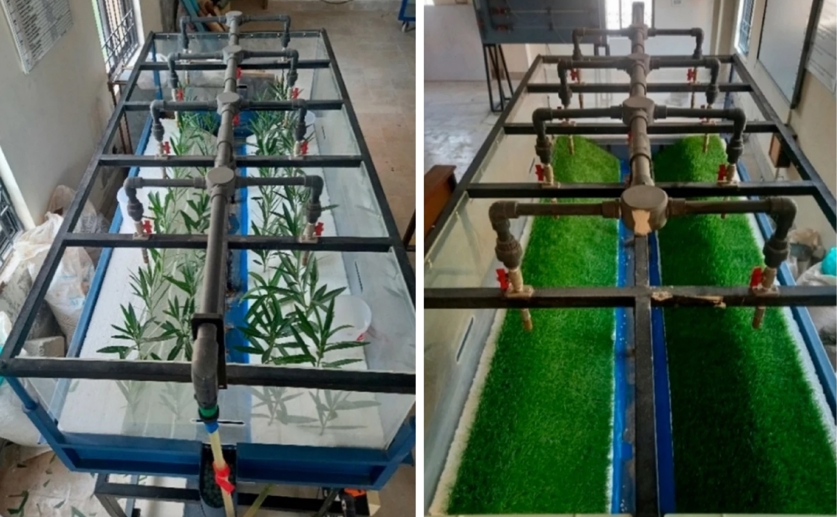
In a laboratory, researchers simulated the flood-mitigating effects of rigid vegetation (left) and flexible vegetation (right) to generate data for an AI model aimed at enhancing flood resilience.

Image adapted from: Mabrouk et al. / CC BY (Source)

Key Findings

  • This study, conducted in hilly terrain, investigated using artificial intelligence (AI) to optimize flood resilience by predicting peak water flow from nature-based solutions
  • Flexible vegetation, like grasses, reduced peak discharge by 8% more than rigid vegetation due to better water absorption and slower flow
  • The random forest AI model consistently outperformed the support vector regression model in accurately predicting peak discharge, demonstrating its suitability for complex hydrological conditions
Flash flooding poses a significant threat in hilly areas, demanding effective and sustainable management strategies. Traditional ‘grey’ infrastructure solutions can be expensive and have negative environmental consequences. Nature-based solutions (NBS) offer a promising alternative, but require careful planning and assessment to ensure their effectiveness across varying environmental conditions. Researchers at Northern Border University[1] have recently investigated the potential of using artificial intelligence (AI) to optimize flood resilience in hilly terrain by predicting peak discharge – the highest rate of water flow during a flood event – generated from these landscapes. The core of the problem lies in the complex hydrological processes at play in hilly regions. Factors like slope steepness, rainfall intensity, and the type of vegetation present all influence how water flows across the land. Understanding these interactions is crucial for designing NBS that can effectively reduce flood risk. Previous work has highlighted the benefits of NBS in urban environments, noting their ability to enhance water retention and reduce surface runoff[2][3]. However, these studies often focus on relatively flat urban areas, and less research has been conducted on applying these solutions to the unique challenges of hilly terrain. To address this gap, the Northern Border University team employed two AI models – random forest (RF) and support vector regression (SVR) – to analyze data from laboratory-scale experiments. These experiments simulated rainfall on slopes with different types of vegetation: flexible vegetation (FV), representing plants that bend and move with water flow, and rigid vegetation (RV), representing plants with stiffer stems. A total of 344 data series were generated, encompassing variations in slope, rainfall intensity, and a ‘time ratio’ (T/Tc) which represents the duration of the rainfall event relative to the time it takes for water to flow from the start to the end of a slope. The data was divided into training, testing, and validation sets to ensure the models were accurate and reliable. The performance of both AI models was evaluated using several statistical measures, including root mean square error (RMSE) – a measure of the difference between predicted and actual values, coefficient of determination (R2) – indicating how well the model explains the variability in the data, and mean absolute error (MAE) – the average absolute difference between predicted and actual values. Crucially, the researchers also used SHAP (SHapley Additive exPlanations) analysis, a technique that helps to understand which factors have the biggest influence on the model’s predictions. The results showed that flexible vegetation was more effective at reducing peak discharge, achieving an 8% reduction compared to rigid vegetation. This is attributed to its greater surface resistance, slowing down water flow, and its higher infiltration capacity, allowing more water to soak into the ground. Importantly, the RF model consistently outperformed the SVR model, demonstrating a higher predictive power with R-values of 0.9809 for FV and 0.9906 for RV conditions. This suggests that the RF model is better suited for capturing the complex, non-linear relationships between the different hydrological factors. SHAP analysis revealed that the ‘time ratio’ (T/Tc) had the most significant influence on peak discharge, particularly under flexible vegetation conditions, with a SHAP range of ±25. Rainfall intensity also played a role, but to a lesser extent, with SHAP ranges of ±5 and ±7 for FV and RV respectively. This finding highlights the importance of considering the duration of rainfall events when designing NBS for hilly terrain. This research builds upon earlier studies that advocate for integrated stormwater management strategies combining natural ecosystems with engineered solutions[3]. By utilizing AI, the Northern Border University study provides a more precise and data-driven approach to optimizing NBS placement and design. The use of AI-driven models for predicting nonlinear hydrological phenomena, as demonstrated by this work, could be a valuable tool for urban planners and policymakers seeking to enhance flood resilience in hilly regions. The findings also echo the broader trend of recognizing the co-benefits of NBS, including environmental improvements like enhanced biodiversity and water quality[4].

EnvironmentSustainabilityEcology

References

Main Study

1) Artificial intelligence evaluation of nature based flood resilience in hilly terrain

Published 10th October, 2025

https://doi.org/10.1038/s41598-025-19629-9


Related Studies

2) Optimizing nature-based solutions for urban flood risk mitigation: A multi-objective genetic algorithm approach in Gdańsk, Poland.

https://doi.org/10.1016/j.scitotenv.2024.178303


3) Urban green spaces and flood disaster management: toward sustainable urban design.

https://doi.org/10.3389/fpubh.2025.1583978


4) Nature-based solutions can help reduce the impact of natural hazards: A global analysis of NBS case studies.

https://doi.org/10.1016/j.scitotenv.2023.165824


Related Articles

An unhandled error has occurred. Reload 🗙