Design Principles for Landscape Studies of Human and Natural Systems

Greg Howard
23rd August, 2025

Design Principles for Landscape Studies of Human and Natural Systems

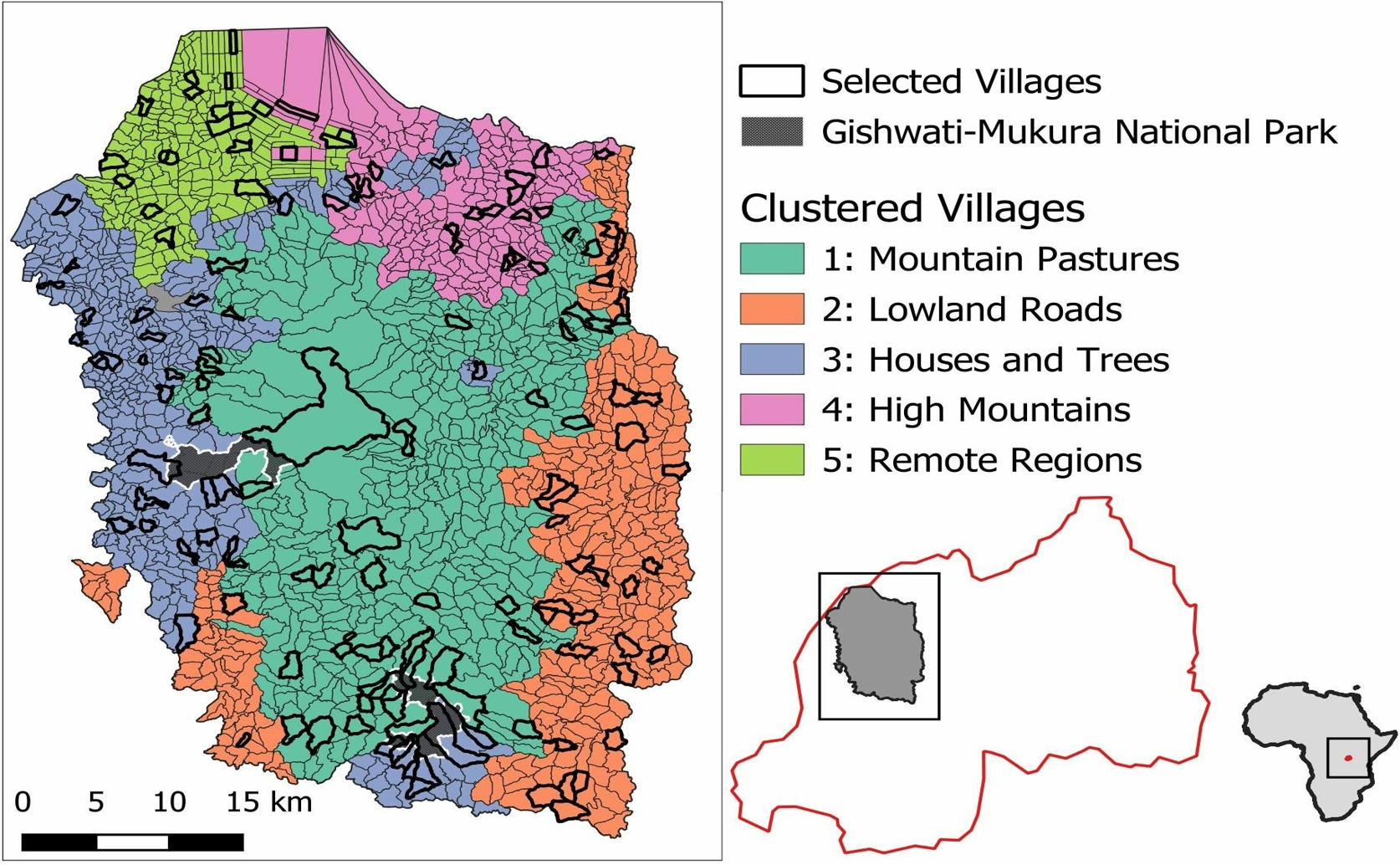
The hierarchical clustering analysis identified five distinct social-ecological clusters across the landscape of western Rwanda, providing a spatially homogenous framework for the stratified random selection of village sampling units.

Image adapted from: Baumann et al. / CC BY (Source)

Key Findings

  • Researchers in western Rwanda identified five distinct landscape areas to help integrate data from various studies on ecosystem restoration
  • The study used readily available data like elevation and land use to create these areas, ensuring consistent data collection across different research teams
  • This method provides a structured framework for interdisciplinary collaboration, linking environmental changes to community livelihoods and well-being
Understanding how people interact with their environments is crucial for achieving sustainability, particularly when it comes to managing and restoring ecosystems. Research in this area often involves diverse teams studying complex landscapes, collecting data ranging from household economics to ecological health and local knowledge. A significant challenge in these large, interdisciplinary projects is effectively integrating these varied datasets to gain a holistic understanding. Researchers at Humboldt-University Berlin, Leuphana Universität, Georg-August Universität Göttingen, and Northeastern University (Shenyang)[1] have proposed a solution: identifying specific “social-ecological research units” as common reference points for data collection. These units act as anchors, allowing different research teams to focus their efforts on comparable areas, ultimately facilitating integration of findings. The core idea is to create a structured framework that supports collaboration and allows for identifying both commonalities and differences across the landscape. The problem this addresses is the inherent difficulty in comparing data collected at different scales and using different methods. For example, ecological data might be gathered from precisely defined plots, while socioeconomic data is collected at the village level. Without a common framework, it’s hard to link changes in the environment to changes in people’s livelihoods or well-being. This is especially relevant considering the increasing recognition that landscapes aren't simply physical environments, but are deeply intertwined with human perception, culture, and values[2]. The researchers developed four key principles to guide the identification of these research units. First, the spatial scale of the units needs to be appropriate for the research questions – large enough to capture meaningful ecological variation, but small enough to reflect local social contexts. Second, identifying key social-ecological gradients – such as elevation, rainfall, or distance to markets – helps to understand how different parts of the landscape vary. Third, the accessibility of stratification data is vital; data used to define the units must be readily available. Finally, the framework needs flexibility to account for practical challenges like logistical constraints or unexpected local conditions. To demonstrate this approach, the team applied it to a real-world study on ecosystem restoration in western Rwanda. They identified five distinct clusters within the study area, based on factors like land use, elevation, and access to resources. These clusters were spatially homogenous, meaning they were relatively consistent within each area. They then sampled 152 villages – roughly 9.5% of the total – strategically chosen to represent all five clusters. This sampling strategy ensures that different research teams, each focusing on a specific aspect of the restoration project, will be collecting data from comparable areas. This methodology builds upon earlier work highlighting the importance of integrating natural and social sciences in landscape research[2]. However, it moves beyond simply advocating for integration to providing a practical framework for achieving it. The Rwandan study exemplifies how this structured approach can support interdisciplinary collaboration and enable a more comprehensive understanding of complex social-ecological systems. The work also resonates with research emphasizing the need to incorporate local knowledge and traditional practices into restoration efforts[3]. By focusing on specific, well-defined research units, it becomes easier to understand how different communities interact with the restored ecosystems and to identify potential opportunities for incorporating sustainable harvesting or other traditional management practices. The success of restoration projects is often linked to community support and engagement, and a place-based approach, like the one proposed by, can help to foster this by acknowledging the unique characteristics and needs of each local area. Furthermore, the study acknowledges the role of livelihood strategies in shaping landscape outcomes[4]. Understanding how households make a living – whether through diversified farming, reliance on cash crops, or other means – is crucial for assessing the impact of restoration projects on local well-being. By collecting socioeconomic data within the defined research units, researchers can link changes in livelihood strategies to changes in the ecosystem and identify potential trade-offs or synergies.

EnvironmentSustainabilityEcology

References

Main Study

1) Design principles for social-ecological research at the landscape scale applied to western Rwanda

Published 22nd August, 2025

https://doi.org/10.1371/journal.pone.0330704


Related Studies

2) Interdisciplinary interpretations and applications of the concept of scale in landscape research.

https://doi.org/10.1016/j.jenvman.2012.08.027


3) Importance of including cultural practices in ecological restoration.

https://doi.org/10.1111/cobi.12915


4) Livelihood strategies, capital assets, and food security in rural Southwest Ethiopia.

https://doi.org/10.1007/s12571-018-00883-x


Related Articles

An unhandled error has occurred. Reload 🗙