Finding Carbon Dioxide Sources In Different Areas Using Carbon Fingerprints

Jim Crocker
20th June, 2025

Finding Carbon Dioxide Sources In Different Areas Using Carbon Fingerprints

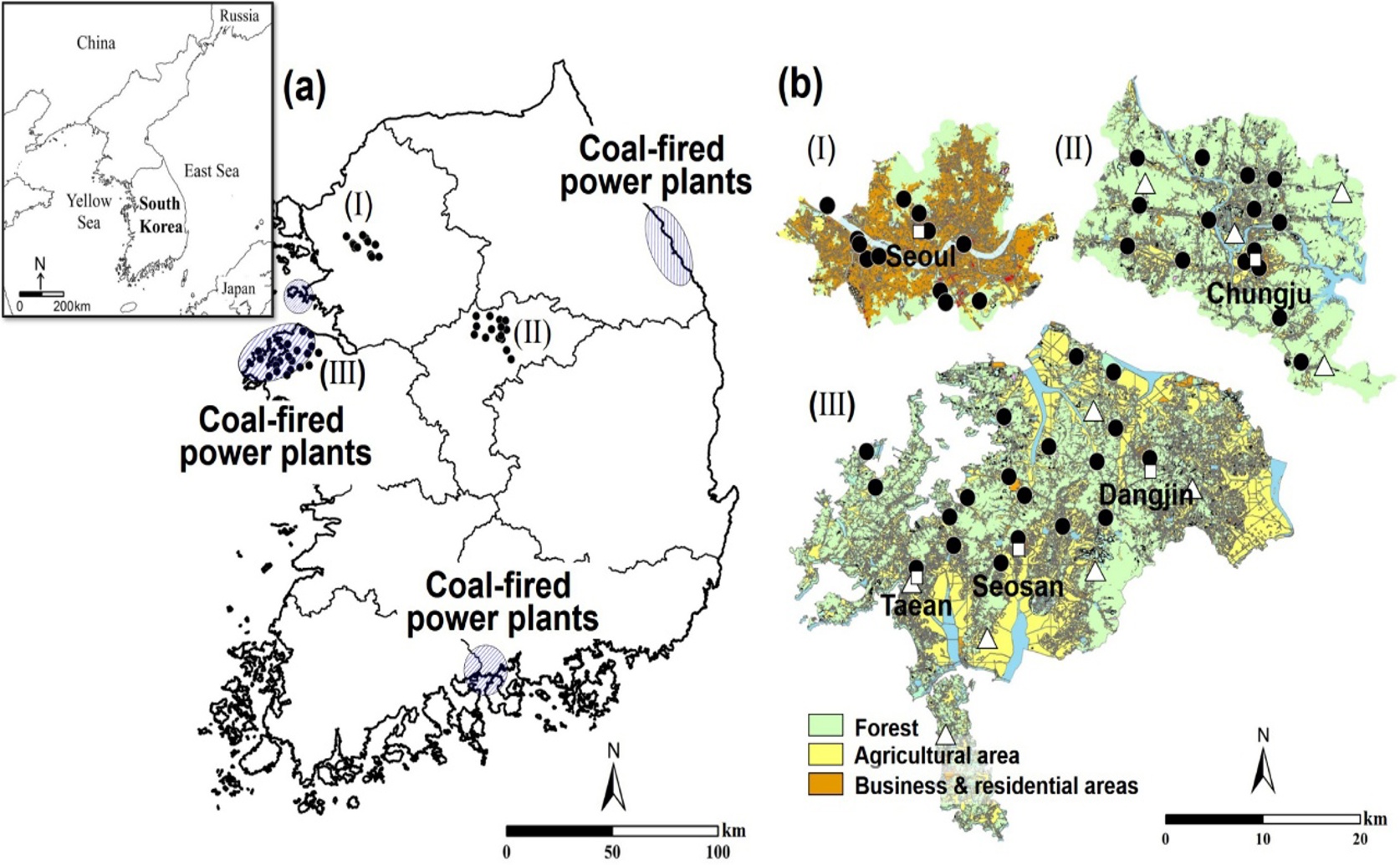
To trace regional CO₂ sources, this study collected air and soil samples (b) from South Korea’s urban capital, Seoul (I), the forested inland region of Chungju (II), and the west coast (III), a rural area distinguished by several major coal-fired power plants (a).

Image adapted from: Jeong et al. / CC BY (Source)

Key Findings

  • A study in South Korea used carbon isotopes to show that vehicle exhaust is the main source of CO2 in urban areas like Seoul
  • In rural areas, coastal regions are primarily affected by coal power plant emissions, while inland forested areas show CO2 mainly from natural sources like soil
Understanding the origins of atmospheric carbon dioxide (CO2) is crucial for managing air quality and addressing climate change. While overall CO2 levels are rising globally, identifying whether the CO2 in a specific area comes from vehicle exhaust, industrial activity, or natural processes like soil respiration can inform local environmental strategies. Distinguishing these sources, especially in complex urban or mixed environments, presents a significant scientific challenge. A recent study conducted by researchers from the Korea Basic Science Institute, Chungnam National University, and the University of Maryland aimed to tackle this problem by identifying the primary CO2 sources in various regions of Korea[1]. From October 2022 to April 2023, they collected air samples from urban and rural areas, each with distinct land-use patterns. To pinpoint the sources, they analyzed not only the concentration of CO2 but also its stable isotope composition, specifically carbon-13 (δ13C-CO2). Stable isotopes are non-radioactive forms of an element that differ slightly in their atomic mass. For carbon, the two main stable isotopes are carbon-12 (12C) and carbon-13 (13C). The ratio of 13C to 12C in CO2, expressed as δ13C, acts like a unique fingerprint. Different sources of CO2, such as fossil fuels, plant respiration, or volcanic activity, have distinct δ13C values because of the specific chemical processes involved in their formation. For instance, CO2 from burning fossil fuels like coal or gasoline tends to be depleted in 13C (meaning it has a lower δ13C value) compared to CO2 from natural processes like soil respiration. By measuring the δ13C of CO2 in air samples and comparing it to the known δ13C values of "end-members" – representative samples from specific sources like soil, vehicle exhaust, or coal – scientists can determine the relative contribution of each source. The Korean study found clear distinctions across different areas. In urban samples, they observed higher CO2 concentrations coupled with lower δ13C values. When these urban samples were plotted against their isotopic composition, they showed trends similar to those found in tunnel air samples, strongly indicating that vehicle exhaust was a dominant source of CO2 in urban settings. This finding aligns with previous research in other major cities; for example, studies in Beijing also used δ13C measurements to identify the significant impact of morning rush hour traffic on urban CO2 levels and its isotopic signature[2]. Similarly, research in Naples, Italy, demonstrated how stable isotopes of CO2 were critical in distinguishing anthropogenic emissions from fossil fuel combustion in the city center from geogenic (volcanic) CO2 emissions in nearby volcanic zones, even within an urban environment[3]. Moving to rural areas, the Korean study noted that samples from coastal regions exhibited CO2 concentration and δ13C trends similar to the urban and tunnel samples. This suggested that these coastal areas were significantly affected by CO2 emissions from coal-fired power plants, a common industrial activity in such locations. This again resonates with findings from Beijing, where coal combustion was identified as a major contributor to atmospheric CO2, especially during heating seasons, with its distinct isotopic signature[2]. In contrast, inland rural samples in Korea showed a different pattern, characterized by a specific isotopic signature (an estimated δ13C-CO2 value of −27.0‰). This signature, combined with the observed CO2 levels, strongly suggested that natural sources, particularly CO2 released from soil, were the predominant contributors to atmospheric CO2 in these areas. Soil CO2 primarily comes from the respiration of plant roots and microbes in the soil. However, "natural sources" can be more complex than just biological respiration. For instance, studies in irrigated drylands of the southwestern United States have shown that agricultural practices can accelerate the formation of secondary calcite in soils, releasing significant amounts of "abiotic" CO2 – CO2 not derived from biological processes – which also contributes to the atmospheric CO2 burden[4]. This highlights the intricate nature of natural CO2 sources and how isotopic analysis can help differentiate them. The methodology employed in the Korean study, using the relationship between atmospheric CO2 concentrations and δ13C-CO2 values, proved effective in distinguishing primary CO2 sources based on land-use patterns. This multi-isotope approach is a powerful tool, as demonstrated in other contexts, such as assessing methane oxidation and its contribution to atmospheric CO2 above landfills in France, where δ13C of CO2 samples helped identify and quantify various source contributions in the surrounding atmosphere[5]. By providing a clear and reliable method for source apportionment, this research offers valuable insights for environmental and public health management, enabling targeted strategies to reduce specific CO2 emissions and improve air quality in different regions.

EnvironmentSustainabilityEcology

References

Main Study

1) Tracing CO2 sources in urban and rural areas characterized by different land-use patterns using carbon isotopes

Published 17th June, 2025

https://doi.org/10.1371/journal.pone.0326306


Related Studies

2) Mixing ratio and carbon isotopic composition investigation of atmospheric CO2 in Beijing, China.

https://doi.org/10.1016/j.scitotenv.2015.08.130


3) Unveiling spatial variations in atmospheric CO2 sources: a case study of metropolitan area of Naples, Italy.

https://doi.org/10.1038/s41598-024-71348-9


4) Dryland irrigation increases accumulation rates of pedogenic carbonate and releases soil abiotic CO2.

https://doi.org/10.1038/s41598-021-04226-3


5) Assessing methane oxidation under landfill covers and its contribution to the above atmospheric CO₂ levels: the added value of the isotope (δ¹³C and δ¹⁸O CO₂; δ¹³C and δD CH₄) approach.

https://doi.org/10.1016/j.wasman.2012.04.008


Related Articles

An unhandled error has occurred. Reload 🗙