Why Dali's Scenic Spots Are Appealing: Influencing Factors Revealed

Jim Crocker
17th May, 2025

Why Dali's Scenic Spots Are Appealing: Influencing Factors Revealed

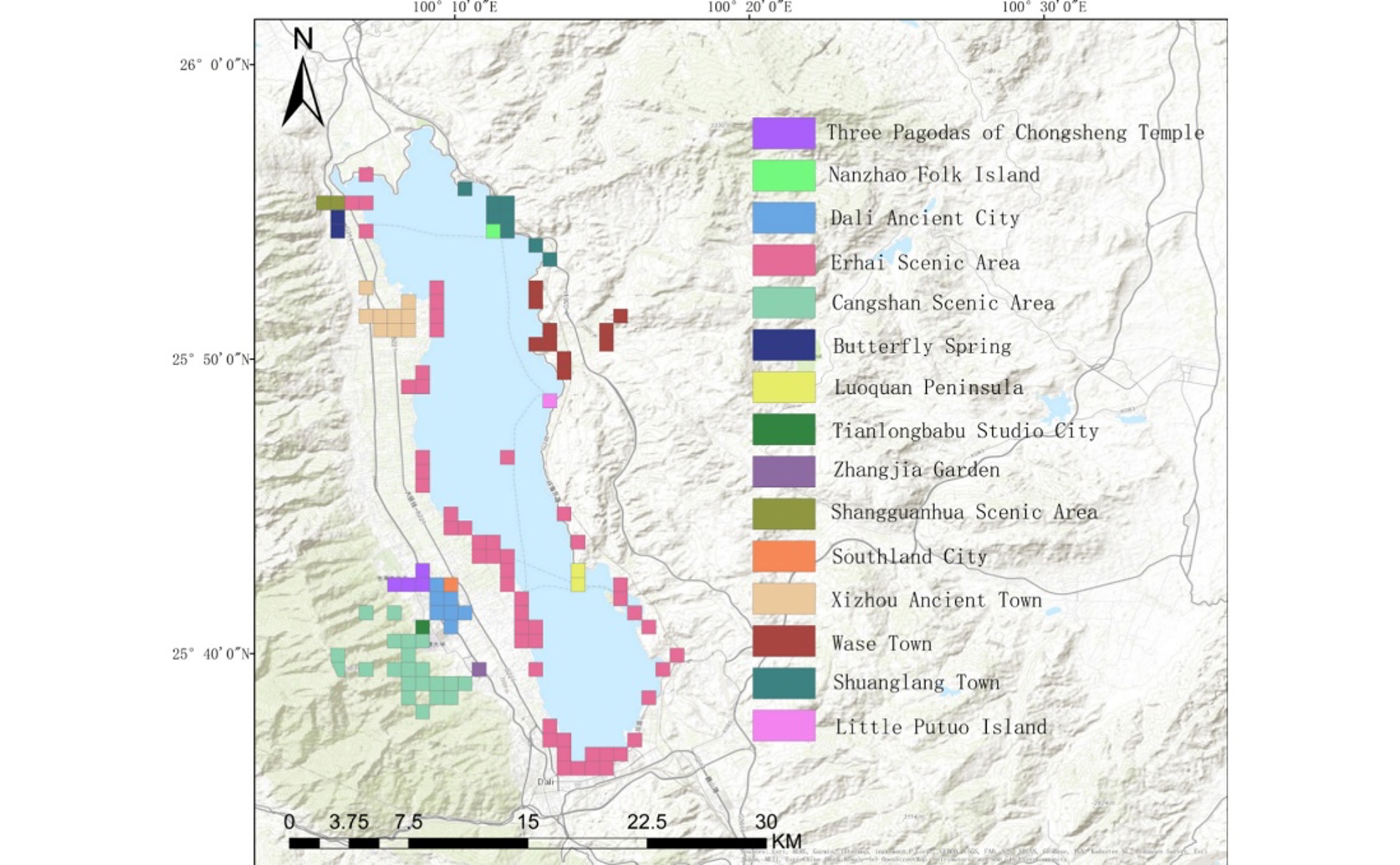
The spatial distribution of the 15 identified scenic areas demonstrates a "two-center, multi-point" pattern, with Dali Ancient City and Xizhou Ancient Town serving as the core tourism hubs amidst numerous scattered attractions.

Image adapted from: Wang et al. / CC BY (Source)

Key Findings

  • In Dali, China, Dali Ancient City and Xizhou Ancient Town are the top spots attracting most tourists
  • Areas with more attractions and better facilities draw more visitors and receive higher satisfaction
  • High tourist satisfaction and strategic management can support sustainable growth of Dali’s tourism
Tourism development relies heavily on understanding what makes certain scenic areas attractive to visitors. A recent study conducted by researchers at the Information Engineering University in Zhengzhou[1] delves into the factors that influence the popularity and satisfaction of scenic areas in Dali, a prominent tourist destination in China. By leveraging modern data sources and analytical techniques, the study provides valuable insights that can aid in the sustainable growth of urban tourism. The study addresses the challenge of accurately gauging scenic area attractiveness, which is essential for effective tourism planning and management. Traditional methods, such as interviews and surveys, often fall short due to their limited scope and the time-consuming nature of data collection. To overcome these limitations, the researchers integrated multiple data sources, including point of interest (POI) data, mobile signaling, and microblog check-in information. This comprehensive approach allows for a more nuanced analysis of tourist behavior and preferences. Using kernel density analysis and hotspot analysis, the team mapped out the popularity of various scenic areas in Dali. They discovered a distinct two-center, multi-point distribution pattern, with Dali Ancient City and Xizhou Ancient Town serving as the primary hubs. These centers attract the majority of tourists, while numerous smaller areas scatter around them, offering diverse attractions. This pattern echoes findings from previous studies, such as the spatial distribution of high-quality tourist attractions in Shandong Province, where clustering around major cities like Qingdao and Jinan was observed[2]. The study also examined the temporal activity of scenic areas, revealing that most locations are busier during the day. However, Dali Ancient City remains a hotspot even at night, likely due to its vibrant cultural and historical appeal. This aligns with earlier research on South Anhui's tourism attractions, where areas with rich cultural heritage, like Huangshan City, were identified as main centers with significant tourist activities[3]. A key aspect of the research was assessing tourist satisfaction through sentiment analysis of microblog check-ins. By utilizing the ROST-CM6 tool, the researchers were able to extract and quantify positive sentiments expressed by visitors. The analysis showed a high level of satisfaction across various scenic areas, underpinned by numerous positive adjectives used by tourists. This positive sentiment is crucial for maintaining and enhancing the appeal of these destinations. One of the most significant findings of the study is the impact of internal POIs on the popularity and attractiveness of scenic areas. The presence of more POIs within a scenic area correlates strongly with higher tourist numbers and greater overall attractiveness. This suggests that diverse and well-distributed attractions within a single area can enhance its appeal. Moreover, the study found that the interplay between different factors—such as natural environment, transportation, and socio-economic conditions—has a more substantial effect on attractiveness than any single factor alone. This multifaceted influence mirrors the conclusions drawn from spatial distribution studies in Gansu Province, where natural environment and transportation were pivotal in shaping tourist attraction patterns[4]. The researchers employed GeoDetector, a sophisticated statistical tool, to dissect the contributions of various factors to scenic area attractiveness. They considered subjective human factors, objective attributes of the attractions themselves, and the density of surrounding POI facilities. The results highlighted that both intrinsic qualities of the attractions and the external environment significantly influence tourist preferences. This comprehensive analysis underscores the necessity of a holistic approach to tourism development, ensuring that both the attractions and their supporting infrastructure are optimized. Furthermore, the study shed light on the origins of tourists visiting Dali. Most visitors come from Yunnan Province, neighboring provinces, and economically developed coastal regions. This demographic insight is valuable for targeted marketing and resource allocation, ensuring that the needs and expectations of different tourist groups are met effectively. In comparison to earlier studies, such as the spatial distribution of tourist attractions in Shandong and Gansu provinces[2][4], the Dali study expands the understanding of how various factors interplay to shape tourism landscapes. While previous research primarily focused on the geographical and infrastructural aspects, the incorporation of sentiment analysis and real-time data from social media provides a more dynamic and current perspective on tourist satisfaction and behavior. Overall, the findings from this study offer actionable recommendations for urban tourism development in Dali. By recognizing the importance of internal POIs and the synergistic effects of multiple factors, policymakers and tourism planners can better design and promote scenic areas to enhance their attractiveness. Additionally, understanding tourist satisfaction through sentiment analysis allows for continuous improvement based on real-time feedback. In conclusion, the research conducted by the Information Engineering University provides a robust framework for assessing and enhancing the attractiveness of scenic areas. By integrating diverse data sources and employing advanced analytical methods, the study not only corroborates previous findings but also introduces new dimensions to the understanding of urban tourism dynamics. These insights are instrumental in fostering sustainable tourism growth, ensuring that destinations like Dali continue to thrive and enchant visitors from around the world.

EnvironmentSustainabilityEcology

References

Main Study

1) Scenic area attractiveness in Dali City and its influencing factors evaluated using multi-source spatiotemporal data

Published 15th May, 2025

https://doi.org/10.1371/journal.pone.0323310


Related Studies

2) Spatial distribution and influencing factors of high-quality tourist attractions in Shandong Province, China.

https://doi.org/10.1371/journal.pone.0288472


3) Study on distribution characteristic of tourism attractions in international cultural tourism demonstration region in South Anhui in China.

https://doi.org/10.1371/journal.pone.0269948


4) Spatial distribution pattern and driving mechanism of tourist attractions in Gansu Province based on POI data.

https://doi.org/10.1371/journal.pone.0292165


Related Articles

An unhandled error has occurred. Reload 🗙