How Dams Change the Nile River’s Connections Over Time

Jim Crocker
2nd May, 2025

How Dams Change the Nile River’s Connections Over Time

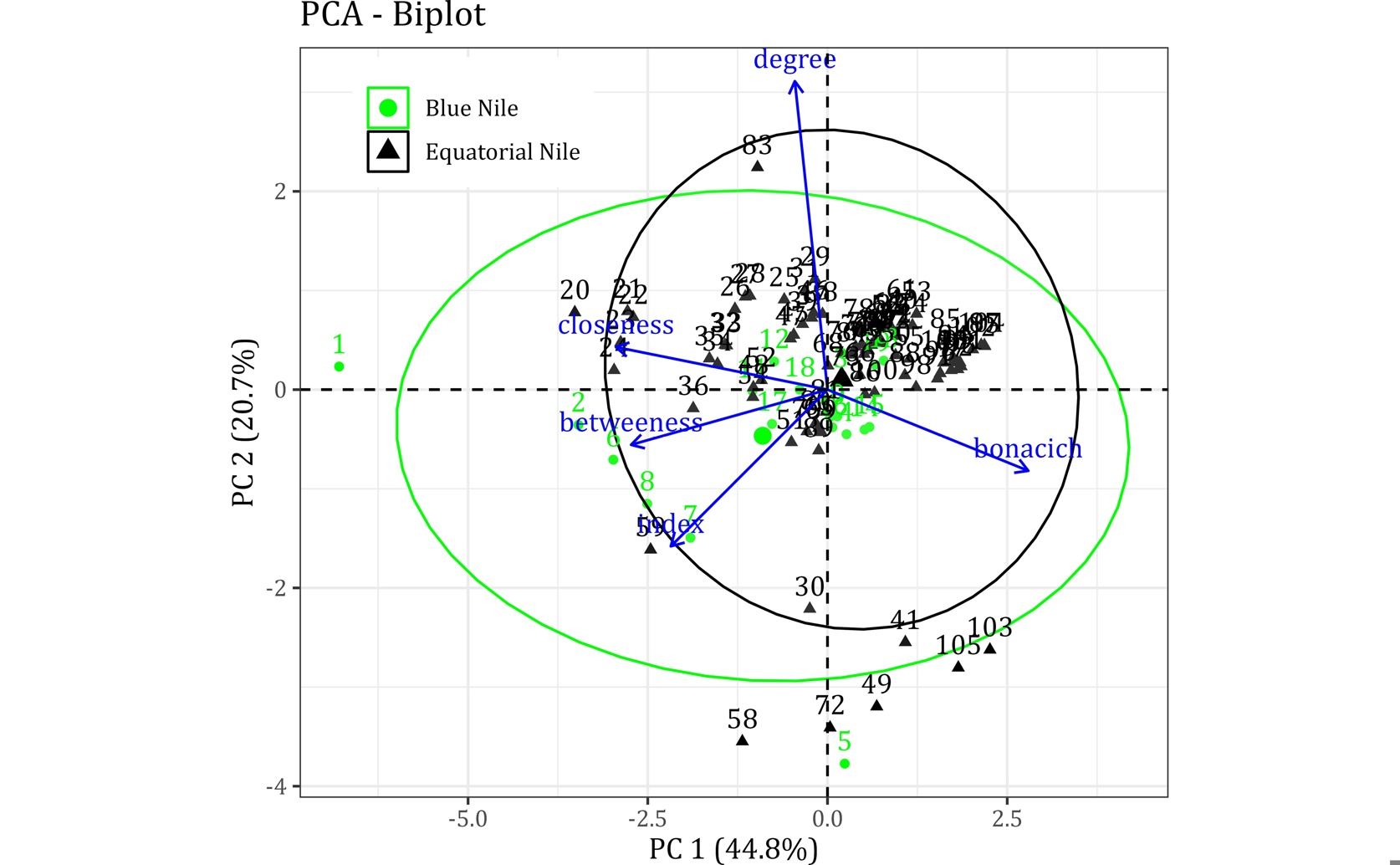
A principal component analysis of network metrics reveals that a dam's position, particularly its centrality, is strongly linked to its impact on river fragmentation, which isolates major dams such as the Grand Ethiopian Renaissance Dam.

Image adapted from: Basooma et al. / CC BY (Source)

Key Findings

  • In the Nile River Basin, more dams are disrupting river flows, harming aquatic habitats
  • River connectivity has fallen from over 50% to below 20%, endangering fish and biodiversity
  • Experts suggest creating fish passages and better managing dams to protect the ecosystem
Dams play a crucial role in providing hydropower, supplying water for agriculture, and protecting against floods. However, they also disrupt natural river flows, which can harm river ecosystems by breaking up the continuous habitat that many aquatic species rely on. A recent study by researchers at BOKU University, Vienna, Austria[1] examines how the increasing number of dams in the Nile River Basin affects the connectivity of river networks, which is essential for maintaining healthy ecosystems. The Nile River Basin is divided into two main areas: the Equatorial Nile Basin (ENB) and the Blue Nile Basin (BNB). Over the years, the number of dams in these areas has grown significantly, with a notable surge between 2010 and 2015 in the ENB. The study analyzed 101 existing, under-construction, and proposed dams in the ENB from 1954 to 2035, and 19 dams in the BNB from 1925 to 2035. Using the Reach Connectivity Index (RCI) and network centrality measures, the researchers assessed how these dams fragment the river networks over time and space. The findings reveal a substantial decline in river connectivity due to the increasing number of dams. In the BNB, the mean RCI decreased from 62.5% in 1925 to 21.35% projected for 2035. Similarly, in the ENB, the mean RCI dropped from 50.1% in 1954 to 18.1% by 2035. This reduction in connectivity is most pronounced in the middle sections of both basins, with the ENB experiencing a more significant decline than the BNB. Such fragmentation poses a serious threat to the basin’s biodiversity, as it restricts the movement of aquatic species and disrupts their natural life cycles. This study builds on previous research that highlighted the global impact of dams on freshwater species. For instance, a study from BOKU University[2] assessed how around 40,000 existing large dams and 3,700 future dams fragment the habitats of approximately 10,000 lotic fish species worldwide. It found that non-diadromous fish species, which do not migrate between freshwater and marine environments, are more affected by habitat fragmentation than diadromous species. The current study in the Nile Basin supports these findings by demonstrating how dams decrease river connectivity, thereby impacting fish populations. Furthermore, the research aligns with findings from Busitema University[3], which showed that habitat fragmentation can lead to smaller, isolated fish populations with reduced genetic diversity. In the Nile Basin, reduced connectivity due to dams could similarly result in isolated fish populations that are more vulnerable to environmental changes and genetic bottlenecks. This emphasizes the importance of maintaining river connectivity to preserve genetic diversity and the overall health of aquatic ecosystems. The study also connects to research conducted by Makerere University[4], which examined how dams in the Victoria Nile affect the morphology of Nile tilapia, a key species in the region. The morphological changes observed in tilapia populations near dams suggest that these barriers influence not only connectivity but also the physical characteristics of fish, likely as a response to altered environmental conditions. This highlights the broader ecological impacts of dam-induced fragmentation beyond just habitat disruption. To mitigate these impacts, the researchers recommend several measures. One key suggestion is the implementation of effective fish migratory corridors around existing dams, such as the Grand Ethiopian Renaissance Dam in the BNB and Kakono Dam in the ENB. These corridors would allow fish to move upstream and downstream, maintaining connectivity and supporting healthy populations. Additionally, the study calls for the creation of a comprehensive database of all barriers within the basin and the assessment of their passability. Regular monitoring using methods like remote sensing and environmental DNA (eDNA) is also recommended to track the effects of dams on both plant and animal life in the rivers. By integrating these strategies, river management can better address the challenges posed by dam-induced fragmentation. This approach not only supports biodiversity but also ensures the sustainability of the Nile River Basin’s vital ecosystems, which are essential for the livelihoods of millions of people who depend on these waters for fishing, agriculture, and other needs. Overall, the study from BOKU University provides a detailed analysis of how increasing dam construction in the Nile River Basin is leading to significant river fragmentation. By building on previous research and offering practical recommendations, it contributes to a better understanding of the ecological consequences of dams and underscores the need for effective management practices to preserve river connectivity and biodiversity.

EnvironmentSustainabilityEcology

References

Main Study

1) Spatiotemporal changes in river network connectivity in the Nile River Basin due to hydropower dams

Published 29th April, 2025

https://doi.org/10.1371/journal.pone.0322338


Related Studies

2) Impacts of current and future large dams on the geographic range connectivity of freshwater fish worldwide.

https://doi.org/10.1073/pnas.1912776117


3) Artificial barriers prevent genetic recovery of small isolated populations of a low-mobility freshwater fish.

https://doi.org/10.1038/s41437-017-0008-3


4) Exploring the morphological dynamics of Nile tilapia (Oreochromis niloticus Linn. 1758) in Victoria Nile as depicted from geometric morphometrics.

https://doi.org/10.1186/s40850-023-00190-9


Related Articles

An unhandled error has occurred. Reload 🗙