Shiitake mushrooms could lead to new, eco-friendly electronic components

Jenn Hoskins
11th October, 2025

Shiitake mushrooms could lead to new, eco-friendly electronic components

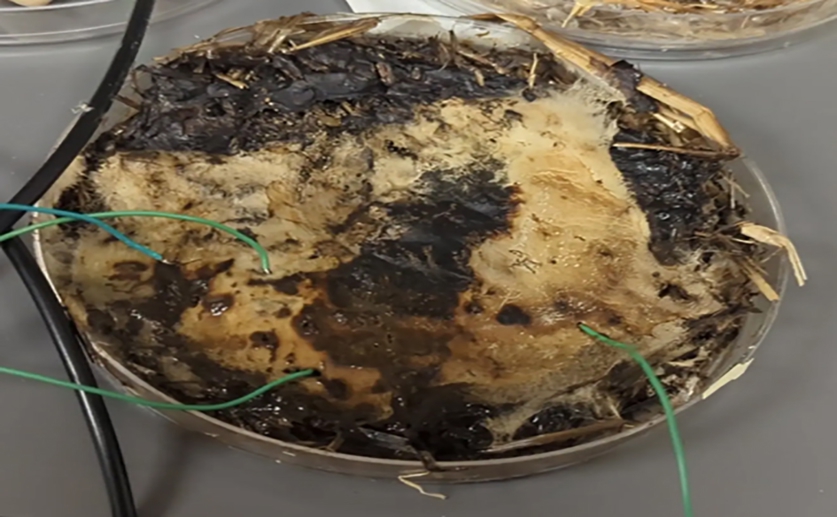
Fungal sample with probe points. Each sample grew a mycelial network that was connected to conventional electronics.

Image adapted from: LaRocco et al. / CC BY (Source)

Key Findings

  • Researchers grew memristors using shiitake mushrooms, offering a low-cost, sustainable alternative to traditional electronics
  • These fungal memristors successfully “remembered” past signals and were trained to perform tasks with 90% accuracy
  • The fungal memristors retained their functionality after being dehydrated and rehydrated, showing promise for practical use and long-term stability
Neuromorphic computing aims to mimic the brain’s efficient information processing capabilities. Traditional computers struggle with tasks like pattern recognition and learning due to their separation of processing and memory. Neuromorphic systems, however, integrate these functions, offering potential for faster, more energy-efficient computation. Current neuromorphic chips often rely on specialized hardware and rare-earth materials, making them expensive and challenging to produce. Another emerging approach, using neural organoids (engineered brain tissue), faces difficulties in maintaining the complex biological environment needed for stable operation.[1] Researchers at Ohio State University and Shenzhen University have been investigating an unconventional alternative: shiitake fungi. The study explores the potential of shiitake (Lentinula edodes) mycelial networks – the root-like structure of the fungus – as a computing substrate. Fungi naturally exhibit electrical signaling that resembles the spiking activity of neurons, the fundamental units of the brain. This inherent electrical activity makes them a promising candidate for bio-integrated computing. The core idea is to leverage this natural signaling to perform computational tasks. The research team demonstrated that fungal “memristors” could be grown and trained. A memristor is a type of circuit element whose resistance changes depending on the history of the electrical current flowing through it. This ability to “remember” past signals is crucial for building memory and performing complex computations. The team interfaced the mycelial networks with electrodes, allowing them to apply electrical signals and measure the resulting responses. They then trained these fungal networks to perform specific tasks, achieving an accuracy of 90% ± 1%. A significant challenge in using biological materials for computing is long-term stability. The researchers addressed this by showing that the fungal memristors could be preserved through dehydration, a process that effectively puts the fungal networks into a dormant state without losing their functionality. Upon rehydration, the networks were able to resume operation, retaining their trained capabilities. This is a major step towards creating practical and reliable fungal computers. Interestingly, the study also revealed that shiitake fungi exhibit radiation resistance. This property is particularly valuable for applications in aerospace, where electronic systems are exposed to high levels of radiation. This resilience is a significant advantage over traditional semiconductor-based systems, which can be easily damaged by radiation. The work builds on earlier advances in bioelectronics and materials science. For example, the development of all-silicon-based memristors[2] has shown the potential for integrating memristor technology directly into existing silicon-based electronics, reducing manufacturing complexity. However, these silicon-based memristors often require external components for large-scale arrays. The fungal memristors, in contrast, are self-contained and do not require such external circuitry. Furthermore, research into engineered living materials (ELMs)[3] highlights the benefits of using biological systems for creating adaptable and self-repairing materials. The shiitake fungal networks represent a unique type of ELM, possessing inherent electrical signaling and adaptability. The ability to control the spike timing in memristors is also a key area of research[4], with applications in mimicking synaptic plasticity – the brain’s ability to strengthen or weaken connections between neurons. While the current study doesn’t delve into the fine-grained control of spike timing, the inherent electrical activity of the mycelial networks suggests that such control may be possible in future research. The findings demonstrate that fungal computers can provide scalable, eco-friendly platforms for neuromorphic tasks, bridging bioelectronics and unconventional computing.

SustainabilityBiotechMycology

References

Main Study

1) Sustainable memristors from shiitake mycelium for high-frequency bioelectronics

Published 10th October, 2025

https://doi.org/10.1371/journal.pone.0328965


Related Studies

2) Three-dimensional crossbar arrays of self-rectifying Si/SiO2/Si memristors.

https://doi.org/10.1038/ncomms15666


3) Exploring the Application and Prospects of Synthetic Biology in Engineered Living Materials.

https://doi.org/10.1002/adma.202305828


4) Pulse Shape and Timing Dependence on the Spike-Timing Dependent Plasticity Response of Ion-Conducting Memristors as Synapses.

https://doi.org/10.3389/fbioe.2016.00097


Related Articles

An unhandled error has occurred. Reload 🗙