How farm runoff poisons the food web of an endangered bird species

Greg Howard
27th September, 2025

How farm runoff poisons the food web of an endangered bird species

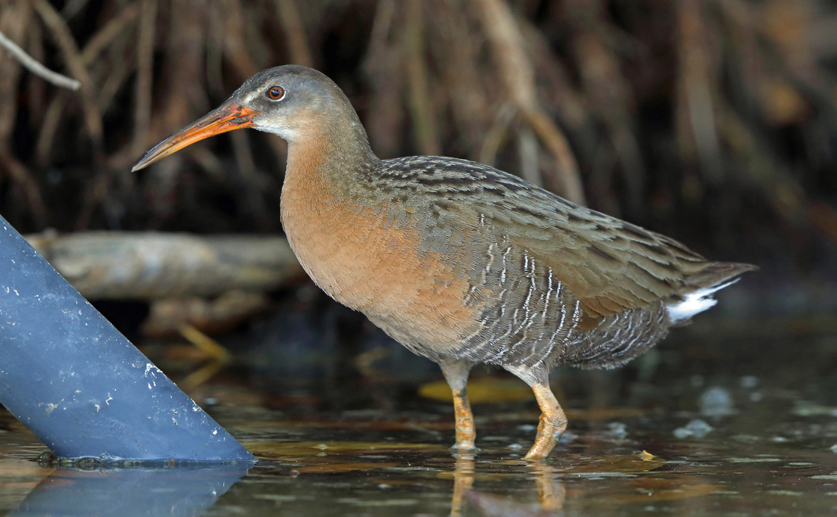
Yuma Ridgway’s rail, a bird species endangered by selenium contamination in its wetland habitat

Photo: Nigel Voaden. / CC BY (Source)

Key Findings

  • Rails at the Salton Sea in California, a critical habitat, accumulate higher levels of selenium when living in marshes fed by agricultural runoff
  • Faster water flow in marshes correlated with lower selenium concentrations in rails and their prey
  • Selenium levels in rail tissues and eggs often exceeded established toxicity thresholds, raising concerns for the endangered Yuma Ridgway’s rail population
Selenium is an essential trace element for animal health, but at high concentrations, it becomes toxic. Aquatic environments, particularly wetlands, are vulnerable to selenium accumulation, posing risks to wildlife that depend on them. This is especially concerning in areas like the Salton Sea in California, a lake largely maintained by agricultural drainage water – water that often contains elevated selenium levels. The Salton Sea supports a diverse bird population, including the endangered Yuma Ridgway’s rail, and researchers at University of Idaho[1] investigated whether these wetlands are functioning as an “ecological trap”, attracting rails to areas with dangerously high selenium exposure. The study, conducted between 2020 and 2023, focused on comparing selenium levels in rails inhabiting three different types of marshes: those fed by irrigation runoff, those fed by the Colorado River, and those fed by groundwater. Researchers collected biological samples – blood, breast feathers, and head feathers – from rails in each marsh type to assess selenium concentrations. To understand how selenium moves through the food web, they also tracked adult rails using GPS transmitters to locate nests and foraging areas. Samples of eggshells, unhatched eggs, and rail prey items were collected from these locations. The results showed significant variations in selenium concentrations depending on the water source. Marshes fed by agricultural runoff consistently had the highest selenium levels, while those fed by the Colorado River and groundwater had lower concentrations. Interestingly, the speed at which water flowed into the marsh (inflow velocity) also played a role, with faster flows correlating to lower selenium levels. Distance from the water inflow point, however, did not appear to affect selenium concentrations within the marshes. These findings build upon previous research highlighting the transfer of contaminants like mercury and selenium between parents and offspring in birds[2]. The earlier study demonstrated that mercury concentrations in eggs correlated strongly with those in the mother's tissues, but the proportion of mercury transferred varied between species. Similarly, selenium concentrations in eggs were linked to selenium levels in the mother’s liver. The University of Idaho research expands on this understanding by showing how water source and flow rate influence selenium levels in rails and their eggs. The study also connects to broader understanding of biphasic dose-response relationships[3], where the effect of a substance changes depending on the dose – low doses may have different effects than high doses. While this study doesn’t directly investigate biphasic effects, the variability in selenium concentrations across different marsh types suggests that rails in different habitats experience different exposure levels, potentially leading to varying health outcomes. The implications of this research are significant for conservation efforts. Given the risk of an ecological trap, the University of Idaho team suggests that supplementing wetlands with Colorado River water could be a viable strategy to reduce selenium bioaccumulation in Yuma Ridgway’s rails. This approach could create safer foraging and nesting habitats for this endangered species. Furthermore, the study emphasizes the importance of considering water source and inflow velocity when assessing and managing selenium contamination in wetland ecosystems.

AgricultureEnvironmentWildlife

References

Main Study

1) Irrigated agriculture influences selenium levels in an endangered marsh bird

Published 24th September, 2025

https://doi.org/10.1007/s10661-025-14533-1


Related Studies

2) Maternal transfer of contaminants in birds: Mercury and selenium concentrations in parents and their eggs.

https://doi.org/10.1016/j.envpol.2015.12.016


3) A general approach to modeling biphasic relationships.

Journal: Environmental science & technology, Issue: Vol 42, Issue 4, Feb 2008


Related Articles

An unhandled error has occurred. Reload 🗙