Developing Better Solar Panels for Energy and Farming with Red Light

Greg Howard
23rd September, 2025

Developing Better Solar Panels for Energy and Farming with Red Light

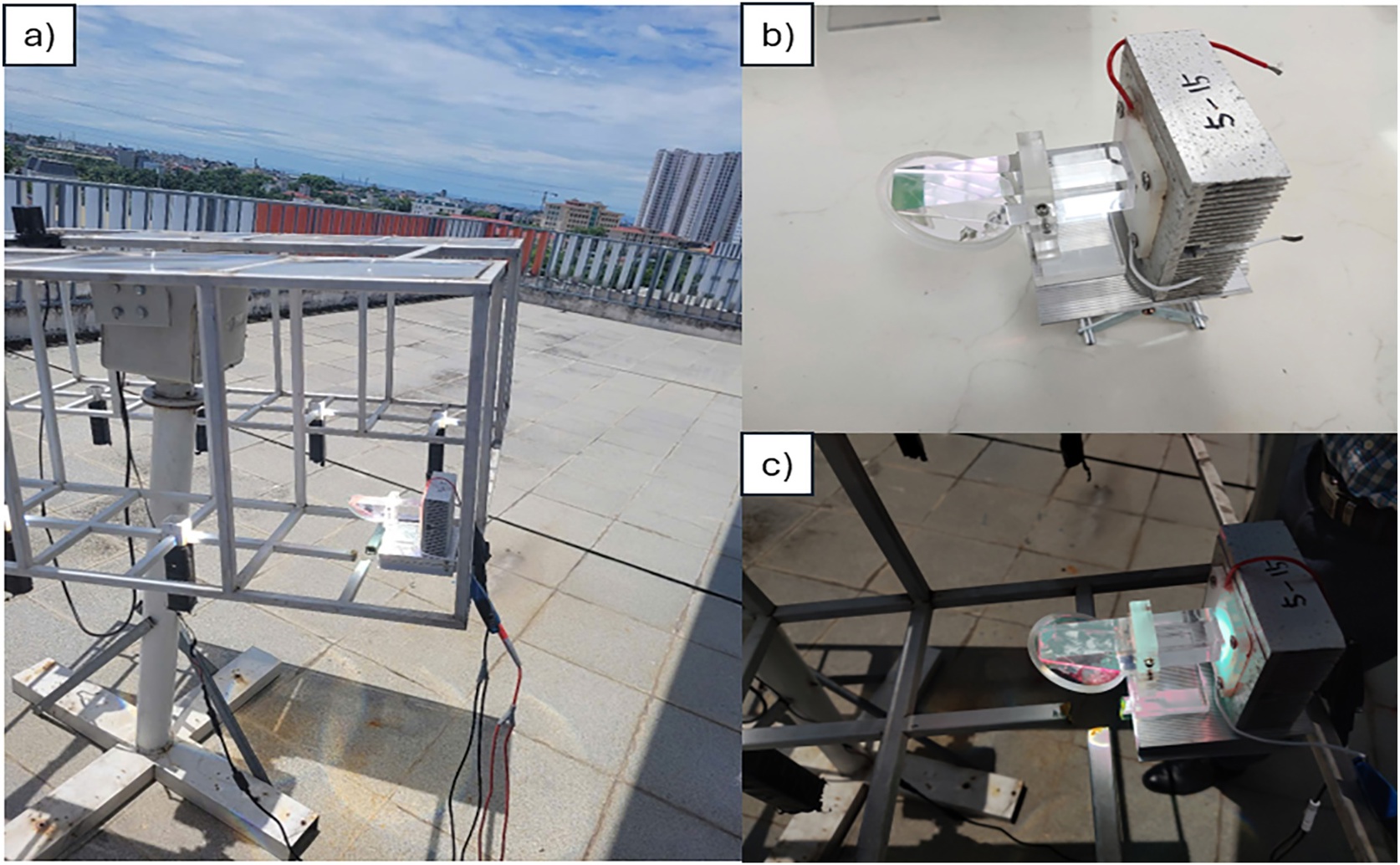
The fabricated RSSCA prototype (a) incorporates custom secondary optics (b) to achieve the precise sunlight concentration (c) required to split the solar spectrum for simultaneous electricity generation and sustainable agriculture.

Image adapted from: Vu et al. / CC BY (Source)

Key Findings

  • This study, conducted in Vietnam and Korea, introduces a new Red Spectrum Splitting Concentrated Agrivoltaic (RSSCA) system for growing rice alongside generating solar power
  • The RSSCA system concentrates sunlight, filters red light for optimal rice growth, and converts the remaining light into electricity with 31.2% efficiency
  • Simulations show RSSCA delivers sufficient daily light for rice in Hanoi and Ho Chi Minh City, producing 3-5 times more electricity than traditional solar panels
Agricultural land is facing increasing demand, not just for food production but also for renewable energy sources like solar power. Traditional solar panel installations, known as photovoltaic (PV) systems, can unfortunately reduce crop yields because they block sunlight needed for plant growth. Researchers at Phenikaa University, Vietnam Academy of Science and Technology, Myongji University, Hanoi University of Science and Technology, and Universiti Malaysia Pahang have been working on a solution to this problem, introducing a new system called Red Spectrum Splitting Concentrated Agrivoltaic (RSSCA)[1]. The core issue with conventional agrivoltaics is the broad spectrum of sunlight blocked by the panels. Plants don’t utilize all wavelengths of light equally; red light is particularly crucial for photosynthesis and growth. The RSSCA system aims to address this by concentrating sunlight and selectively filtering it. It uses a Fresnel lens – a special type of lens that focuses light – and a dichroic mirror, which reflects certain colours of light while allowing others to pass through. This allows the RSSCA system to transmit the red wavelengths (around 630 nanometers) that rice plants need most directly to the crops. The remaining wavelengths, less essential for rice growth, are directed towards highly efficient multi-junction solar cells to generate electricity. Optical simulations and analytical modelling were used to evaluate the system's effectiveness. The results demonstrate a photoelectric conversion efficiency of 31.2% – meaning 31.2% of the sunlight hitting the system is converted into electricity. Importantly, the system also provides sufficient Daily Light Integral (DLI) for rice cultivation. DLI is a measure of the total amount of light available to plants over a day, and is a key factor in plant growth. In locations like Hanoi and Ho Chi Minh City, Vietnam, the RSSCA system delivered DLI values ranging from 14.3 to 32.2 mol/m2/day and 24.3 to 37.8 mol/m2/day, respectively. These are significantly higher than the 6.6–16.1 and 14.4–18.2 mol/m2/day values observed under conventional PV systems. Electricity production with the RSSCA system was also notably improved, peaking at 2790 W/m2/day in Ho Chi Minh City and 2577 W/m2/day in Hanoi – 3 to 5 times higher than traditional PV setups. This increase in electricity generation is achieved while simultaneously providing better light conditions for the rice crops. The system also offers improved light uniformity across the field, which helps ensure consistent plant growth. Rice plants are uniquely adapted to deal with varying water conditions[2]. They can survive both complete submergence and waterlogging through mechanisms like internal aeration and root adaptations. While this study doesn’t directly address water stress, the improved light conditions provided by RSSCA could potentially enhance the plant’s ability to cope with such stresses, as healthy, well-lit plants are generally more resilient. However, the study also identified a limitation: the RSSCA system’s performance decreases in regions with limited direct sunlight, such as Seoul, Korea, during winter. This is because the system relies on concentrating sunlight, and less sunlight available means less energy to split and direct. The researchers found the RSSCA system is most effective in tropical and subtropical areas where direct sunlight is abundant. Overall, the RSSCA system represents a promising approach to integrating food and energy production on the same land, particularly in regions with high solar irradiance. The selective wavelength filtering and concentration strategy overcomes many of the limitations of conventional agrivoltaics, offering a viable path towards sustainable land use.

AgricultureEnvironmentSustainability

References

Main Study

1) Development and optimization of red spectrum splitting concentrated agrivoltaic system for energy generation and sustainable agriculture

Published 22nd September, 2025

https://doi.org/10.1371/journal.pone.0332865


Related Studies

2) Mechanisms for coping with submergence and waterlogging in rice.

https://doi.org/10.1186/1939-8433-5-2


Related Articles

An unhandled error has occurred. Reload 🗙