Seas of Renewal: Sea Urchin Waste for Healing Materials

Jim Crocker
3rd September, 2025

Seas of Renewal: Sea Urchin Waste for Healing Materials

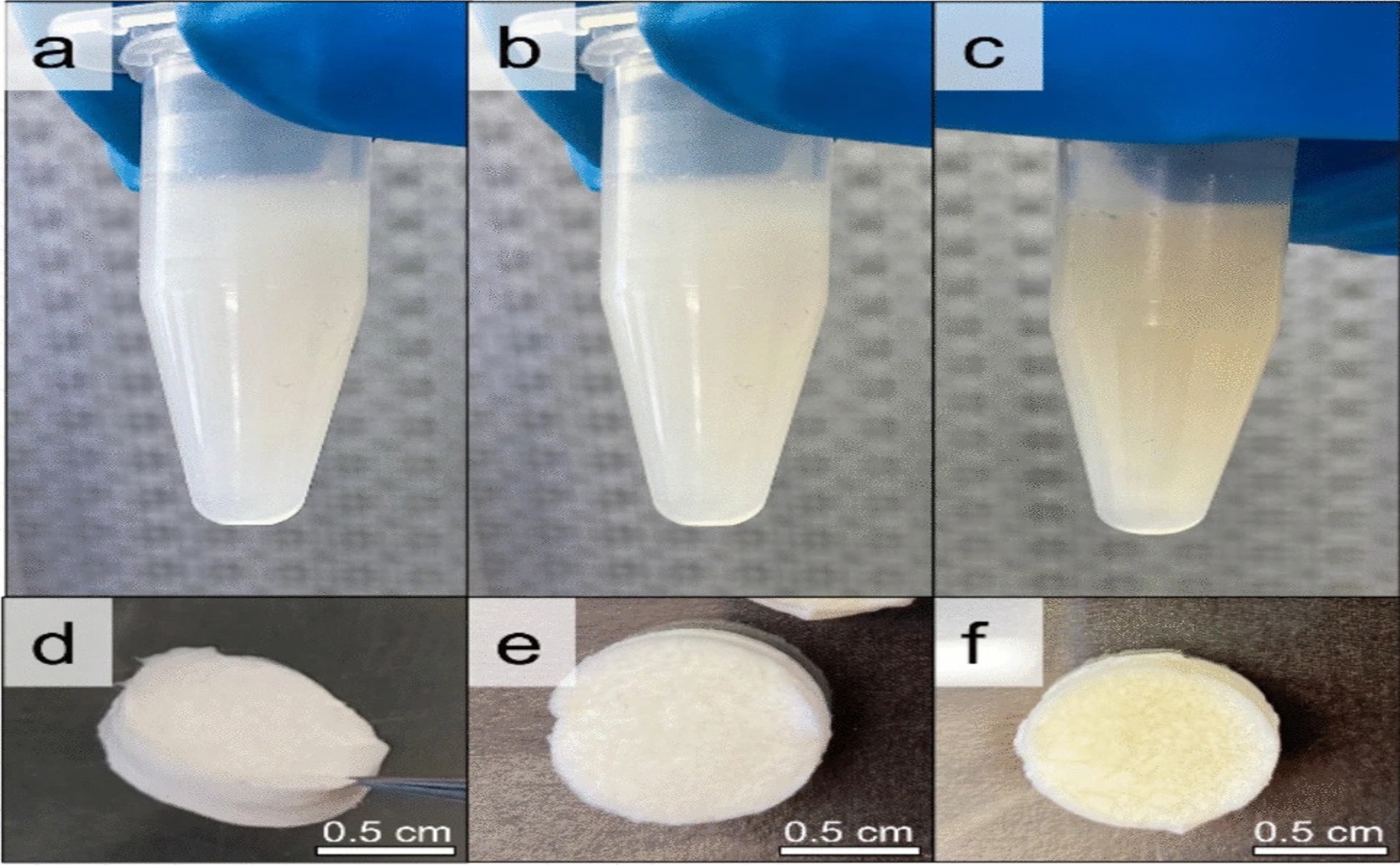
Homogeneous collagen suspensions containing 0% to 10% polyhydroxynaphthoquinones (a–c) were successfully lyophilized into uniform 3D scaffolds (d–f), demonstrating that bioactive extracts from sea urchin (Paracentrotus lividus) waste can be effectively integrated into stable composite biomaterials without aggregation.

Image adapted from: Martinelli et al. / CC BY (Source)

Key Findings

  • Sea urchin waste can be processed into collagen scaffolds with added antioxidant compounds (PHNQs) for potential wound healing applications
  • Adding PHNQs to collagen at 10% concentration improved scaffold stability and reduced degradation rates compared to collagen alone
  • PHNQs bind to collagen via a new covalent bond, enhancing structural integrity and retaining antioxidant activity without harming skin cells
Chronic wounds, such as skin ulcers, are a major problem for healthcare systems worldwide, and finding ways to speed up healing is crucial. One approach involves using biomaterials – substances that interact with the body – to help rebuild damaged tissue. Researchers at the University of Milan[1] have been investigating a novel method to create improved biomaterials using waste products from sea urchins, specifically focusing on collagen scaffolds enhanced with antioxidant compounds called polyhydroxynaphthoquinones (PHNQs). The core idea is to transform what would normally be discarded sea urchin material into a valuable resource for tissue regeneration. Collagen, a naturally occurring protein found in skin, provides the structural base for these scaffolds. However, collagen alone can degrade relatively quickly, limiting its effectiveness. The team aimed to improve the scaffold’s stability and add therapeutic benefits by incorporating PHNQs, which are known for their antioxidant properties. Antioxidants are molecules that protect cells from damage caused by unstable molecules called free radicals. Free radicals are linked to inflammation and slow wound healing. Interestingly, similar antioxidant compounds found in silymarin, extracted from milk thistle seeds, have shown promise in protecting liver cells[2]. Taxifolin, a component of silymarin, was particularly effective at scavenging these free radicals, suggesting that introducing similar compounds into biomaterials could boost their healing potential. The researchers successfully integrated PHNQs into the collagen scaffolds at an optimal ratio, resulting in a composite material with improved stability and integrity. They then conducted a series of tests to assess the properties of these new scaffolds. Water uptake measurements indicated how well the scaffolds maintained their structure in a moist environment, crucial for wound healing. Mechanical property tests determined their strength and flexibility, while degradation kinetics showed how quickly they broke down over time. A key finding was that the composite scaffolds degraded more slowly than collagen alone, likely due to strong interactions between the collagen and PHNQs. To understand these interactions at a molecular level, the team used computational modelling, employing a method called tight-binding molecular dynamics[3]. This technique allowed them to simulate how the collagen and PHNQs behaved and revealed that a covalent bond – a strong chemical link – formed between a representative collagen molecule and one of the PHNQs. This bond explains the enhanced stability observed in the composite material. Crucially, the incorporation of PHNQs didn't compromise their antioxidant activity. This is important because the therapeutic benefit of the antioxidants needs to be retained for the scaffold to be effective. The researchers confirmed that the composite scaffolds still possessed antioxidant properties, offering an additional advantage for wound healing. Finally, the team tested the scaffolds for cytotoxicity – their potential to harm cells. They exposed normal human dermal fibroblasts (NHDF), which are cells found in skin, to the collagen-PHNQ combination and found that the cells remained viable, indicating that the material was not toxic. The results demonstrate that sea urchin waste can be successfully valorized into collagen-based composite scaffolds with improved properties and retained therapeutic benefits. The study highlights the potential for these materials in regenerative medicine applications, offering a sustainable and effective approach to wound healing. Furthermore, this work builds upon earlier research showing the antioxidant power of similar compounds[2], and utilises advanced computational methods[3] to understand the underlying mechanisms driving the improved stability and functionality of the new biomaterials.

MedicineBiotechMarine Biology

References

Main Study

1) Seas of Renewal: Turning Sea Urchin Waste into Polyhydroxynaphtoquinone-Collagen Biomaterials for Regenerative Medicine

Published 30th August, 2025

https://doi.org/10.1007/s10126-025-10504-2


Related Studies

2) Free Radical Scavenging and Antioxidant Activities of Silymarin Components.

https://doi.org/10.3390/antiox2040398


3) GFN2-xTB-An Accurate and Broadly Parametrized Self-Consistent Tight-Binding Quantum Chemical Method with Multipole Electrostatics and Density-Dependent Dispersion Contributions.

https://doi.org/10.1021/acs.jctc.8b01176


Related Articles

An unhandled error has occurred. Reload 🗙