Better Salmonella Control For Lab Tests

Jenn Hoskins
5th August, 2025

Better Salmonella Control For Lab Tests

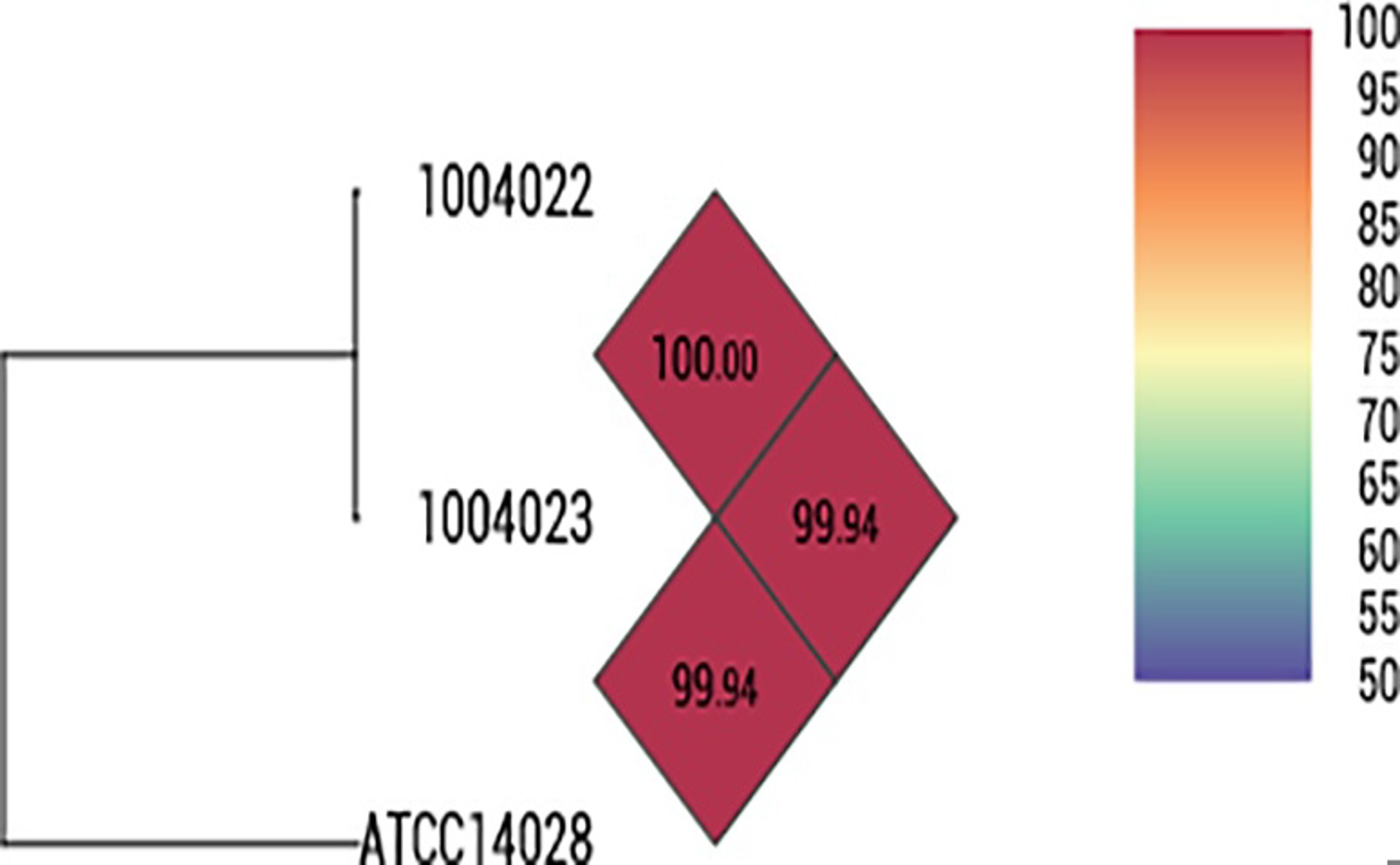
OrthoANI analysis reveals that the domestic isolates MFDS 1004022 and 1004023 exhibit 99.94% genomic homology with the standard Salmonella Typhimurium ATCC 14028 strain, confirming their suitability as alternative positive controls.

Image adapted from: Lee et al. / CC BY (Source)

Key Findings

  • To reduce costly reliance on imported strains for food safety tests, Korean researchers identified two local Salmonella strains, MFDS 1004022 and 1004023, as potential replacements
  • Extensive genetic analysis, including whole-genome sequencing, confirmed these domestic strains are nearly identical to the international standard, sharing 99.94% of their genetic code
  • Adopting these validated domestic strains will significantly cut costs and streamline microbiological testing procedures, enhancing food safety management in Korea
Microbiological testing is crucial for ensuring public health, particularly in food safety and pharmaceutical quality control. These tests rely on highly standardized procedures and materials to guarantee consistent and reliable results across different laboratories and over time. A key component of these procedures involves the use of "positive control strains" – specific, well-characterized microorganisms that are expected to produce a known result, confirming that the test system is working correctly. However, many of these designated control strains are sourced internationally, leading to complex and costly import processes for countries like Korea. This challenge prompted a recent study by researchers from the Ministry of Food and Drug Safety and Islamic Azad University, IRAN, ISLAMIC REPUBLIC OF[1]. Their aim was to identify and validate a domestically isolated strain that could serve as a suitable replacement for Salmonella enterica subsp. enterica serovar Typhimurium ATCC 14028, a widely recognized positive control strain used in international and national microbiological testing standards, including those by the International Organization for Standardization and the Korean Pharmacopoeia. The need for domestic alternatives is not unique to Salmonella. A similar initiative was undertaken to find a Korean alternative for Staphylococcus aureus ATCC 6538P, another reference strain used in antibiotic microbial assays. In that effort, a strain named NCCP 16830 was successfully identified as having equivalent characteristics and performance to the imported reference, demonstrating the feasibility and value of such replacement efforts[2]. The selection of any positive control material requires careful consideration of several characteristics to ensure its long-term relevance and usability in testing standards[3]. These include its biological mechanism, ease of preparation, chemical purity, stability, and its ability to produce consistent responses across the expected range of the test. Practical factors like commercial availability, user safety, and disposability are also important[3]. Finding a domestic alternative directly addresses issues of commercial availability and ease of access, while the rigorous validation ensures the biological and technical criteria are met. In the current study, researchers began by examining 19 S. Typhimurium strains preserved in the Korean Culture Collection for foodborne pathogens. Their goal was to confirm that any candidate strain possessed characteristics equivalent to the established positive control. This involved a multi-stage process of characterization. First, the strains underwent biochemical characterization, which involves observing how microorganisms react to different chemical environments and nutrients. This helps identify specific metabolic pathways and enzymatic activities unique to a strain. Out of the 19 candidates, two strains showed different results in a citrate utilization test, indicating they were not biochemically identical to the reference strain. These two were excluded. Next, the remaining 17 strains proceeded to molecular analysis, specifically using Polymerase Chain Reaction (PCR). PCR is a technique that amplifies specific segments of DNA, allowing scientists to detect unique genetic markers. All 17 strains showed identical genetic profiles to the positive control strain in these PCR tests. To ensure the highest level of confidence in the equivalence of the candidate strains, the researchers then performed whole-genome sequencing (WGS) on these 17 selected strains. Whole-genome sequencing involves determining the complete DNA sequence of an organism. This provides an incredibly detailed genetic blueprint, allowing for precise comparisons between strains. Modern microbiology increasingly relies on such genome-sequence-based similarity for classifying and comparing microbes, moving beyond older methods like DNA-DNA hybridization[4]. Algorithms like Average Nucleotide Identity (ANI) and OrthoANI are used to compare entire genome sequences, providing a robust measure of how closely related two strains are[4]. This approach allows for a much more granular understanding of genetic relatedness than traditional methods, helping to define species boundaries and even identify near-identical strains[5]. The WGS analysis revealed that two specific strains, MFDS 1004022 and 1004023, were remarkably similar to the imported S. Typhimurium ATCC 14028. They shared the same "sequence type" (ST19), which is a classification based on the DNA sequences of several specific genes, indicating a very close evolutionary relationship. Furthermore, these domestic strains exhibited fewer than 20 Single Nucleotide Polymorphisms (SNPs) compared to the reference strain. SNPs are single-letter differences in the DNA sequence, and a very low number indicates an extremely high degree of genetic similarity. Overall, these strains showed an impressive 99.94% genomic homology with the ATCC 14028 strain, meaning their entire genetic codes were nearly identical. This high level of genomic similarity is crucial for a positive control, as it ensures the alternative strain will behave almost identically to the original in various tests. Based on these comprehensive biochemical and molecular analyses, particularly the high genomic homology confirmed by whole-genome sequencing, S. Typhimurium MFDS 1004022 and 1004023 were proposed as suitable domestic alternatives to the imported strain. The distribution of these validated domestic strains to microbiological testing laboratories is expected to significantly streamline microbial testing and analysis procedures, reducing reliance on foreign imports and contributing to more efficient food safety management within Korea.

MedicineHealthBiotech

References

Main Study

1) Evaluation of an alternative positive control strain of Salmonella enterica subsp. enterica serovar Typhimurium for microbial assays

Published 4th August, 2025

https://doi.org/10.1371/journal.pone.0329363


Related Studies

2) Characterization and validation of an alternative reference bacterium Korean Pharmacopoeia Staphylococcus aureus strain.

https://doi.org/10.1007/s12275-022-1335-5


3) Characteristics to consider when selecting a positive control material for an in vitro assay.

https://doi.org/10.14573/altex.2102111


4) OrthoANI: An improved algorithm and software for calculating average nucleotide identity.

https://doi.org/10.1099/ijsem.0.000760


5) Genomic insights that advance the species definition for prokaryotes.

Journal: Proceedings of the National Academy of Sciences of the United States of America, Issue: Vol 102, Issue 7, Feb 2005


Related Articles

An unhandled error has occurred. Reload 🗙