Data Science Reveals Common Ways COVID-19 and Chronic Hepatitis B Affect Health

Greg Howard
26th May, 2025

Data Science Reveals Common Ways COVID-19 and Chronic Hepatitis B Affect Health

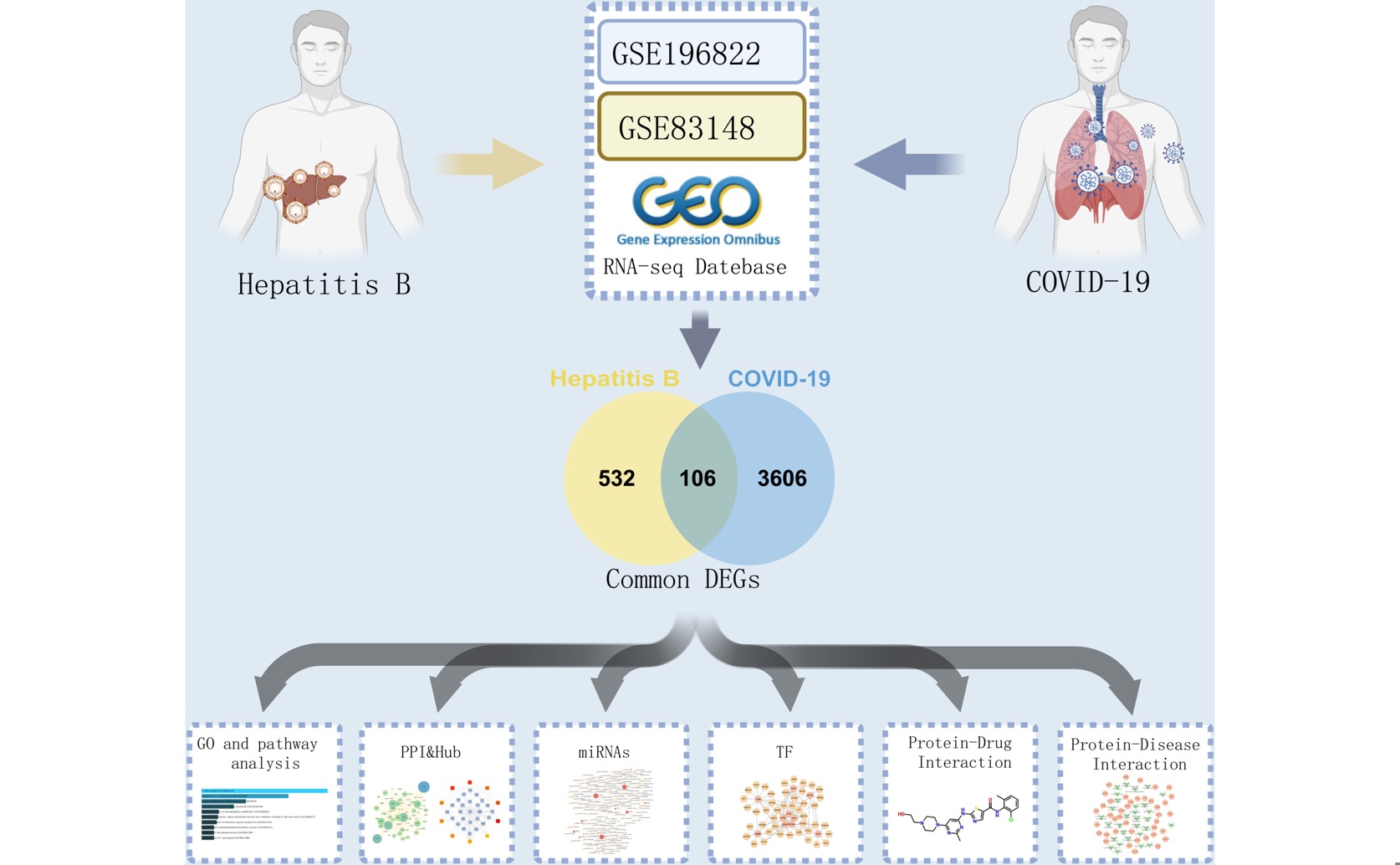
The bioinformatics workflow depicted here successfully integrated transcriptomic datasets to identify 106 shared differentially expressed genes and specific drug candidates, revealing critical immune and cell cycle pathways common to Coronavirus disease 2019 (Severe acute respiratory syndrome coronavirus 2) and Hepatitis B (Hepatitis B virus).

Image adapted from: Ma et al. / CC BY (Source)

Key Findings

  • Researchers in China and the USA identified 106 genes shared by COVID-19 and chronic hepatitis B, showing how both affect the immune system
  • Key genes related to cell growth and immune response were discovered, pointing to new ways to treat both illnesses
  • Existing drugs like aspirin and estradiol were suggested as potential treatments for managing both COVID-19 and hepatitis B
The ongoing COVID-19 pandemic, caused by the SARS-CoV-2 virus, has had a profound impact on global health. Alongside this, chronic hepatitis B virus (HBV) infection remains a significant public health concern. A recent study conducted by researchers at Sichuan University in China and Rutgers University in the USA explores the shared molecular mechanisms between COVID-19 and chronic HBV infection, offering insights that could inform treatment strategies for both diseases[1]. Understanding how these two viruses interact at a molecular level is crucial, especially since patients with chronic HBV may experience more severe outcomes if they contract COVID-19. Previous research has highlighted the role of the angiotensin-converting enzyme 2 (ACE2) as a key receptor that SARS-CoV-2 uses to enter human cells[2]. ACE2 is not only present in the respiratory system but also in the liver and gastrointestinal tract, which might explain the hepatic complications observed in COVID-19 patients[3]. This connection underscores the importance of investigating the interplay between COVID-19 and other liver-related diseases like HBV. In their study, the researchers employed bioinformatics and systems biology approaches to analyze RNA sequencing data from two datasets (GSE196822 and GSE83148). These datasets included information on gene expression in individuals infected with SARS-CoV-2 and those with chronic HBV infection. By identifying differentially expressed genes (DEGs) common to both conditions, the study aimed to uncover shared pathways and potential therapeutic targets. The analysis revealed 106 shared DEGs between COVID-19 and HBV, many of which are involved in immune-related pathways. This finding suggests that the immune system plays a central role in the progression of both diseases. Further examination using protein-protein interaction (PPI) networks identified eight hub genes: CDK1, E2F7, E2F8, TYMS, KIF20A, CENPE, TPX2, HMMR, CD8A, and GZMA. These genes are pivotal in cell cycle regulation, immune response, and cellular proliferation, indicating that their dysregulation could contribute to the severity of both COVID-19 and chronic HBV infection. To validate these findings, the researchers used additional datasets (GSE171110 and GSE94660) which confirmed that the expression levels of these hub genes were significantly different in both COVID-19 and HBV groups compared to healthy controls. This consistency across multiple datasets strengthens the reliability of the results and highlights the potential of these genes as targets for therapeutic intervention. Transcriptional regulatory network analysis further identified 155 microRNAs (miRNAs) and 43 transcription factors (TFs) that may regulate these hub genes. These regulatory elements are crucial for controlling gene expression and could serve as additional targets for drug development. Understanding these regulatory networks provides a deeper insight into how gene expression is altered in the presence of both viruses, potentially leading to more effective treatments. One of the key outcomes of the study is the identification of potential therapeutic drugs that could be effective against both COVID-19 and chronic HBV infection. The researchers highlighted several compounds, including progesterone, estradiol, dasatinib, aspirin, etoposide, irinotecan hydrochloride, phorbol 12-myristate 13-acetate, lucanthone, and calcitriol. These drugs were identified based on their interactions with the shared DEGs and their potential to modulate the immune response and viral replication processes. This study builds on previous research that has explored the role of ACE2 in COVID-19[2] and the impact of COVID-19 on liver diseases[3]. For instance, Study[2] demonstrated that modulating ACE2 expression could reduce susceptibility to SARS-CoV-2 infection, a finding that aligns with the current study’s focus on shared molecular mechanisms involving immune-related pathways. Additionally, Study[3] highlighted the prevalence of liver dysfunction in COVID-19 patients, which is pertinent given the current study’s investigation into the intersection of COVID-19 and chronic HBV. Furthermore, the research aligns with findings from Study[4], which examined the relationship between metabolic unhealthy obesity (MUO) and COVID-19, identifying immune-related pathways and potential therapeutic agents. Both studies emphasize the importance of immune system regulation in the context of COVID-19 and related comorbidities, suggesting that targeting immune pathways could be a viable strategy for managing multiple health conditions simultaneously. By identifying shared molecular targets and potential drugs, the study from Sichuan University and Rutgers University provides a valuable framework for developing treatments that can address both COVID-19 and chronic HBV infection. The use of bioinformatics and systems biology allows for a comprehensive understanding of the complex interactions between these diseases, paving the way for future clinical trials and therapeutic interventions. In summary, this research offers significant insights into the molecular interplay between COVID-19 and chronic HBV infection. By uncovering shared genetic pathways and identifying potential therapeutic compounds, the study not only advances our understanding of these diseases but also opens new avenues for treatment strategies that could benefit patients suffering from both conditions.

MedicineHealthBiotech

References

Main Study

1) Bioinformatics and system biology approach to discover the common pathogenetic processes between COVID-19 and chronic hepatitis B

Published 23rd May, 2025

https://doi.org/10.1371/journal.pone.0323708


Related Studies

2) FXR inhibition may protect from SARS-CoV-2 infection by reducing ACE2.

https://doi.org/10.1038/s41586-022-05594-0


4) Bioinformatics and system biology approach to identify the influences of SARS-CoV-2 on metabolic unhealthy obese patients.

https://doi.org/10.3389/fmolb.2023.1274463


Related Articles

An unhandled error has occurred. Reload 🗙