Advanced AI System for Detecting Heart Rhythm Problems Using Smart Optimization

Jenn Hoskins
17th May, 2025

Advanced AI System for Detecting Heart Rhythm Problems Using Smart Optimization

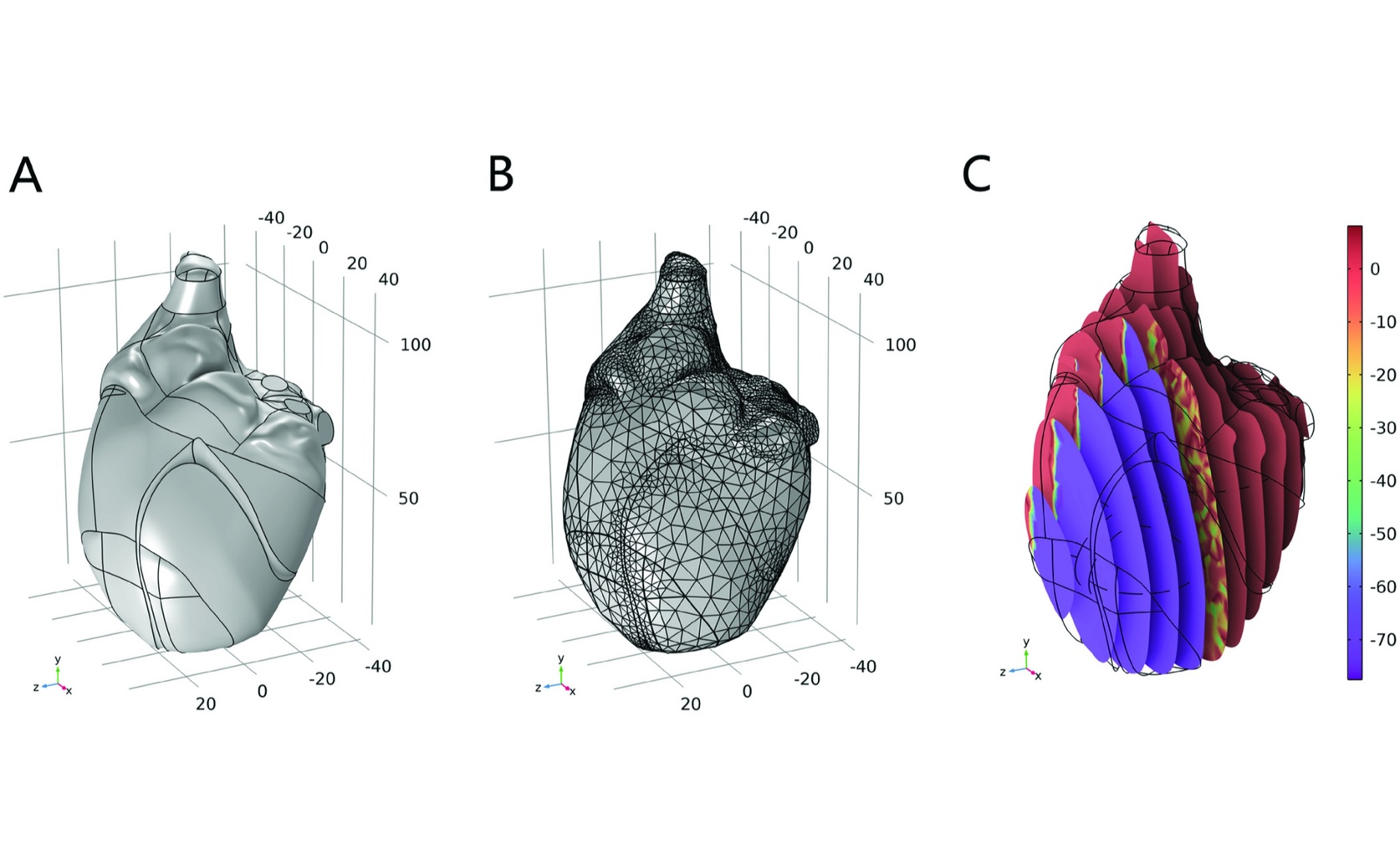
To facilitate the simulation of cardiac electrophysiology for arrhythmia classification, a full-scale 3D heart geometry (A) was converted into a finite element mesh (B) and initialized with potential distributions (C) to generate the synthetic data required for the deep learning model.

Image adapted from: Zhao et al. / CC BY (Source)

Key Findings

  • Researchers in China and Australia developed an AI system to detect irregular heartbeats more accurately
  • The system uses advanced mathematical models and optimization techniques to analyze heart signals, reducing errors
  • When tested on a standard ECG database, it achieved over 96% accuracy, showing promise for real-world medical use
Cardiac arrhythmias, or irregular heartbeats, pose significant challenges in medical diagnostics. Traditional methods for detecting these irregularities rely heavily on the expertise of physicians who must interpret electrocardiogram (ECG) signals—a task that is both time-consuming and prone to human error due to the subtlety of the signal anomalies. The advent of artificial intelligence (AI) and machine learning (ML) offers promising solutions to enhance the accuracy and efficiency of arrhythmia detection. A recent study conducted by researchers at the University of Chinese Academy of Sciences and the University of Queensland, Australia[1], has made significant strides in this area by developing an advanced AI-driven system for classifying arrhythmias. Building on earlier work that highlighted the potential of AI and ML in medical diagnostics[2][3][4], this study integrates sophisticated algorithms to improve the precision of ECG signal analysis. The primary innovation of this research lies in its use of a finite element model (FEM) based on the Hodgkin-Huxley (HH) model, a mathematical framework traditionally used to describe the electrical characteristics of neurons. By adapting the HH model to simulate cardiac electrophysiology, the researchers were able to generate synthetic ECG signals that accurately reflect different types of arrhythmias. This approach addresses a key limitation in previous AI applications, which often focused solely on ECG data without incorporating the underlying physiological mechanisms. To process these complex ECG signals, the study employed a multi-objective optimization method known as the crayfish optimization algorithm (MOCOA). This method was specifically tailored to optimize key parameters in variational mode decomposition (VMD), a technique used to break down ECG signals into their constituent components. By fine-tuning these parameters, the researchers enhanced the quality of the signal decomposition, making it easier for the AI model to identify patterns indicative of various arrhythmias. The resulting system, termed MOCOA-VMD, utilizes a deep VMD-attention network for ECG signal classification. This network combines convolutional neural networks (CNN) and long short-term memory (LSTM) units to effectively handle the temporal and spatial features of ECG data. The inclusion of an attention mechanism allows the model to focus on the most relevant parts of the signal, further improving its diagnostic accuracy. In tests, the MOCOA-VMD model achieved an impressive accuracy of 94.46%, surpassing other models that used techniques like ensemble empirical mode decomposition (EEMD) and standard CNN or LSTM modules. To ensure the robustness and generalizability of their model, the researchers validated their approach using the MIT-BIH arrhythmia database, a widely recognized repository of ECG recordings. The model's high performance on this real-world data set underscores its potential for practical clinical application. Additionally, the study employed Bayesian optimization to fine-tune the model’s hyperparameters, enhancing its performance to reach an accuracy of 96.11%. This advancement is particularly significant when viewed in the context of previous research. Earlier studies have demonstrated the benefits of AI in arrhythmia detection, emphasizing the importance of signal denoising, quality assessment, and accurate classification[2][3][4]. However, many of these approaches did not fully leverage the mathematical foundations of cardiac electrophysiology, which can limit their effectiveness in handling complex and variable ECG signals. The integration of the FEM-HH model in the current study provides a more comprehensive framework for understanding and interpreting ECG data, thereby addressing a critical gap in the existing literature. Moreover, the use of multi-objective optimization and advanced deep learning techniques represents a significant step forward in the field. By optimizing both the signal decomposition parameters and the neural network architecture, the study achieves a level of precision that previous models have struggled to attain. This holistic approach not only improves diagnostic accuracy but also enhances the model’s ability to generalize across different types of arrhythmias and patient populations. The implications of this research extend beyond arrhythmia detection. The methodologies developed in this study have the potential to be applied to other areas of signal processing within medicine, where accurate and rapid analysis of complex data is crucial. For instance, similar AI-driven approaches could enhance the detection of other cardiovascular conditions or be adapted for use in different types of biomedical signal analysis. In summary, the study by the University of Chinese Academy of Sciences and the University of Queensland represents a significant advancement in the use of AI for arrhythmia classification. By integrating a finite element model based on the Hodgkin-Huxley framework with advanced optimization and deep learning techniques, the researchers have developed a highly accurate and robust system for ECG signal analysis. This work builds upon and enhances previous research, offering a promising tool for improving the diagnosis and management of cardiac arrhythmias in clinical settings[2][3][4].

MedicineHealthBiotech

References

Main Study

1) Deep VMD-attention network for arrhythmia signal classification based on Hodgkin-Huxley model and multi-objective crayfish optimization algorithm

Published 14th May, 2025

https://doi.org/10.1371/journal.pone.0321484


Related Studies

2) Artificial Intelligence and Machine Learning in Arrhythmias and Cardiac Electrophysiology.

https://doi.org/10.1161/CIRCEP.119.007952


3) A review of arrhythmia detection based on electrocardiogram with artificial intelligence.

https://doi.org/10.1080/17434440.2022.2115887


4) Automated diagnosis of arrhythmia using combination of CNN and LSTM techniques with variable length heart beats.

https://doi.org/10.1016/j.compbiomed.2018.06.002


Related Articles

An unhandled error has occurred. Reload 🗙