
Tracking Color Movement In Cephalopods With A Computer System
Greg Howard
31st July, 2025


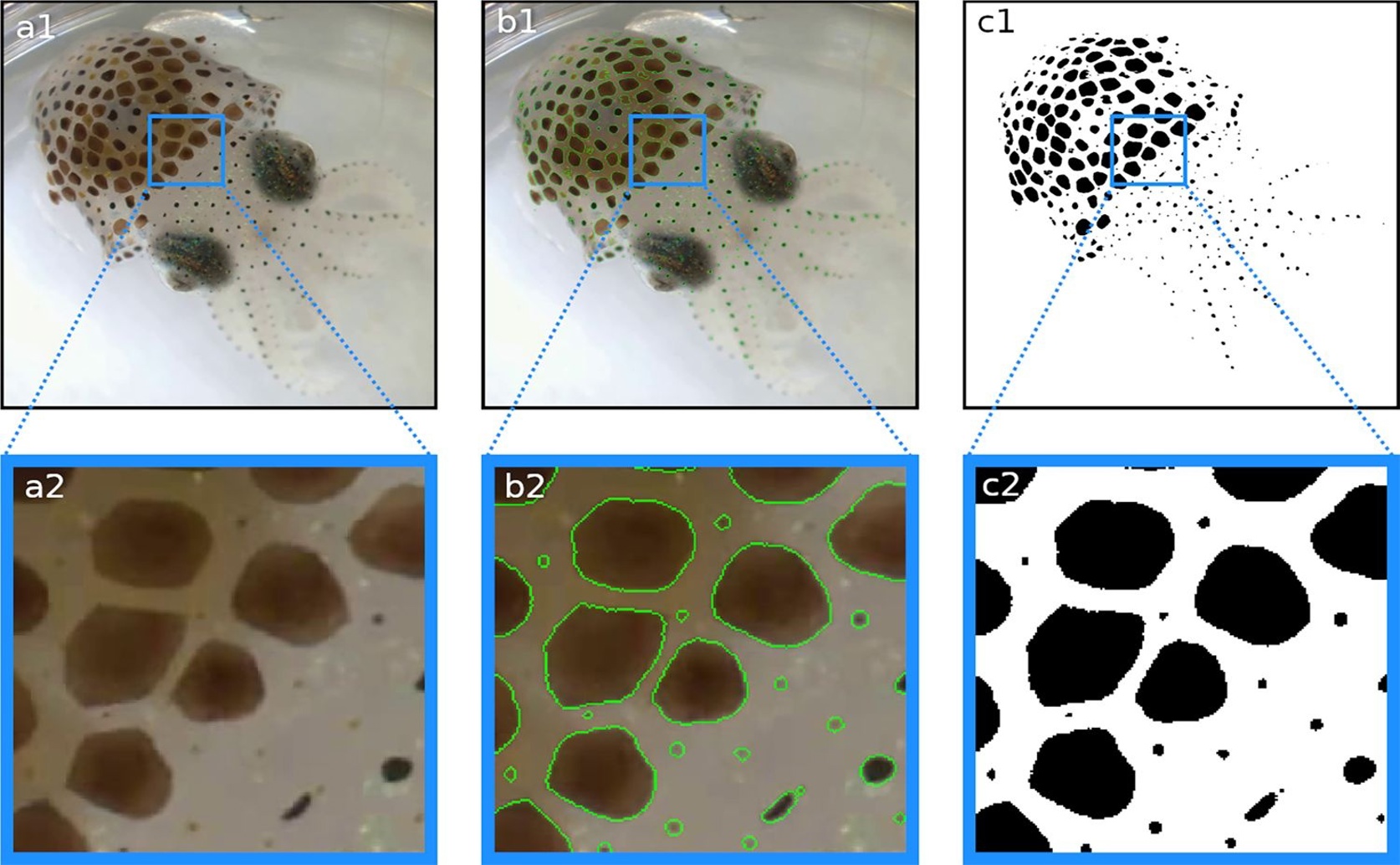
The segmentation models within CHROMAS accurately classify pixels in video of the bobtail squid (Euprymna berryi) (a1, a2), creating boundary overlays (b1, b2) and binary masks (c1, c2) that successfully isolate even the smallest and faintest chromatophores.
Key Findings
- Researchers at the Max Planck Institute for Brain Research developed CHROMAS, a new computer tool to precisely track how individual color cells in cephalopods like cuttlefish change their size
- This tool reveals how the brain controls these tiny color cells and identifies groups of cells that work together to create complex camouflage patterns
References
Main Study
1) A computational pipeline to track chromatophores and analyze their dynamics
Published 28th July, 2025
https://doi.org/10.7554/eLife.106509
Related Studies
2) Cephalopod dynamic camouflage: bridging the continuum between background matching and disruptive coloration.
3) Cuttlefish camouflage: the effects of substrate contrast and size in evoking uniform, mottle or disruptive body patterns.
4) Fully Convolutional Networks for Semantic Segmentation.
5) Principal component analysis: a review and recent developments.
Related Articles
 24th February, 2025 | Jim Crocker